A look into Corporate fraud in Australia, Stranglehold of Monopolies, Telecom's Oppression, Biased Law System, Corporate influence in politics, Industrial Relations disadvantaging workers, Outsourcing Australian Jobs, Offshore Banking, Petrochemical company domination, Invisibly Visible.
It's not what you see, it's what goes on behind the scenes. Australia, the warrantless colony.
Note: Site has more info in desktop mode or 'web version' as seen at bottom of page, when on smartphone.
COMMONWEALTH OF AUSTRALIA (ABN: 122 104 616)
Australia's Prime Minister (CEO) Tony Abbott : "Australia is Open for Business"
University student Tom Wade spent an hour
on the phone to Centrelink and got nowhere with his issue. So, he went
up the chain of command, and here's how he did it.
Uni student Tom Wade was one of hundreds of thousands
of Australians driven to despair by Centrelink's customer service
performance.
But instead of getting mad, Mr Wade got
busy, accessing the Australian Government Directory and confronting
senior Department of Human Services Bureaucrats directly with his
complaints.
Tom Wade used the Commonwealth
government directory to contact senior executives in the Department of
Human Service when he couldn't get through to Centrelink using the
official channels. Photo: Chris Hopkins
The administrative blunder was soon sorted, Mr Wade
says, and he is encouraging frustrated clients to take their grievances
up Centrelink's food chain, saying departmental bosses should be held
accountable for the failings at the coalface.
When Mr Wade's youth allowance payments were cancelled in
late 2014 he did what most clients do and took to Centrelink's phone
lines to solve the problem.
But in a story that will be
all too familiar with hundreds of thousands of clients of the welfare
agency, seemingly endless periods of waiting on hold resulted in being
put through to someone who could not help the Melbourne student.
So, after using search engine Google to figure out who were the power people behind the scenes at Centrelink, the 23-year-old stumbled on his most powerful weapon; the Australian Government Directory.
"I
got on the organisational structure from the Department of Human
Services' website and just started Googling people from the top down,
starting with Kathryn Campbell the secretary,
"Then
I did [DHS customer service boss] Grant Tidswell, the second one down
and his entry in the directory was the second Google result."
Eventually,
Mr Wade settled his attentions on Brendan Jacomb, DHS' national manager
of "service delivery performance and analysis".
"I got
through to him directly and he's the one to who I started dishing out
the (performance) targets from the department's annual report," Mr Wade
said.
"He was caught a bit off guard about that, kinda surprised, but he said they'd get back to me about the details."
After
the internal DHS blunder that caused his payment cut-off was corrected,
Mr Wade decided he had hit on a winning formula and ran with it.
"I
had to fix up the detail of my Medicare account, so instead of calling
general inquiries and waiting ages, I found the lady in charge of
Medicare, rang her up and asked her to fix it up for me," he said.
"She asked 'Where did you get my number?' and I just said I looked her up directly.
"She didn't know what to say to that, but she did forward me to the right people and I got straight through."
The
department was not enthusiastic about Mr Wade's approach, with a
spokesman saying that anyone unhappy with the service they have received
should go through the usual channels.
"Customers can ask
for a review of a decision, provide feedback or make a complaint by
writing to us, calling 1800 132 468 or visiting one of our service
centres," a spokeswoman told Fairfax.
After finishing his
degree and moving into the workforce, Mr Wade is no longer a Centrelink
client but he encourages anyone feeling the frustration of dealing with
the giant agency to use his methods.
"For anyone who
wants to get in touch with Centrelink, you already know the general
inquiries lines are going to be backed up and a slow process, so find
the person you feel has the power to help you directly and get in
contact," he said.
"Put the responsibility on someone in a position of authority to help you with your problem.
"Sh*t
rolls downhill so you've got to aim as high as you can, if you get in
touch with someone too high up to deal with your problem then they will
delegate."
Telstra appears stumped as to how the unusual privacy breach occurred. Photo: Bloomberg
When it was time to upgrade to the latest iPhone, Richard Thornton did what he had done many times before.
He wiped his old iPhone 5 with a factory reset, removed the SIM card, and sold the device second hand to a private buyer.
Melbourne dad Richard Thornton was the victim of a privacy breach. Photo: Richard Thornton
And then something "scary" happened. The buyer of the iPhone 5
contacted Mr Thornton to tell him he was receiving his personal Telstra
voicemail messages.
"They told me, 'One of your mates called about a gig you were doing
for New Year's Eve," Mr Thornton, a Melbourne-based IT professional and
musician, told Fairfax.
The new phone owner (also a Telstra
customer, who wishes to remain anonymous), explained to Mr Thornton that
when the iPhone 5 was powered off and then on again, it downloaded Mr
Thornton's voicemail messages to the phone's inbuilt visual
voicemail app, where he could then browse and listen to them in full.
A screenshot of Mr Thornton's Telstra
voicemail messages which appeared on the iPhone 5 after he wiped it and
sold it. Photo: Richard Thornton
Meanwhile, the new owner was not receiving notifications for his
own voicemail, and had to ring up Telstra's voicemail service manually
to check them.
The serious privacy breach, which Mr Thornton detailed on his blog, has stumped both Telstra and Apple, although the responsibility appears to lie with Telstra rather than the iPhone maker.
Mr Thornton said Telstra gave him "the runaround" when he first notified them of the issue, telling him it was "impossible".
"They said it can't happen, you must have forgotten something," Mr Thornton said.
"You mustn't have reset your Apple ID, or you left your SIM in the phone [before you sold it].
"I thought, no, I work in IT – I kinda know what I'm doing here."
A Telstra customer service representative told him his only option was to disable voicemail, Mr Thornton said.
After
more than 24 hours trying to resolve the issue with Telstra customer
service, a senior Telstra engineer apologised to Mr Thornton
and confirmed what was already clear: two separate phones were accessing
and downloading his personal voicemail.
"He [the engineer] had a
direct line to Apple, and [when he told them about the issue] they said,
'We don't believe you'," Mr Thornton said.
Telstra has now
implemented a fix which rejects the old phone's automatic requests to
download Mr Thornton's voicemails. However the telco has yet to
determine the root cause of the problem.
"They know what the symptoms are but they don't know what the cause is," Mr Thornton said.
Replying to a post by Mr Thornton on Reddit,
some suggested the problem may lie in Telstra's visual voicemail using a
mobile phone's International Mobile Station Equipment Identity
(IMEI) number for authentication. An IMEI is a unique number used to
identify individual mobile devices.
However a Telstra spokesperson said the telco does not use IMEI numbers to authenticate visual voicemail.
Telstra
is understood to not yet have been able to replicate the voicemail
duplication issue, but is looking to analyse the individual iPhone 5
device to get to the bottom of the privacy breach.
"We are
committed to protecting our customers' privacy, keeping their personal
information safe and ensuring the security of their data," the Telstra
spokesperson said.
It is unclear whether this type of problem has affected any other customers.
Mr
Thornton said he was lucky the person who bought his iPhone 5 had been
co-operative and forthcoming about the issue, but was worried about the
implications for privacy-critical businesses such as law firms or
medical and government organisations who resold their digital equipment.
He said he would "probably not" resell an old phone in the future, even though he'd done so three or four times in the past.
A recent Deloitte survey found 27 per cent of Australians give away their old mobile phones, while 8 per cent sell them.
Nearly a third of the 26 large foreign banks operating in
Australia, including Goldman Sachs, JPMorgan, Lloyds and BNP Paribas,
had no taxable income in 2014, data released by the Australian Taxation
Office shows.
Eight banks with total revenue of $9 billion had no
taxable income, while Credit Suisse, which had a taxable income of
$397,000 on revenue of $707 million, also paid zero tax.
The Tax
Transparency report released by the ATO in December provides the first
detailed breakdown of tax payments by the banking sector, which paid a
total $11.4 billion in income tax in 2014, on revenue of $218 billion.
The
big four Australian banks dominated the rankings, reporting 71 per cent
of the revenue and 83 per cent of tax paid, totalling $9.5 billion. The
top taxpayer was ComBank, which paid $2.87 billion at a tax rate of
29.1 per cent.
All Australian banking
and lending institutions reported taxable profits, but most paid lower
tax rates than foreign banks – notably National Australia Bank, which
had a 20.1 per cent tax rate, and Macquarie Group, which had a tax rate
of 16 per cent.
In a robust defence of its tax practices,
Macquarie told the Senate corporate tax inquiry in February 2015 that as
an accounting measure its tax rate had been 38 per cent or higher for
the past two years.
Cash tax payments
Tax Commissioner Chris Jordan urged the Senate committee to look at cash tax payments rather than accounting provision for tax.
ANZ Bank's $1.96
billion 2014 tax bill was 24.4 per cent of taxable income. The bank did
not provide 2014 figures for the Senate committee but said that in 2013
"ANZ made cash payments to the ATO of $1.955 billion (excluding
policyholder tax), which equals 29.3 per cent of taxable income".
In
total, 26 foreign banks reported $29.3 billion income for 2014 through
35 tax entities, with 15 of these – a total of 43 per cent – not paying
tax.
The figures, released under legislation originally introduced
by former Labor treasurer Wayne Swan, refer only to tax relating to the
2014 financial year.
A spokesman for BNP Paribas, which made
$2.86 billion in revenue across three firms (BNP Pacific Australia, BNP
Paribas and BNP Paribas Securities Services Australian Branch) said the
bank made a loss in the 2014 financial year because of the deductions of
prior year losses stemming from bad debt write-offs.
JPMorgan made $1.6
billion in revenue without profit, believed to be because of
carry-forward losses stemming from the global financial crisis. The bank
declined to comment.
Goldman Sachs, which made no profit and paid no tax after earning $632 million in the year, also declined to comment.
No profit or tax
The
Royal Bank of Scotland, which has drastically reduced its presence in
Australia, also didn't make a profit or pay tax, after earning $1.2
billion. Calls to media representatives in Singapore, Hong Kong and
Britain went unanswered.
Lloyds Bank, which no longer operates in Australian, made $771 million in revenue without profit.
Rabobank's
Co-operatieve Centrale Raiffeisen-Boerenleenbank had $1.4 billion in
revenue in the 2014 financial year but made a loss. Rabo Australia had
income of $1.24 billion, a taxable profit of $185.3 million and paid
$55.5 million in tax.
"Combined as a group, the Rabobank
Australian group pays the correct and proper tax amount in Australia and
for the 2014 tax year [the year in the figures released by the ATO in
December], the effective rate of tax paid was 29.5 per cent of taxable
income," Rabobank Australia spokeswoman Denise Shaw said.
"No tax
was paid by Co-operatieve Centrale Raiffeisen-Boerenleenbank BA, as it
was in a tax-loss position due to various factors.
"Rabobank is
extremely committed to being fully compliant in fulfilling its tax
obligations, and pays in accordance with the spirit and purpose of our
tax laws. We work co-operatively and transparently with the ATO."
While
Macquarie's 2014 annual report accounts reported pre-tax profit of $2.1
billion from global income and tax of $827 million for 2014, the ATO
data shows Australian taxable income was $797 million, with tax payable
of $128 million.
Reflected franking offsets
In a note to
its latest accounts, Macquarie said the 16 per cent tax rate reflected
franking offsets on Australian dividends, and offsets for foreign tax
offsets and research and development.
Macquarie declined to
comment on its reported 38 per cent tax rate in its accounting profit.
While the bank faces tax rates as high as 40 per cent in the US, this
would account for only a fraction of the elevated tax bill, which it
also attributed in its 2014 accounts to "tax uncertainties".
The
higher tax bill appears to reflect payments for contested assessments by
the ATO, with penalty rates and interest relating to earlier years.
This
puts Macquarie in the awkward position of defending its tax status to
the Senate committee investigating tax avoidance by citing high tax
rates, which have been inflated by penalties and interest charges for
tax avoidance.
"In accordance with ATO practice, the group has
paid a portion of the primary tax and interest covered by these amended
assessments and this amount has been included in these financial
statements as part of tax receivables, pending resolution," the
Macquarie annual report said.
A 2013 Federal Court judgment
detailed tax avoidance findings by the ATO relating to Macquarie's
offshore banking unit – an Australian-based operation that is taxed at
the concessional rate of just 10 per cent.
The ATO found that
Macquarie booked expenses relating to the offshore banking unit instead
to its general earnings, which are taxed at 30 per cent.
Included interest charges
These included interest charges and the profit share paid to executives, which is believed to be up to 25 per cent of profit.
The
Federal Court rejected a claim that the assessments should be
overturned because they represented a "U-turn" on the ATO's previous
position.
Industry group Australian Financial Markets
Association spokeswoman Heather Gascoigne said some foreign-owned banks
did not pay tax because they were still writing off losses from the
global financial crisis.
These losses had mostly flowed through
the system and "future disclosures by the commissioner in respect of
later income years will evidence higher tax payments by the foreign bank
sector", Ms Gascoigne said.
afr.com.au 17 Jan 2016
If a 'mere mortal' was to do what the 'corporations' do one would be behind bars.
Many country's people around the world celebrate major events like the independence of a nation, in honour of victims of war, celebrating the dead and many more occasions that are specific to each nation's people.
The 26th Day of January was the day chosen by the 'authorities' for the plebs of Australia to celebrate a day called 'Australia Day'.
What does this day really signify?
Many people (especially Indigenous 'Australians') will call it Invasion Day, definitely a day NOT to be celebrated.
It's the day that the 'First Fleet' arrived in 1788 to begin an 'economic project' on this Continent with a ship load of 'convicts' (you know people who stole bread, because they could not feed their family due to the economic oppression by the 'authorities').
Then the slaughter of the Indigenous inhabitants began with full support of the British Monarchy, you know the descendants of the current Queen - Her Most Excellent Majesty Queen Elizabeth the Second.
Please note also that the so called royalty of Europe was inbred where Queen Victoria is the Great Great grandmother of both Queen Elizabeth the Second and her husband Prince Philip, who are also cousins.
So what happened really happened when Captain Cook (not 'came to town', but rather) made towns.
Well without going into a 15 to 20 page document on the event's we've put it into a meme:
Martial Law was installed (officially) for 40 years, until 1828.
If you know what event ceased that state of Martial Law you can write it in the comments of this post.
While people may think or have the perception that Tony Abbott is a moron, etc one thing he did say publicly (or even let slip?) was that "Australia was started as an economic project"
A BOOK about a love affair between people of different religions has been banned from the school curriculum in Israel.
The
Education Ministry dropped ‘Borderlife’ from the country’s high school
curriculum over concerns that it would encourage intermarriage between
Jews and non-Jews.
The novel is about a romance between a Jewish woman and a Palestinian man.
The rejection of the novel caused outrage in Israel, with critics accusing the government of censorship, AP reported.
Banning
the book has also touched on the feeling of mistrust between Arabs and
Jews, which has deepened during the current wave of Israeli-Palestinian
violence.
Criticism of the government caused the Education Ministry to back off the ban slightly and Army Radio
reported the book could now be read in advanced literature studies
classes, but it still can’t be taught as part of the regular school
curriculum.
Israeli media said teachers had requested the book to
be part of student reading lists and AP reported the ministry had
debated about adding it to the curriculum before deciding against it.
Haaretz news
quoted a letter by ministry official Dalia Fenig, who said the book,
which last year received Israel’s prestigious Bernstein literary prize,
was inappropriate for high-schoolers.
“Adolescent youth tend to
romanticise and don’t have, in many cases, the systematic point of view
that includes considerations about preserving the identity of the nation
and the significance of assimilation,” Fenig wrote.
Currently
there is a book included in the Israeli school curriculum, ‘A Trumpet in
the Wadi’, a story about a love affair between a Jewish man and a
Christian Arab woman.
Fenig told Army Radio there didn’t need to be another book on the list that dealt with relationships between Jews and non-Jews.
Israel’s Education Minister Nafatali Bennett backed the decision to ban ‘Borderlife’.Source:News Corp Australia
The
ministry official also said the timing wasn’t right as it coincided
with the current outburst of violence and she feared tensions could run
high in the classroom, AP reported.
According to AP, more than
three months of Israeli-Palestinian violence has killed 21 people on the
Israeli side and 131 Palestinians.
Education Minister Naftali Bennett told Israel’s Channel 2 TV that
sections of the book portrayed soldiers as “sadistic” and exposed
details of a romance between a Palestinian jailed for security reasons
and an Israeli woman.
“Should I force Israeli children to read this? Is this a top priority?” he said.
Authors and politicians refuted the book ban with the opposition legislator, Ksenia Svetlova, calling the decision “sickening”.
AP
reported some Jews were afraid intermarriage and assimilation, a term
used for the gradual weakening of Jewish identity with immersion in
Western culture, would threaten the community’s continued survival.
Jews and Arabs hardly intermarry in Israel and the communities often live separately.
Last
year, religious Israeli politicians were outraged by news that the son
of Prime Minister Benjamin Netanyahu was dating a non-Jewish Norwegian
woman.
Author of ‘Borderlife’, Dorit Rabinyan, told Army Radio
the rejection of her book was ironic because “the novel deals precisely
with the Israeli fear of assimilation in the Arab milieu within which
we exist.”
On 26 January, one of the saddest days in human history will be
celebrated in Australia. It will be “a day for families”, say the
newspapers owned by Rupert Murdoch. Flags will be dispensed at street
corners and displayed on funny hats. People will say incessantly how
proud they are.
For many, there is relief and gratitude. In my lifetime,
non-indigenous Australia has changed from an Anglo-Irish society to one
of the most ethnically diverse on earth. Those we used to call “New
Australians” often choose 26 January, “Australia Day”, to be sworn in as
citizens. The ceremonies can be touching. Watch the faces from the
Middle East and understand why they clench their new flag.
It was sunrise on 26 January so many years ago when I stood with
Indigenous and non Indigenous Australians and threw wreaths into Sydney
Harbour. We had climbed down to one of the perfect sandy coves where
others had stood as silhouettes, watching as the ships of Britain’s
“First Fleet” dropped anchor on 26 January, 1788. This was the moment
the only island continent on earth was taken from its inhabitants; the
euphemism was “settled”. It was, wrote Henry Reynolds, one of few honest
Australian historians, one of the greatest land grabs in world history.
He described the slaughter that followed as “a whispering in our
hearts”.
The original Australians are the oldest human presence. To the
European invaders, they did not exist because their continent had been
declared terra nullius: empty land. To justify this fiction, mass murder was ordained. In 1838, the Sydney Monitor
reported: “It was resolved to exterminate the whole race of blacks in
that quarter.” This referred to the Darug people who lived along the
great Hawkesbury River, not far from Sydney. With remarkable ingenuity
and without guns, they fought an epic resistance that remains almost a
national secret. In a land littered with cenotaphs honouring Australia’s
settler dead in mostly imperial wars, not one stands for those warriors
who fought and fell defending Australia.
This truth has no place in the Australian consciousness. Among
settler nations with indigenous populations, apart from a facile
“apology” in 2008, only Australia has refused to come to terms with the
shame of its colonial past. A Hollywood film, Soldier Blue, in
1970 famously inverted racial stereotypes and gave Americans a glimpse
of the genocide in their own mythical “settlement”. Almost half a
century later, it is fair to say an equivalent film would never be made
in Australia.
In 2014, when my own film, Utopia, which told the story of
the Australian genocide, sought a local distributor, I was advised by a
luminary in the business: “No way I could distribute this. The audiences
wouldn’t accept it.”
A
scene from Utopia, the documentary produced by John Pilger. The scene
is from a small Aboriginal called Irrultja, in the Utopia homelands.
He was wrong – up to a point. When Utopia opened in Sydney* a
few days before 26 January, under the stars on vacant land in an
Aboriginal inner-city area known as The Block, more than 4,000 people
came, the majority non-Indigenous. Many had travelled from right across
the continent. Aboriginal leaders who had appeared in the film stood in
front of the screen and spoke in “language”: their own.
Nothing like it had happened before. Yet, there was no press. For the
wider community, it did not happen. Australia is a murdochracy,
dominated by the ethos of a man who swapped his nationality for the Fox
Network in the US.
The star Aboriginal AFL footballer Adam Goodes wrote movingly to the Sydney Morning Herald,
demanding that “the silence is broken”. “Imagine,” he wrote, “watching a
film that tells the truth about the terrible injustices committed
against your people, a film that reveals how Europeans, and the
governments that have run our country, have raped, killed and stolen
from your people for their own benefit.
“Now imagine how it feels when the people who benefited most from
those rapes, those killings and that theft – the people in whose name
the oppression was done – turn away in disgust when someone seeks to
expose it.”
Goodes himself had already broken a silence when he stood against
racist abuse thrown at him and other Indigenous sportspeople. This
courageous, talented man retired from football last year as if under a
cloud – with, wrote one commentator, “the sporting nation divided about
him”. In Australia, it is respectable to be “divided” on opposing
racism.
On Australia Day 2016 – Aboriginal and Torres Strait Islander people
prefer Invasion Day or Survival Day – there will be no acknowledgement
that Australia’s uniqueness is its first people, along with an ingrained
colonial mentality that ought to be an abiding embarrassment in an
independent nation. This mentality is expressed in a variety of ways,
from unrelenting political grovelling at the knee of a rapacious United
States to an almost casual contempt for Indigenous Australians, an echo
of “kaffir”-abusing South Africans.
Apartheid runs through Australian society. Within a short flight from
Sydney, Aboriginal people live the shortest of lives. Men are often
dead before they reach 45. They die from Dickensian diseases, such as
rheumatic heart disease. Children go blind from trachoma, and deaf from
otitis media, diseases of poverty. A doctor told me, “I wanted to give a
patient an anti-inflammatory for an infection that would have been
preventable if living conditions were better, but I couldn’t treat her
because she didn’t have enough food to eat and couldn’t ingest the
tablets. I feel sometimes as if I’m dealing with similar conditions as
the English working class of the beginning of the industrial
revolution.”
The racism that allows this in one of the most privileged societies
on earth runs deep. In the 1920s, a “Protector of Aborigines” oversaw
the theft of mixed race children with the justification of “breeding out
the colour”. Today, record numbers of Indigenous children are removed
from their homes and many never see their families again. On 11
February, an inspiring group called Grandmothers Against Removals will
lead a march on Federal Parliament in Canberra, demanding the return of
the stolen children.
John
Pilger, during shooting for the film Utopia. This picture was taken at
Irrultja, a small community in the Utopia homelands in Central
Australia.
Australia is the envy of European governments now fencing in their
once-open borders while beckoning fascism, as in Hungary. Refugees who
dare set sail for Australia in overcrowded boats have long been treated
as criminals, along with the “smugglers” whose hyped notoriety is used
by the Australian media to distract from the immorality and criminality
of their own government. The refugees are confined behind barbed wire on
average for well over a year, some indefinitely, in barbaric conditions
that have led to self-harm, murder, suicide and mental illness.
Children have not been spared. An Australian Gulag run by sinister
private security firms includes concentration camps on the remote
Pacific islands of Manus and Nauru. People often have no idea when they
might be freed, if at all.
The Australian military – whose derring-do is the subject of
uncritical tomes that fill the shelves of airport bookstalls – has
played an important part in “turning back the boats” of refugees fleeing
wars, such as in Iraq, launched and prolonged by the Americans and
their Australian mercenaries. No irony, let alone responsibility, is
acknowledged in this cowardly role.
On this Australia Day, the “pride of the services” will be on
display. This pride extends to the Australian Immigration Department,
which commits people to its Gulag for “offshore processing”, often
arbitrarily, leaving them to grieve and despair and rot. Last week it
was announced that Immigration officials had spent $400,000 on medals
which they will award their heroic selves. Put out more flags.
On January 26, Indigenous Australians and their supporters will
march from The Block in Redfern, Sydney, to the Sydney Town Hall. The
march will begin at 10 am.
On Thursday February 11, Grandmothers Against Removals will
address a rally in Canberra. This will start at 12 noon at the
Aboriginal Tent Embassy, then march to Parliament House.
* Note to readers: Chris Graham, the owner and editor of
New Matilda, worked as an Associate Producer on John Pilger’s film
Utopia.
Apparently the people are supposed to be represented by people they elect called Members of Parliament, so that they make laws that are for 'good governance' but of whom?
What the people see is a highly organised band of self serving people that put in place 'questionable' laws for the benefit of their financial interests or personal portfolios.
While the corporate media may focus on the single mother "dole cheat" and the Australian Tax Office (ATO) focuses on the tax evading ( for example) restaurateur, Australia's criminal elite are siphoning billions of dollars annually from the hard working 'Aussie Battler' tax payer.
This is not something that has just sprung up, it been going on for quite some time with no action from ( read supported by ) the 'authorities'.
Australia's MP's are a dodgy lot, and what the best part about it is they are above the law.
Is it a conspiracy theory?
See how many MP's are in jail for fraud or any other crimes?
See how many convictions have 'stuck' to the MP's?
From the news.com.au article of 20 Jan 2016 of the headline:
Fears for civil unrest in New Caledonia over possible closure of Queensland Nickel refinery
Clive Palmer has blamed low nickel prices for Queensland Nickel’s crippling woes.
THERE
are fears the collapse of Clive Palmer’s nickel empire could trigger
civil unrest in New Caledonia, just weeks after its president personally
warned the mining magnate of a potentially violent fallout.
News
that Mr Palmer’s flailing Queensland Nickel business had been sent into
voluntary administration on Monday sent shock waves through the French
overseas territory, which relies heavily on its nickel ore exports
income — Mr Palmer is one of its top customers.
As anger mounts in
Australia over the loss of 237 jobs from Queensland Nickel’s Yabulu
refinery in Townsville, there is real concern a future closure or mothballing of the refinery will spark political unrest and violence in New Caledonia, where a quarter of all private sector employment relates to nickel exports.
“If Yabulu collapses, there would be dire consequences for the country as a whole,” an anonymous government agency source told The Guardian.
“The
impact would be tremendous. It would possibly trigger some industrial
conflict and social discontent. And the government would be in a
difficult situation.”
New Caledonian president Philippe Germain personally warned Mr Palmer against closing his refinery at a meeting in November.
New
Caledonia is one of the world’s biggest exporters of nickel ore, much
of which is shipped to Townsville for processing by Queensland Nickel.
Picture: Mike HoskenSource:News Corp Australia
In a sworn affidavit, obtained by The Australian
last month, Queensland Nickel managing director Clive Mensink said: “I
am advised by Mr Palmer ... they expressed their concern as to whether
Queensland Nickel would continue to buy ore and that the failure of
Queensland Nickel to be in a position to do so would result in political
unrest, violence and even closure of mines in New Caledonia, as
Queensland Nickel has been the sole purchaser of laterite nickel ore for
the last 20 years.”
Mr Mensink said there were about 500 people in New Caledonia working on the mines that sourced Queensland Nickel’s supply.
“These people would lose their jobs if Queensland Nickel stopped buying nickel from New Caledonia,” he said.
There
is already tension in New Caledonia following Mr Germain’s refusal last
year to grant export licences to independent local miners who wanted to
sell laterite nickel ore to customers other than Queensland Nickel. The
decision sparked protests and industrial blockades, The Guardian reported.
Workers leave the Queensland Nickel refinery in Townsville after being told they no longer had jobs.Source:News Corp Australia
New Caledonia, about 1470km northeast of Brisbane, hosts about a quarter of the world’s known nickel deposits.
FTI
Consulting said on Monday it had taken over administration of
Queensland Nickel, which has reported debts of about $70 million.
The
237 refinery workers who lost their jobs are yet to hear if they’ll get
their superannuation payments, but the administrators told the
Australian Workers’ Union that Queensland Nickel doesn’t have the cash
to payout workers’ entitlements.
The union’s secretary Ben Swan told the ABC the situation was a nightmare for workers.
“There
are people who have made substantial commitments even in the last
couple of months in terms of their livelihoods who are now going to be
facing financial ruin,” he said.
There is also a cloud over the job security of a further 550 workers.
Mr
Palmer has not spoken to the media since the administrators took over
but has instead taken to Twitter, tweeting yesterday: “Labor and the
Liberals should stop attacking Queensland Nickel and media should
focuses (sic) on issues”.
But Queensland Premier Annastacia Palaszczuk, who flew to
Townsville for crisis talks and to meet affected workers, said Mr Palmer
had a duty to tell his sacked workers if they’ll get their
entitlements.
“Why he has let them down, and are they going to get their entitlements?” she told the Nine Network.
“It
is simply not good enough for Mr Palmer and Queensland Nickel to sit by
and not communicate with the workforce that has devoted their entire
life to this company.”
Ms Palasczuzuk said her government was working on fast-tracking public works projects to create jobs for sacked workers.
But she denied she had ever offered Mr Palmer a loan to prop up his flailing business.
“It was never conceivable that we could give them a loan,” she said.
“The Federal Government has come out and said exactly the same thing.”
Palmer has duty to nickel workers: Palaszczuk
Mr Palmer has blamed poor nickel prices, which are at a 15-year-low, for the job losses.
He
has also repeatedly defended his decision to use more than $20 million
from Queensland Nickel to bankroll his Palmer United Party, saying he
did it to campaign on issues for the greater good.
“In 2013, I
could have received $15m as a dividend from QNI (Queensland Nickel),” he
tweeted yesterday. “Instead it was donated to PUP which mandated a
reduction in electricity prices”.
Mr Mensick insists the company will trade out of its current problems.
Annastacia Palaszczuk chairing the Working Queensland Cabinet Committee in Townsville. Picture: Jack TranSource:News Corp Australia
HEALTH
experts are warning Australians to be wary of store-bought smoothies,
after a survey of 40 cold drinks found some contained more kilojoules
than a Big Mac and more sugar than a bottle of soft drink.
To
put the following numbers in context, the recommended daily kilojoule
intake for adults is 8700kj and the World Health Organisation recommends
we consume no more than 6 teaspoons of added sugar per day.
Boost Juice’s ‘Brekkie to Go-Go Super smoothie’ contains 2560kj, 500kj more than a Big Mac (2060kj) and 18 teaspoons of sugar.
The
‘Protein Supreme’ smoothie from Boost’s Black Label range, which is
marketed as “premium smoothies with an abundance of nutrition”, contains
2360kj and 12 teaspoons of sugar. The Gloria Jeans ‘Mango Fruzie’,
marketed as ‘98 per cent fat free’, contains 31 teaspoons of sugar and
2150kj.
McDonald’s Large Bananaberry Bash smoothie is labelled ‘99 per cent fat free’, but contains 17 teaspoons of sugar.
“Food
outlets use phrases like 97% ‘fat free’ or ‘dairy free’ to make their
smoothies and frappés sound healthy, but with up to 31 teaspoons of
sugar and as many kilojoules as a Big Mac, these drinks can actually do
more harm than good,” LiveLighter’s Alison Ginn said in a statement.
“Like
with soft drinks and other sugary drinks, regular consumption of
frappés and smoothies can contribute to weight gain and a build up of
toxic fat around your organs, which increases the risk of type 2
diabetes, heart disease and some cancers.”
To limit the damage
caused by these drinks, Ms Ginn recommends choosing the smallest size
drink available, asking for skim milk or sharing with a friend.
Following
the release of the survey results, Gloria Jeans says it will no longer
market its Fruzie range as 98 per cent fat free.
“In order to
better represent the drinks to consumers in line with feedback from the
community, we have removed this reference,” said Gloria Jeans in a
statement to news.com.au.
“In line with our commitment to be open
and transparent with our guests, Gloria Jean’s Coffees now displays the
kilojoule content for each product on all menus across the country.”
A
McDonald’s spokeswoman said kilojoule information is also displayed on
its menu boards to help customers make “informed decisions” about what
they order.
Boost Juice said some of its smoothies are designed to
replace meals. “Unlike a fizzy drink which offers empty calories, these
products contain important things like healthy fats, protein,
vitamins, fibre and minerals, which the LiveLighter research ignores,” it said in a statement.
“For example our Protein Supreme contains coconut water, banana, honey, coconut milk,
chia seeds, dates, muesli, cinnamon and whey protein powder. The sugar in the product is
mostly naturally occurring, from fructose and lactose.”
Nutritionist Dr Joanna McMillan says consumers shouldn’t be sucked in by terms used to market smoothies.
“Just
because something says it’s gluten-free or dairy-free or fat free or
natural, doesn’t make it healthy.
People get confused by those terms and
some of the kilojoules in these things are off the charts,” she told
news.com.au.
Dr McMillan says the healthiest smoothies are those made at home with mostly vegetables and a small amount of fruit to sweeten.
“If
you’re going to buy a smoothie, look for the kilojoule count, look at
the ingredients and don’t be bamboozled by trendy ingredients like
coconut oil or coconut milk. They just add kilojoules,” she said.
Another corporate whore selling her ass, to promote a product that is apparently unhealthier than McDonald's plastic food.
It's bad enough that McDonald's products (would never call it 'food') are laced with carcinogens, but to find other companies are producing products that are unhealthier is ... well .... refreshing.
Speed kills. Speed cameras save lives. We have heard it all before.
But, two-hundred and forty-nine people people died in fatal traffic
accidents on Victoria’s roads last year — a 2.5 per cent increase from
2013’s figure.
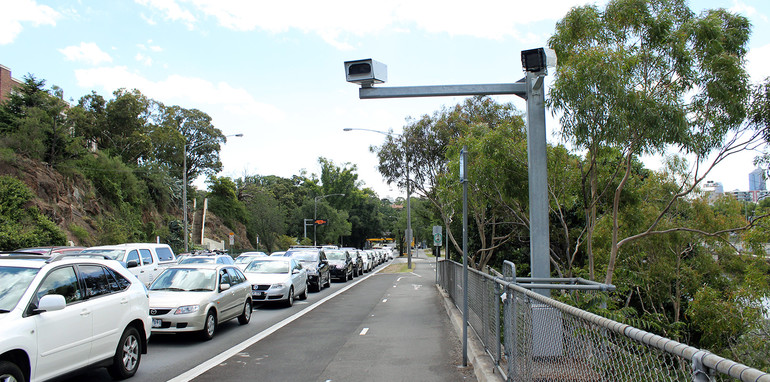
This is despite a record number of fixed and mobile speed cameras deployed on roads in Victoria and around Australia.
For years, the government has been claiming that speed cameras save
lives and that speed is the greatest common factor in fatal car
accidents.
But with road deaths on the rise, could it be that speed cameras
actually don’t save lives and in fact are contributing to our road toll
by breeding poor driving practises?
Since Saab introduced seat belts as standard in 1958, occupant safety
has been improving every year, and the sedans, wagons, utes and SUVs we
drive today are safer than ever. And safer cars will undoubtedly go
further in reducing the road toll than speed cameras.
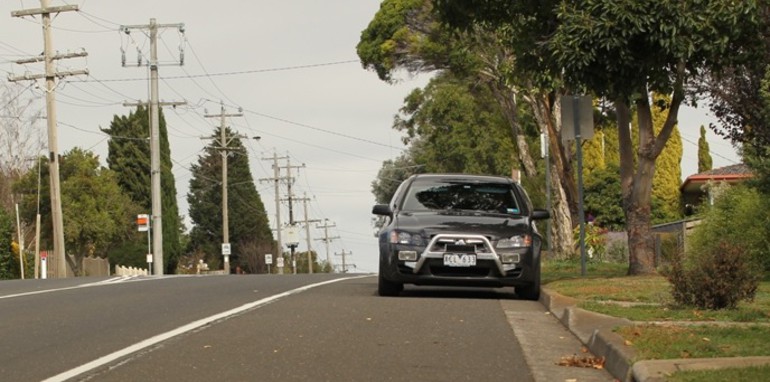
Speed cameras certainly have their place in society, but with the
draconian enforcement of low-level speeding and covert tactics, such as
hiding in bushes and unmarked mobile speed cameras (in Victoria, at
least), more needs to be done.
The proof is in the numbers. People are still crashing, they are just safer doing so.
The TAC (Victoria’s Transport Accident Commission, which is
responsible for paying benefits to people injured in road accidents)
records the number of people injured in car accidents that require
hospital stays of more than 14 days and hospital stays of fewer than 14
days.
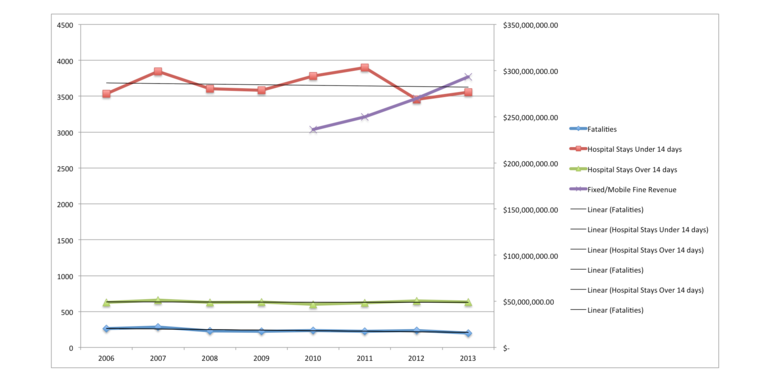
The data set I interrogated was over an eight-year period from 2006
to 2013. The set of numbers included injuries involving a car or
motorcycle and excluded pedestrian injuries. During this period, the
number of registered vehicles in Victoria has increased by around 2.3%
per year. The data shows that in 2006, 3535 people required hospital
stays of fewer than 14 days in comparison to 2013, where 3558 people
required hospital stays shorter than a fortnight. That’s an increase of
less than 1 per cent.
Similarly, for the same period, in 2006 there were 629 people
admitted to hospital for stays of more than 14 days, while in 2013 there
were 632 people that required hospital stays of more than a fortnight, a
similar increase of less than 1 per cent.
Now, compare those figures to fatalities over the same period. In
2006 there were 261 road fatalities in Victoria (excluding pedestrians),
compared to 200 in 2013, a reduction of around 23 per cent.
This shows that while fatalities have decreased by a significant
margin, we haven’t seen the same decrease in serious injuries requiring
hospital stays, which cost Victorian road users $8.89 billion between
2003 and 2014 — mainly funded by vehicle registration fees. This
supports the theory that while cars have become significantly safer,
people are still making the wrong choices behind the wheel and driving
poorly.
The other aspect of road policing that hasn’t seen a significant
decrease is revenue from traffic fines. Prior to the 2011-2012 Victorian
Budget, these figures were bundled into a general revenue from fines
category. Public figures for revenue from speed cameras (fixed and
mobile) are only available from 2010 onwards.
The figures show that revenue from speed cameras alone — on the spot
police fines are not included in this figure — in 2010 was around $236
million. Fast forward to 2013 and that figures jumps a whopping $57
million to $293 million. Imagine ripping almost $300 million from
government coffers; speed cameras have become like a drug addiction that
governments can’t help but feed off.
Included below is a graph (click here
to see larger version) that shows the relationship between hospital
stays shorter than 14 days, longer than 14 days, fatalities and revenue
from speed cameras. The graph shows that the increase in revenue from
speed cameras isn’t commensurate with a reduction in hospital stays.
Hospital stays of fewer than 14 days and more than 14 days during this
period trended steady.
When asked about speed cameras and levels of enforcement, a
spokesperson for the Department of Justice and Regulation told
CarAdvice:
“Broadly speaking the rate of people being fined by cameras is not
changing, but as the population grows, so too does the number of fines
issued.
“The overall number of infringements issued annually is increasing as
Victoria’s population grows and there are more cars on the road.
“Over 99 per cent of vehicles passing fixed cameras and over 98 per
cent of vehicles passing mobile cameras comply with the speed limit.
“Fixed and mobile road safety cameras reduce speeds and cut road
trauma because they are placed in high-risk or high-speed areas, areas
with history of road trauma, or areas that will provide a road safety
benefit.
“100 per cent of the money from camera fines is allocated to the
Better Roads Victoria Trust Account. The funds from this account are
used to improve road safety for all road users.”
With an enforcement focus skewed on speed, ask yourself this
question: how many speed cameras did you travel through (whether it be a
fixed or mobile one) in the past month? Now, ask yourself how many
times were you stopped to be tested for drugs or alcohol over the same
period?
Similarly, in the past 10 years, how many times did you undertake driver training to improve your skills?
The unfortunate reality of speed camera-biased enforcement can be
demonstrated with the tragic death of pedestrian Anthony Parsons and
husband and wife Savva and Ismini Menelaou, who were passengers in a
Ford Falcon struck at the intersection of Warrigal and Dandenong roads
in Oakleigh, Victoria last year.
Brazilian national Nei Lima DaCosta was high on ice and drove through
one fixed speed camera at 30km/h over the speed limit minutes before
careering through the intersection of Warrigal and Dandenong roads at
120km/h (40km/h over the speed limit) through another speed and red
light camera. He killed three innocent people. These two cameras did
nothing to help save the lives of three innocent people.
This particular example illustrates why so much more needs to be done
on enforcing and dealing with poor driving, whether it be due to drugs,
lack of skills or visible policing.
Speed cameras alone will never be a useful immediate enforcement or
protection tool against drivers excessively speeding, or people who
don’t know how to drive to start with.
Those people that use the idiom “don’t speed and you won’t get
caught” simply don’t understand the reality of driving safely. If I had
the preference of watching the road or my speedometer, I know which one I
would choose.
I’m of the firm belief that we need to overhaul driver training,
begin properly blitzing drink and drug driving, along with scrapping low
level speed enforcement. I would have no issue with being stopped twice
a day for drug or alcohol testing if it meant impaired drivers were
taken off the road more promptly.
We also need more transparency on where the money generated from speed cameras goes and where it should be spent.


 Telstra appears stumped as to how the unusual privacy breach occurred. Photo: Bloomberg