24 September 2022

Disable Intel ME thanks to the NSA


Corporations lie to you, they lie to you every single day, period.

It's all in the language they use.

What's more important, is that no one really cares until you take it to court, and even then.

Over the years, Intel's "Management Engine" has been discussed to death, about it's "backdoor" capability to be exploited by others.

Intel refuted those backdoor accusations, saying, “Intel does not put backdoors in its products nor do our products give Intel control or access to computing systems without the explicit permission of the end user. In short, Intel does not participate in efforts to decrease security in technology.”

So, let's put emphasis on the word "backdoor", where we can use the words, feature or portal or let's even thrown in a few TLAs (Three Letter Acronyms) like AMT (Advanced Management Tool) or an an IMF (Integrated Management Feature).

quie simply put, Intel got caught out in with their propriatary architecture and still continued to provide false information (i.e. lie).

Intel is a term used by government 'defence' (or more accurately offence) personnel to that described intelligence gathering.

What most important with this whole fiasco is that a government 'intel' organisation requires their computer to have the ME (Management Engine) disabled.

Therefore the government does not want the government to spy on itself, which makes perfecrt sence.

See the following:

As Positive Technologies researchers Mark Ermolov and Maxim Goryachy poked into the firmware, they discovered an undocumented HAP field. HAP, which stands for the High Assurance Platform (pdf) program, was developed by the NSA. The framework was for the “development of the ‘next generation’ of secure computing platforms.”

The researchers discovered an undocumented field called “reserve-hap” and that HAP could be set to “1” for true. Apparently, the NSA wanted to ensure the agency could close off any possible security risk by disabling Intel ME. The researchers wrote, “We believe that this mechanism is designed to meet a typical requirement of government agencies, which want to reduce the possibility of side-channel leaks.”

When told about the research, Intel told Positive Technologies:

In response to requests from customers with specialized requirements, we sometimes explore the modification or disabling of certain features. In this case, the modifications were made at the request of equipment manufacturers in support of their customer’s evaluation of the U.S. government’s “High Assurance Platform” program. These modifications underwent a limited validation cycle and are not an officially supported configuration.

If you want to disable Intel ME, you should first read the in-depth technical explanation about the researchers finding “an undocumented PCH strap that can be used to switch on a special mode disabling the main Intel ME functionality at an early stage.” Positive Technologies also made its Intel ME 11.x firmware image unpacker utility available on GitHub. Use at your own risk; the methods to disable Intel ME were described as “risky and may damage or destroy your computer.”

Source: CSO Australia.

These actions of spying on the general population is deliberate by design part of the Nanny State agenda.

23 September 2022

Optus data breach logged with OAIC after public revelation, with falsified figures?

One of the prerequisites is that corporations conducting business in Australia must inform the OAIC (Office of the Australian Information Commissioner) once a data breach has occurred.

Some CEO's chose not to inform the OAIC, where this information will be made public, in order not to lose customer's i.e. profits as a result of poor security pracitices of their corporation's I.T. infrastructure.

Some CEO's choose to wait for a ransom notice in order to pay it, hoping the problem will go away, where the outside world will be none the wiser.

These practices fall under the unconsionable conduct, which is against the law.

But at the end of the day no one (i.e. corpoation's CEO's) cares until it's taken to court.

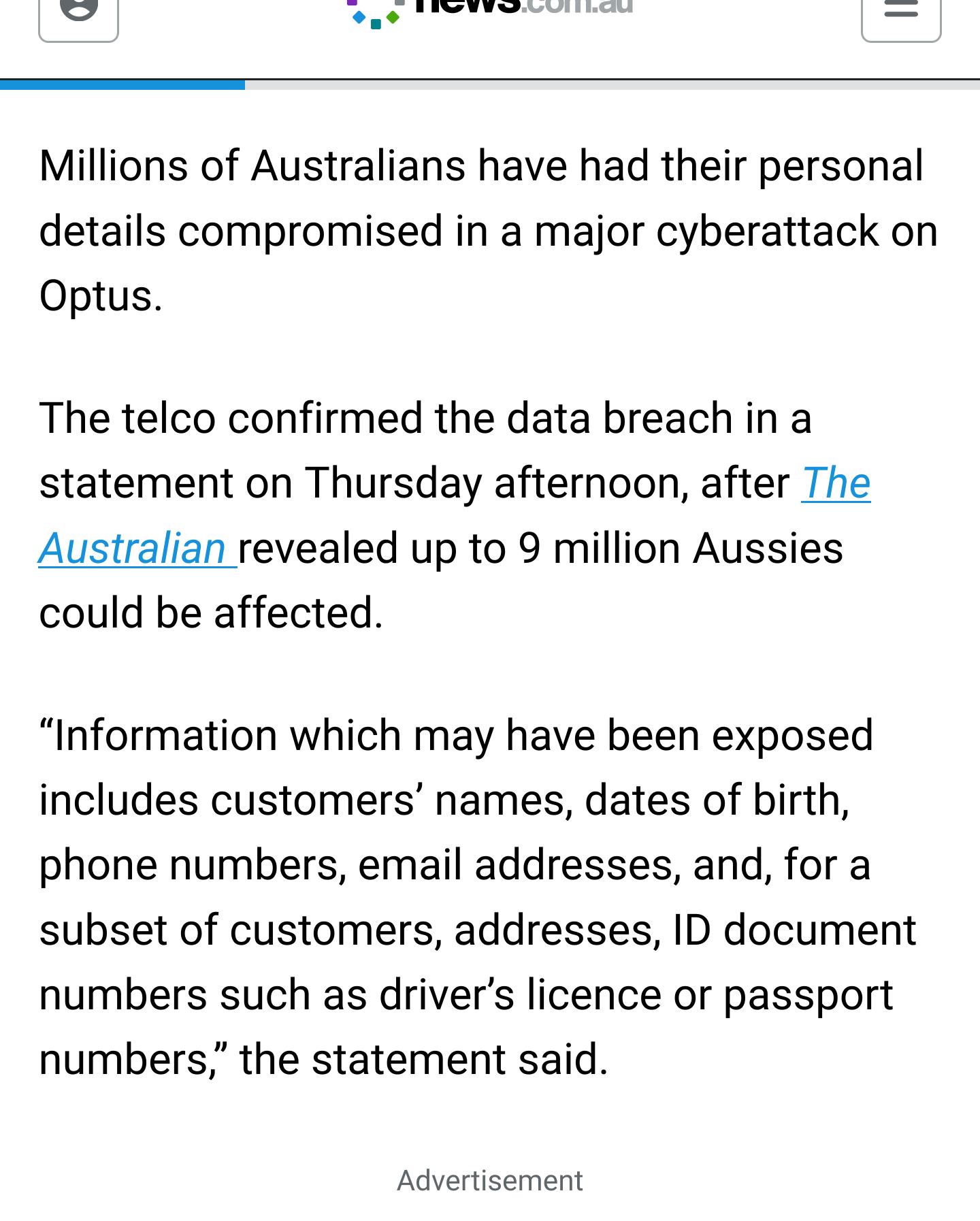
Optus' data breach was reported by news.com.au after 2pm on Thurdsay 22/09/2022:


The Office of the Information Commissioner published Optus' data breach at approx 10pm on 22/09/2022.

When did the data breach factually occur?

When did Optus decide to infom the OAIC?

Optus has not conducted business 'honourably' in Australia, where it has been fined on occassions for false advertising.

"Profit's before People", right?

In any event, when the story broke out Optus claimed that 9 million people were affected, as seen in the  screen shot below:


Then the story was modified approximately 3 hours later


where the claim is that 7 million people:


Another Optus 'false advertising' claim?

One of the greatest problems Australians face with regards to the privacy and security of their data when dealing with corporations is that in order to save on costs, the corporations 'outsource' their I.T. services where the administration is sub par, lacking in the required skill-set to keep the data on the servers and the bad guys out.

As the saying goes: "If you pay peanuts, you get monkeys", behind the keyboards.

Once the data is out of your control you cannot catergoriaclly state that there are no victims, where the authorities or the corpoations involved, may not even know or even report to the victims or even public for quite some time of the magnitude the criminal actions of identity theft has occured from that particular data breach.

21 September 2022

Windows 10 v Linux memory usage and privacy concerns

A personal computer installed with a current version of Windows 10, together with all the associated drivers for the personal computer to operate normally, i.e. video, audio, network, chipset etc consumes a certain amount of RAM, as indicated in the screenshot below:


The amount of RAM used by the Windows operating system is 3.2GB.

A current version of a Linux distribution that is installed on the same hardware, where all the functionality of the installed hardware is functional to the same level of the Windows equivalent yields completely differrent results, as shown in the screen capture below:


The baseline for the Linux installation is 1.4GB or 200MB less than half of what Windows requires!

What's more important is that security and privacy are at a totally differrent level to that of Microsoft's embedded spyware within its operating system.

The best way to stop Microsoft from spying on you via its Windows operating system is quite simply not to use it.

If privacy is a concern to you then products from Amazon, Apple, Google, Meta, Microsoft and others like ByteDance (TikTok) and government health realted apps, which are not 'mandatory' should be avoided.

See more information:


within: https://clario.co/blog/which-company-uses-most-data/

19 September 2022

Windows 10 Processes Threads Handles too high!


Microsoft's Window 10 operating system from the 'factory' or OOBE (Out Of Box Experience) is plain and simple spyware which stifle's your computer's performance.

One can mitigate Microsoft's data hoovering, but ultimtely in order to stop Windows from keylogging your keyboard moves and other things one does on a PC is to not use it, period.

Depending on your hardware a 'normal' Windows 10 installation, after the operating system 'settling down' after ~10minutes may have ~120 processes, 1150 threads and 40,000 handles which is a lot of work for something that is not doing anything beneficial for the user.

While there is no silver bullet to Microsoft's telemetry, while you're using its products. there are a few good utilities that get rid of bloatware and minimise the data collection.

Some products that can be used are DISM++, W10Privacy, O&OS10, WPD in conjunction with a good hosts file (anything from 300kB - 4500kB) which lists Microsoft's telemetry servers and other nasty data gathering sources.

From a fresh installation of Windows together with the implementation of the listed and unlisted tools one should be able to cut the Processes, Threads and Handles by half where during that process one can install a distribution of Linux, learn the basics and not have to deal with Microsoft's data hoovering from the 'factory'. 

Windows 8.1 has less bloat and [maybe less embedded] spyware, where a lockdown of the operating system should yield the results of Processes, Thread and Handles to be in the magnitude of 33, 460, 10630 respectively.

17 September 2022

Uber confirms "cybersecurity incident" and covering up 50m customer's and 7m driver's data breach in 2016

Uber confirms "cybersecurity incident" after 18-year-old claimed to be behind massive breach

It's unclear whether he accessed customer data


What just happened? Uber is investigating a cybersecurity incident that has compromised many of its internal systems, giving the hacker, who says he is just 18 years old, almost complete access to the company's network. The breach is thought to be as bad as or worse than the 2016 incident that exposed the details of 57 million customers.

The New York Times reports that the hacker used a common social engineering technique to access Uber's systems. He sent a text message to one of the ride-hailing giant's employees claiming to be a corporate IT person. The worker was persuaded to hand over their password, granting the perpetrator access to Uber's network.

The hacker provided screenshots of Uber's internal systems to the NYT as proof of his successful attack. He told the publication that he is 18 years old and had been working on his cybersecurity skills for several years, adding that Uber's weak security prompted him to compromise its network.

Once he had access, the hacker sent a Slack message to employees that read: "I announce I am a hacker and Uber has suffered a data breach." It listed several compromised databases and appeared to call for Uber drivers to receive higher pay. Uber took its internal Slack and engineering systems offline earlier today as it investigated the breach.

Sam Curry, a security engineer at Yuga Labs who corresponded with the hacker, said the person has full admin access to Uber's Amazon Web Services and Google Cloud services. "It seems like maybe they're this kid who got into Uber and doesn't know what to do with it, and is having the time of his life," Curry said.

In an official statement, Uber wrote: "We are currently responding to a cybersecurity incident. We are in touch with law enforcement and will post additional updates here as they become available."

Besides his age, little is known about the hacker, though it's speculated that he is British; an employee said he used the word "wankers," and he may go by the username 'teapots2022.' He also accessed Uber's HackerOne vulnerability bug bounty account and left comments on several report tickets.


The breach is being compared to the 2016 incident in which the names, email addresses, and phone numbers of 50 million Uber customers, along with the personal details of 7 million drivers, were stolen. Uber paid the hackers responsible $100,000 to delete the data and stop the incident from becoming public knowledge, and it concealed the breach for over a year. The company had to pay a $148 million settlement for the hack and its failure to disclose what happened.

Source:techspot.com

16 September 2022

FTC Sues Location Data Broker - Kochava


Phone app location data brokers are a growing menace to our privacy and safety. All you did was click a box while downloading an app. Now the app tracks your every move and sends it to a broker, which then sells your location data to the highest bidder.

So three cheers for the Federal Trade Commission for seeking to end this harmful marketplace! The FTC recently sued Kochava, a location data broker, alleging the company violated a federal ban on unfair business practices. The FTC’s complaint against Kochava illustrates the dangers created by this industry.

Kochava harvests and monetizes a staggering volume of location data. The company claims that on a monthly basis, it provides its customers access to 94 billion data points arising from 125 million active users. The FTC analyzed just one day of Kochava’s data, and found 300 million data points arising from 60 million devices.

Kochava’s data can easily be linked to identifiable people. According to the FTC:

The location data provided by Kochava is not anonymized. It is possible to use the geolocation data, combined with the mobile device’s MAID [that is, its “Mobile Advertising ID”], to identify the mobile device’s user or owner. For example, some data brokers advertise services to match MAIDs with ‘offline’ information, such as consumers’ names and physical addresses.

Even without such services, however, location data can be used to identify people. The location data sold by Kochava typically includes multiple timestamped signals for each MAID. By plotting each of these signals on a map, much can be inferred about the mobile device owners. For example, the location of a mobile device at night likely corresponds to the consumer’s home address. Public or other records may identify the name of the owner or resident of a particular address.

Kochava’s location data can harm people, according to the FTC:

[T]he data may be used to identify consumers who have visited an abortion clinic and, as a result, may have had or contemplated having an abortion. In fact, … it is possible to identify a mobile device that visited a women’s reproductive health clinic and trace that mobile device to a single-family residence.

Likewise, the FTC explains that the same data can be used to identify people who visit houses of worship, domestic violence shelters, homeless shelters, and addiction recovery centers. Such invasions of location privacy expose people, in the words of the FTC, to “stigma, discrimination, physical violence, emotional distress, and other harms.”

The FTC Act bans “unfair or deceptive acts or practices in or affecting commerce.” Under the Act, a practice is “unfair” if: (1) the practice “is likely to cause substantial injury to consumers”; (2) the practice “is not reasonably avoidable by consumers themselves”; and (3) the injury is “not outweighed by countervailing benefits to consumers or to competition.”

The FTC lays out a powerful case that Kochava’s brokering of location data is unfair and thus unlawful. We hope the court will rule in the FTC’s favor. Other location data brokers should take a hard look at their own business model or risk similar judicial consequences.

The FTC has recently taken many other welcome actions to protect people’s digital rights. Last month, the agency announced it is exploring new rulemaking against commercial surveillance. Earlier this year, the FTC fined Twitter for using account security data for targeted ads, brought lawsuits to protect people’s right-to-repair, and issued a policy statement against edtech surveillance.

Microsoft advertising infestation on smart phone apps


n a bit of bad news for some who use Outlook, Microsoft confirmed this week that it has started showing more ads in the Android and iOS app to non-paying customers. People without Microsoft 365 subscriptions can avoid ads to some extent by using Focused Inbox for important emails only, but ads will still be shown in the "Other" section of the app.

In related news, Microsoft has also started testing ads in the Microsoft Store. Developers can now register to start participating in this initiative by filling in a form. The way that ads will be surfaced is quite similar to other digital storefronts. For example, if you search for an app, you may see ads for other apps on the side with the "Ad" badge displayed.

When it comes to other Microsoft apps and services, Whiteboard is set to receive a slew of new features soon. This includes embedded online video support, timer, attribution, commenting, and more. Similarly, Teams has netted a bunch of new features for educators and students too. This includes a new experience called "Reflect" and a revamped home page. Finally, frontline workers utilizing Microsoft's Kaizala should know that the messaging service is being retired after one year in favor of Teams.

Source:neowin

Note: If you are concerned about security and privacy Microsoft Office/Windows products are not recommended.

Customs officials have copied Americans’ phone data at massive scale

Contacts, call logs, messages and photos from up to 10,000 travelers’ phones are saved to a government database every year

Courts have given border authorities the power to search people’s devices without a warrant or suspicion of a crime. Above, JFK Airport in New York.

U.S. government officials are adding data from as many as 10,000 electronic devices each year to a massive database they’ve compiled from cellphones, iPads and computers seized from travelers at the country’s airports, seaports and border crossings, leaders of Customs and Border Protection told congressional staff in a briefing this summer.

The rapid expansion of the database and the ability of 2,700 CBP officers to access it without a warrant — two details not previously known about the database — have raised alarms in Congress about what use the government has made of the information, much of which is captured from people not suspected of any crime. CBP officials told congressional staff the data is maintained for 15 years.

Details of the database were revealed Thursday in a letter to CBP Commissioner Chris Magnus from Sen. Ron Wyden (D-Ore.), who criticized the agency for “allowing indiscriminate rifling through Americans’ private records” and called for stronger privacy protections.

The revelations add new detail to what’s known about the expanding ways that federal investigators use technology that many Americans may not understand or consent to.

Agents from the FBI and Immigration and Customs Enforcement, another Department of Homeland Security agency, have run facial recognition searches on millions of Americans’ driver’s license photos. They have tapped private databases of people’s financial and utility records to learn where they live. And they have gleaned location data from license-plate reader databases that can be used to track where people drive.

CBP’s inspection of people’s phones, laptops, tablets and other electronic devices as they enter the country has long been a controversial practice that the agency has defended as a low-impact way to pursue possible security threats and determine an individual’s “intentions upon entry” into the U.S. But the revelation that thousands of agents have access to a searchable database without public oversight is a new development in what privacy advocates and some lawmakers warn could be an infringement of Americans’ Fourth Amendment rights against unreasonable searches and seizures.

CBP spokesman Lawrence “Rusty” Payne said in a statement Thursday that the agency conducts “border searches of electronic devices in accordance with statutory and regulatory authorities” and has imposed rules to ensure the searches are “exercised judiciously, responsibly, and consistent with the public trust.”

The database, known as the Automated Targeting System, is used “to further review, analyze, and assess information CBP obtained from electronic devices associated with individuals who are of a significant law enforcement, counterterrorism” or national security concern, he said.

CBP officials declined, however, to answer questions about how many Americans’ phone records are in the database, how many searches have been run or how long the practice has gone on, saying it has made no additional statistics available “due to law enforcement sensitivities and national security implications.”

A 2018 CBP directive establishing rules for the searches said officers should only retain information relating to immigration, customs or “other enforcement matters” unless they have probable cause that could justify saving more of the phones’ contents.

In the briefing this summer, however, CBP officials said their default configuration for some of the searches had been to download and retain all contact lists, call logs and messages, a Wyden aide said.

CBP officials retain people’s phone data in a very small fraction of searches and only when “absolutely necessary,” Aaron Bowker, CBP’s director of office of field operations, said in an interview Thursday.

CBP conducted roughly 37,000 searches of travelers’ devices in the 12 months ending in October 2021, according to agency data, and more than 179 million people traveled that year through U.S. ports of entry. The agency has not given a precise number of how many of those devices had their contents uploaded to the database for long-term review.

A Wyden aide said their office was told 2,700 DHS officials had access to the data. Bowker said that number is incorrect and that 5 percent of CBP’s 60,000-employee operational workforce, or 3,000 officials, is given access.

Bowker said those authorized officials are trained, audited and supervised, and that the level of data access is appropriate given the size of the task. Bowker said no other government agency has direct access to this data but that officials can request information on a case-by-case basis.

“You have to have enough operational personnel who are able to do this properly around the clock,” Bowker said. “We have 328 ports of entry. We are a 24/7 operation. You don’t know who’s going to show up where and when.”

Law enforcement agencies must show probable cause and persuade a judge to approve a search warrant before searching Americans’ phones. But courts have long granted an exception to border authorities, allowing them to search people’s devices without a warrant or suspicion of a crime.

CBP officials have relied on that exception to support their collection of data from travelers’ phones. Sens. Wyden and Rand Paul (R-Ky.) introduced a bill last year that would require border officials to get a warrant before searching a traveler’s device.

The CBP directive gives officers the authority to look and scroll through any traveler’s device using what’s known as a “basic search,” and any traveler who refuses to unlock their phone for this process can have it confiscated for up to five days.

In a 2018 filing, a CBP official said an officer could access any device, including in cases where they have no suspicion the traveler has done anything wrong, and look at anything that “would ordinarily be visible by scrolling through the phone manually,” including contact lists, calendar entries, messages, photos and videos.

If officers have a “reasonable suspicion” that the traveler is breaking the law or poses a “national security concern,” they can run an “advanced search,” connecting the phone to a device that copies its contents. That data is then stored in the Automated Targeting System database, which CBP officials can search at any time.

Faiza Patel, the senior director of the Liberty and National Security Program at the Brennan Center for Justice, a New York think tank, said the threshold for such searches is so low that the authorities could end up grabbing data from “a lot of people in addition to potential ‘bad guys,’” with some “targeted because they look a certain way or have a certain religion.”

DHS investigators have increasingly used analytical and machine-learning tools to map out relationships and behaviors from vast reserves of phone data, meaning that even people whose phones have not been accessed could get swept up in a database search.

“It’s not just what you say or do that’s of interest to DHS, it’s what everybody you know says and does,” Patel said. “You may become suspicious just because someone you’re only tangentially related to says something on your timeline or is on your call log. … And when you have 2,700 people having access, you have very little control over the uses to which they put this information.”

The CBP directive on device searches was issued several years after a federal appeals court ruled that a forensic copying of a suspect’s hard drive had been “essentially a computer strip search” and said officials’ concerns about crime did “not justify unfettered crime-fighting searches or an unregulated assault on citizens’ private information.”

The Wyden aide also said that the CBP database does not require officers to record the purpose of their search, a common technical safeguard against data-access misuse. CBP officials said all searches are tracked for later audit.

DHS’ Office of Inspector General said in a 2018 report that officers had not always fully documented their device searches, making it hard to verify whether they had been properly run. CBP officials said then that they would conduct closer monitoring.

But in a follow-up report last year, the inspector general’s office said the agency was continuing to “experience challenges” in sufficiently managing searches of people’s phones. CBP said it was working to address the issues.

The “advanced search” program, which began in 2007 as a project known as Document and Media Exploitation, has expanded to cover more than 130 ports of entry, the inspector general’s office said in its report last year.

CBP has over the years referred information from people’s devices to Immigration and Customs Enforcement, local police agencies and the FBI for further investigation, the report said.

CBP officials give travelers a printed document saying that the searches are “mandatory,” but the document does not mention that data can be retained for 15 years and that thousands of officials will have access to it.

Officers are also not required to give the document to travelers before the search, meaning that some travelers may not fully understand their rights to refuse the search until after they’ve handed over their phones, the Wyden aide said.

CBP officials did not say which technology they used to capture data from phones and laptops, but federal documents show the agency has previously used forensic tools, made by companies such as Cellebrite and Grayshift, to access devices and extract their contents.

A CBP officer who runs a search of the system will only see phone data that was extracted from checkpoints in their part of the country, agency leaders told Wyden’s office. But officers will be told that a hit was found in the data from another region, and they are allowed to ask for permission to review that data. CBP did not say how many of those kinds of requests have been made, fulfilled or denied.

The CBP revelations have echoes of a National Security Agency program, first revealed in 2013 by Edward Snowden, that once captured millions of Americans’ phone records as part of a surveillance initiative targeting suspected terrorists. Because officials could follow, or “hop,” from one phone’s records to the next, the system was found to have exposed the records of millions of people not suspected of any crime.

The NSA ended the program in 2019, saying some of the data had been collected in error and that the system had not been all that useful in tracking terrorists or fighting crime.

Source: The Washington Post

15 September 2022

Return YouTube Dislike – The Little Mermaid, ‘woke’ agenda BS


Censorship is high on the agenda of the authorities, which the technocrats are part of / subservient to. 

As Google supplies data to government and non-government organisations, it’s only befitting that it sensors its platforms, i.e. the 'search' facility and YouTube.

The inability for the general population to see the integer value of dislikes for content creator’s videos is plain and simple censorship.

The content viewer is not given an objective detail as to what the general population agrees or disagrees with regards to a particular topic or even political opinion.

In the example of a Disney film called The Little Mermaid, which focuses on some sort of ‘woke’ agenda, the viewer would see only a 725k ‘thumbs up’ at the time of this post having zero idea of how many people dislike Disney's topic at hand.

In this case, the content viewer does not see is the number of dislikes associated with Disney’s opinion of ‘woke’ which is 1.9M, or 2.6 dislikes to one like ratio.

We recommend people see the whole story about other’s opinions with regards to topics on YouTube, therefore the Firefox extension called “Return YouTube Dislikes” by Dmitry Selivanov is the choice at the moment.

These actions are all part of the (global) Nanny State agenda.

14 September 2022

Victoria Police caught issuing fake permits


IMAGINE IF THE VICTORIAN REGISTRY JUST DID WHAT IT WANTED TO DO?

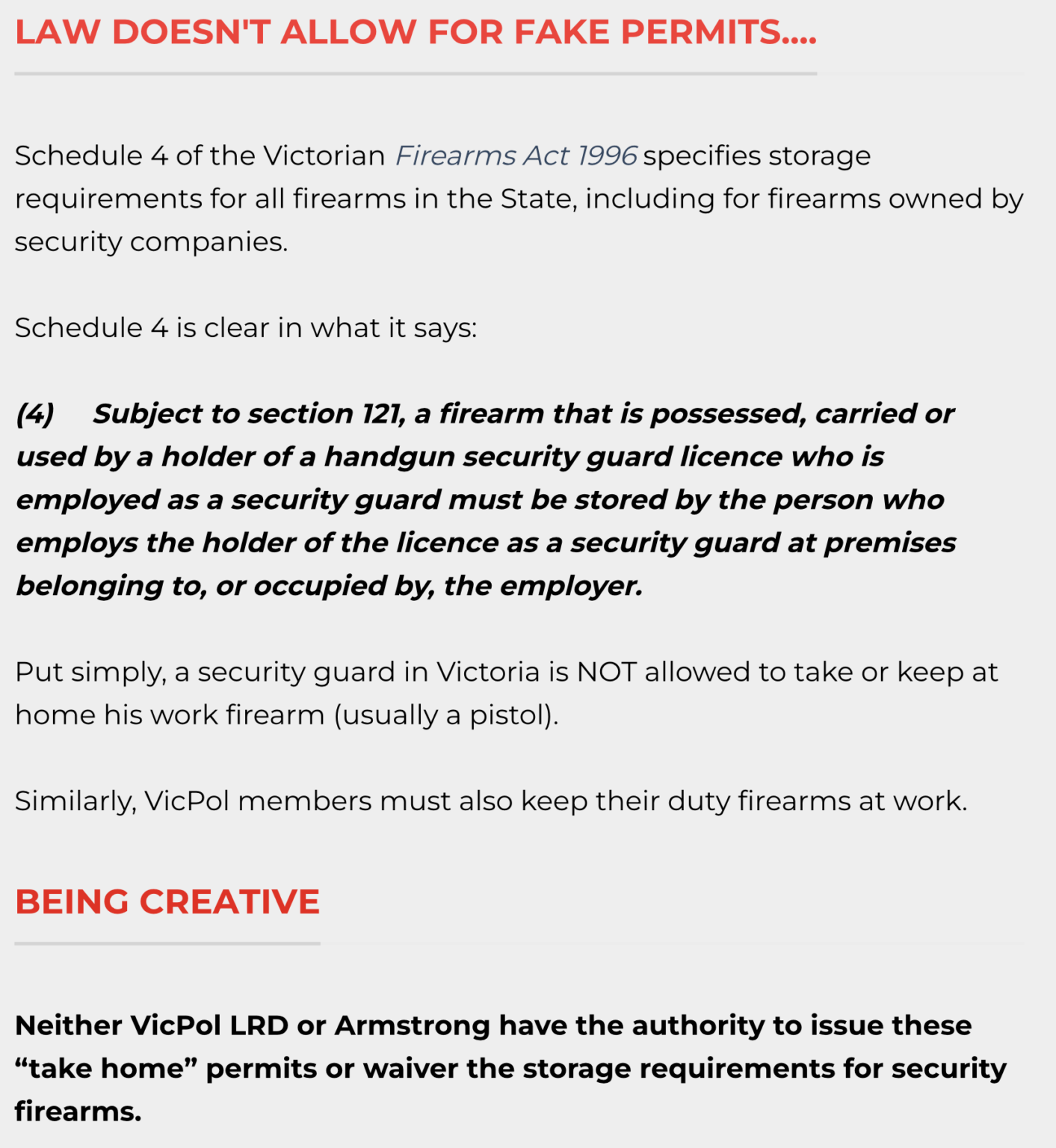
LEADING PRO-SHOOTERS RIGHTS MP and NSC member Tim Quilty MLC, has revealed in Parliament that VicPol’s registry (LRD) have been caught breaking the same laws it administers.

This follows revelations of “missing guns” and allegations of continual misconduct of senior LRD officers.  Now they’re issuing ‘pretend permits’ for their friends.


This the third time Senior Sergeant Armstrong has been named in Parliament.

Tim then went on to detail a long list of misconduct and improper behaviour by LRD, all backed by an overwhelming mountain of evidence.

(To hear what Tim said click here to watch the Parliamentary video footage below.)


source:constitutionwatch.com.au