A look into Corporate fraud in Australia, Stranglehold of Monopolies, Telecom's Oppression, Biased Law System, Corporate influence in politics, Industrial Relations disadvantaging workers, Outsourcing Australian Jobs, Offshore Banking, Petrochemical company domination, Invisibly Visible.
It's not what you see, it's what goes on behind the scenes. Australia, the warrantless colony.
Note: Site has more info in desktop mode or 'web version' as seen at bottom of page, when on smartphone.
COMMONWEALTH OF AUSTRALIA (ABN: 122 104 616)
Australia's Prime Minister (CEO) Tony Abbott : "Australia is Open for Business"
Fresh report analysing total power usage of AI servers suggests consumption is through the roof!
The likes of the Nvidia H100 GPU consume up to 700W alone, let alone all the other components around it.
French firm Schneider Electric reports that power consumption of AI servers will total around 4.3GW in 2023, which is slightly lower than the power consumption of the nation of Cyprus (4.7GW) in 2021. The company anticipates that power consumption of AI workloads will grow at a compound annual growth rate (CAGR) of 26% to 36%, which suggests that by 2028, AI workloads will consume between 13.5GW and 20GW, which is more than Iceland consumed in 2021.
In 2023, the total power consumption of all data centres is estimated to be 54GW, with AI workloads accounting for 4.3GW of this demand, according to Schneider Electric. Within these AI workloads, the distribution between training and inference is charcterised by 20% of the power being consumed for training purposes, and 80% allocated to inference tasks. This means that AI workloads will be responsible for approximately 8% of the total power consumption of all data centres this year. Schneider Electric recommends transitioning from the conventional 120/208V distribution to 240/415V to better accommodate the high- power densities of AI workloads. For cooling, a shift from air cooling to liquid cooling is advised to enhance processor reliability and energy efficiency, although immersive cooling might produce even better results. The racks used should also be more capacious, with specifications such as being at least 750mm wide and having a static weight capacity greater than 1,800kg.
See the full report here:
If corporations truly cared about the environment, then they's be using LESS resources and not more.
Over 8 years ago or on the 15th of June 2015, the colony’s state media aired on a programme called ‘Q&A’ the topic of the Magna Carta (‘Great Charter’ in Latin) from 1215.
Then Speaker of the House of Representatives Ms. Bronwyn Bishop stated (at 12m16s)
that “The first job of a government is to look after the safety of its people”
Also note that the Australian Government did not allow ‘Free Speech’ on this topic on the YouTube platform by turning off comments.
The government’s ‘people’ are those in the Executive that being the Monarch, Governor General, the Parliament that being the MPs, lawmakers and the Judiciary that being the Courts and police.
The general population/serfs/plebs are not part of the government’s ‘people’.
MANY people may have problems in comprehending Ms. Bishops statement, where a simple analogy can be made substituting the word government for a 'favourite' company or international corporation, e.g:
“The first job of Google is to look after the safety of its people”
That means Google’s customers are not on the radar, or of zero significance in relation to the policy.
So what could be the second job of those in government, or even a highly prioritised agenda?
To rort the tax pool to the maximum without any consequences?
To give money for mates jobs in falsified tenders, irrespective of any legal action?
To implement actions that punish people, which have zero legal and lawful basis to exist therefore let alone to be enacted upon?
To commit criminal actions when in office with the intention to get away with them?
Or why not to enact pain and suffering or austerity on the general population to a predefined level that is just below then rioting.
That is what is happening to Australians at this point in time, where the Australian Government is responsible for the housing crisis, rental crisis, job crisis, and high inflation ‘crisis’ where all these actions are carried out to a level just below people having enough and rioting, just like in Sri Lanka.
The people in the Australian Government, must really hate the (mums & dads) tax payers, the very people that afford those in government to have an exorbitant tax rorting lifestyle even after they have left office.
The product is stifled, the consumer is not obtaining the benefit of current technology.
Apple is also against you with regards to your lawful right to repair the product, where it goes out of its way to deliberately engineer components that when replaced will not work in your legally owned Apple device.
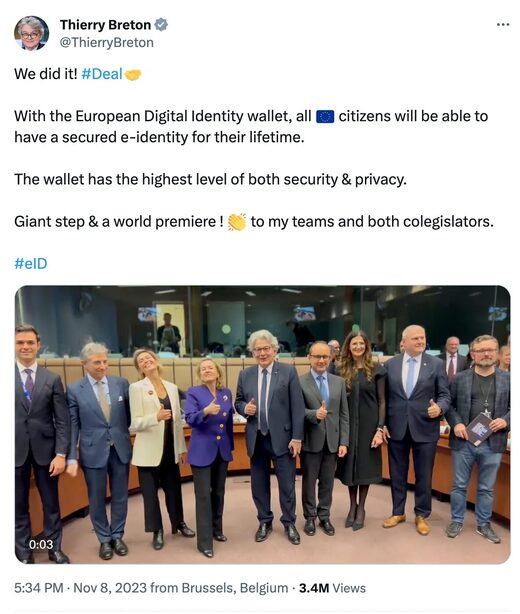
Last Wednesday, Thierry Breton, EU's Internal Market Commissioner, proudly announced on Twitter/X
that he had struck a deal with MEPs to create a European "digital
identity wallet," which would permit all EU citizens to have "a secured
e-identity for their lifetime." According to the European Commission's own website,
the European Digital Identity can be used for a whole range of
transactions, including providing personal identification on and
offline, showing birth certificates and medical certificates, opening a
bank account, filing tax returns, applying for a university, storing a
medical prescription, renting a car, or checking into a hotel.
Several people, including Dutch MEP Rob Roos, have raised concerns that a centralised digital ID could put Europeans' privacy and mobility rights in jeopardy. A letter
signed by over 500 "cybersecurity experts, researchers, and civil
society organisations from across the globe," warns that the proposed
digital ID regulations will reduce rather than enhance citizens digital
security. But one of its leading architects, Internal Market
Commissioner Thierry Breton, maintains that "the wallet has the highest
level of both security & privacy," while EU President Ursula von der
Leyen insists that this is "a technology where we can control ourselves
what data is used and how." So either critics are overplaying civil
liberty and privacy concerns, or the technology's defenders are
downplaying them. They cannot both be right.
In theory, a universal European digital ID could be programmed on a
permanent basis in such a way that the citizen has full control over
which parts of his or her "digital wallet" he shares at any given
moment, and which he or she does not share. We might have little to
worry about if a European digital ID was programmed now and forever by
people who took privacy seriously and were not inclined to exploit the
technology at their fingertips to "nudge" - or even "shove" - citizens
into complying with their policies concerning disease control,
non-discrimination, war propaganda, or climate change.
But in practice, it
would be highly naive to assume that a programmable Europe-wide digital
ID, controlled by a centralised bureacracy would not, sooner or later,
be exploited to "nudge" (or shove)
people into complying with the policies that happen to be favoured by
the "powers that be." And it does not require a wild leap of imagination
to envisage the sorts of ways a European digital ID could be leveraged
to erode the equality and freedom of Europeans, since the very same individuals
that are the public face of this digital ID initiative were the ones
who set in motion the most pervasive system of bio-surveillance in the
history of Europe, namely the so-called "Covid digital certificates."
The operation of the Covid digital certificates, which was approved by
both the European Commission (the same one now pushing for a digital ID
system) and the European Parliament, can give us a fairly clear idea of the uses to which European technocrats are likely to put a digital ID system, if given the chance.
The Covid digital certificate was used to compel citizens who had not
received a Covid vaccine within a certain time period to obtain a costly
and inconvenient Covid test every time they crossed a European border,
and was even used to deny entry to unvaccinated citizens at cultural and
recreational venues across Europe. In other words, the Covid digital
certificate served as a mechanism for coercing citizens into injecting a
certain medication into their bloodstream, and created a two-tier
society, in which the unvaccinated were treated as a new social and
political underclass.
Now, imagine if a centrally controlled European digital
certificate was offered to all European citizens as a tool for accessing
a wide range of services, from banking, air travel and hotel stays to
car rentals, access to recreational venues, and access to online digital
services. Initially, presumably the certificate would be optional and
citizens could use other methods for validating their identity. Then,
under the pretext of enhancing citizens' "security," the certificate
might very well become obligatory for an increasing number of
transactions.
The next step would be to gradually expand the information
contained on the certificate, and use the certificate as a way to deny
or approve citizens' access to certain services based on their spending
habits, their vaccination status, or their "social credit" score.
Of course, this is not something we can be 100% certain will happen.
But the recent implementation of vaccine apartheid in Europe should
disabuse us of any illusion that Europe's political leadership are
committed to respecting and defending our civil liberties or our equal
access to public amenities and services.
Politicans like Thierry Breton and Ursula von der Leyen, and those MEPs
and member state goverments that cheered them on during the pandemic,
were prepared to treat citizens like cattle or disease vectors to be
vaccinated and tested en masse, with scant regard for their personal
medical history and risk factors. It is surely only a matter of
time before people with this sort of contempt for individual liberty
would be inclined to take advantage of a technology like a universal
digital ID as a lever to control people's private choices with a view to
advancing their own careers and policy goals.
Quite a few citizens said "no" to an experimental vaccine, and quite a
few citizens still question the scientific and political rationale for
imposing burdensome carbon taxes, forcibly expropriating farmland based
on climate directives, living in "15 minute cities," making space for
transgender ideology in their hospitals and classrooms, or abstaining
from whatever the powers that be deem to be "hate speech."
What better method to induce public compliance with unpopular or
controversial public policies and laws than to reward compliance with
enhanced mobility and enhanced access to social amenities and services,
and punish non-compliance with reduced mobility and reduced access to
services and amenities? Isn't that exactly what the digital Covid
certificate, a brainchild of the same Commission, did?
Obviously, advocates of a European digital ID will publicly claim they
are only interested in promoting the security of our transactions and
protecting our privacy. But since these are the very same people who
dare to claim that medical segretation and coercion via vaccine
passports "reassures us of (the) spirit of an open Europe, a Europe without barriers,"their assurances regarding citizens' privacy and liberties have no credibility whatsoever.
According to the European Commission's own website, the European Digital
Identity can be used for a whole range of transactions, including
providing personal identification on and offline, showing birth
certificates and medical certificates, opening a bank account, filing
tax returns, applying for a university, storing a medical prescription,
renting a car, or checking into a hotel.
Digital ID is a means of population control. People dumb enough to
trust and believe in the ''authorities'' aka the sheep will go along
smiling until something they use to like is taken away. Gonna be too
late then to opt out. The sheep will open the doors to the wolves in a
manner of speaking. Meanwhile, the day when those with open eyes will
have to chose between cooperating or ''hiding in the woods'' is coming
ever closer.
Apple has been caught lying in a privacy policy. So say the now-notorious security researchers at Mysk.
Apple promised that the “device analytics”
sent to its servers were anonymous. But it turns out that’s not true,
according to the researchers. Everything you do in Apple apps, such as
the Store, transmits an analytics row, containing a field that directly
and uniquely identifies you. This field—the DSID—is linked to highly
personal information in Apple’s databases.
Everything you do is logged and permanently linked to your identity. In today’s SB Blogwatch, we ponder moving to Android.
Your humble blogwatcher curated these bloggy bits for your entertainment. Not to mention: Who/Trek cross-references.
“Findings are especially damning” The
privacy policy governing Apple’s device analytics says “none of the
collected information identifies you personally.” But an analysis of the
data sent to Apple shows it includes a permanent, unchangeable ID
number called a Directory Services Identifier, or DSID. … Apple collects
that same ID number along with information for your Apple ID, which
means the DSID is directly tied to your full name, phone number, birth
date, email address and more. … According to Apple’s analytics
policy, “Personal data is either not logged at all, is subject to
privacy preserving techniques … or is removed from any reports before
they’re sent to Apple.” But … the DSID, which is directly tied to your
name, is sent to Apple in the same packet as all the other analytics
information. … The company hasn’t said anything publicly about the
apparent contradictions in its privacy promises. … The findings
are especially damning given the years Apple spent rebranding itself as a
privacy company. Apple’s recent marketing campaigns suggest the
company’s privacy practices are supposed to be far better than other
tech companies. … But Apple is making strides to build an advertising
empire of its own, built on the personal data of its billions of users.
“A very big deal” As
the old saying has it, “Never ascribe to malice that which can be
adequately explained by incompetence.” I’m pretty confident that
Hanlon’s Razor applies here, and that the reason Apple’s assurances
appear to be false is down to error rather than a deliberate intent to
deceive. The company simply has too much to lose and too little to gain
by any nefarious behavior. … However, as incompetence goes, this
does seem pretty high up the scale. Privacy has become a huge part of
Apple’s marketing message, so to fail to protect privacy in not one but two major ways is a very big deal. Apple needs to fix this—and fix it fast.
“No way to stop it” Apple’s
analytics data include … the “Directory Services Identifier”, an ID
that uniquely identifies an iCloud account. Meaning, Apple’s analytics
can personally identify you. … Apple states in their Device
Analytics & Privacy statement that the collected data does not
identify you personally. This is inaccurate. … DSID is associated with
your name, email, and any data in your iCloud account. … The DSID
is also sent by other Apple apps for analytics purposes. … Analytics
data are directly linked to you. … There’s no way to stop it.
What will Apple do about it?devslash0 has no problem predicting:
It’s
fairly easy to predict what their response will be. … Their line of
defence: … The data contained within the payload sent to the server does
not contain any personal information because the dsId field contains
jibber-jabber. … They will attempt to completely downplay the fact
that it can still be correlated with other data sets and lead to the
same result. In other words, “We’re not sending any PII in the
traditional sense but don’t try to tell us what we can do or not
afterwards.”
Apple
is basically loopholing all the ****ty adtech engagement surveillance
BS that plagues the rest of the industry through the app store,
pretending like it’s any other app. Of course they can, but a lot of the
hard-line privacy stuff goes down the drain with the hypocrisy.
What
bothers me is that Apple really doesn’t have to move in this direction.
… They’ve been uniquely positioned to basically do things that nobody
else can, because they sell so much expensive hardware. Instead, all
mega corps seem to blend together and follow the same playbook. It’s
sad.
Company
lied to take advantage of some bad press for their competitors,
choosing to use “privacy” as their holier-than-thou advertising
schtick—film at eleven.
Of course every company is
collecting your data. The only difference between Apple and Google is
that Google admits it. Apple lies about it so that gullible millenials
can pretend to be better than everyone while sipping their
venti-soy-mocha with “sustainable” coffee beans.
Is there really a big issue here? YES, argues solq:
This
is a complete failure of anonymization and a specific breach of trust. I
refer you to [the iOS Device Analytics privacy policy]. Right at the
top, 2nd sentence in fact, you can read the following, which we now know
to be untruthful: “None of the collected information identifies you
personally.” If the collected information identifies your iCloud account
then it also identifies you personally. … Apple is trusted on privacy and security in excess of their execution record and this issue adds to that.
“From the get-go, this feature was useless,” researcher says of feature put into iOS 14.
Three years ago, Apple introduced a privacy-enhancing feature that hid the Wi-Fi address of iPhones and iPads when they joined a network. On Wednesday, the world learned that the feature has never worked as advertised. Despite promises that this never-changing address would be hidden and replaced with a private one that was unique to each SSID, Apple devices have continued to display the real one, which in turn got broadcast to every other connected device on the network.
The problem is that a Wi-Fi media access control address—typically called a media access control address or simply a MAC—can be used to track individuals from network to network, in much the way a license plate number can be used to track a vehicle as it moves around a city. Case in point: In 2013, a researcher unveiled a proof-of-concept device that logged the MAC of all devices it came into contact with. The idea was to distribute lots of them throughout a neighborhood or city and build a profile of iPhone users, including the social media sites they visited and the many locations they visited each day.
In the decade since, HTTPS-encrypted communications have become standard, so the ability of people on the same network to monitor other people's traffic is generally not feasible. Still, a permanent MAC provides plenty of trackability, even now.
Enter CreepyDOL, a low-cost, distributed network of Wi-Fi
sensors that stalks people as they move about neighborhoods or even
entire cities. At 4.5 inches by 3.5 inches by 1.25 inches, each node is
small enough to be slipped into a wall socket at the nearby gym, cafe,
or break room. And with the ability for each one to share the Internet
traffic it collects with every other node, the system can assemble a
detailed dossier of personal data, including the schedules, e-mail
addresses, personal photos, and current or past whereabouts of the
person or people it monitors.
In 2020, Apple released iOS 14 with a feature that, by default, hid Wi-Fi MACs
when devices connected to a network. Instead, the device displayed what
Apple called a “private Wi-Fi address” that was different for each
SSID. Over time, Apple has enhanced the feature, for instance, by
allowing users to assign a new private Wi-Fi address for a given SSID.
On Wednesday, Apple released iOS 17.1. Among the various fixes was a patch for a vulnerability, tracked as CVE-2023-42846,
which prevented the privacy feature from working. Tommy Mysk, one of
the two security researchers Apple credited with discovering and
reporting the vulnerability (Talal Haj Bakry was the other), told Ars
that he tested all recent iOS releases and found the flaw dates back to
version 14, released in September 2020.
“From the get-go, this feature was useless because of this bug,” he
said. “We couldn't stop the devices from sending these discovery
requests, even with a VPN. Even in the Lockdown Mode.”
When an iPhone or any other device joins a network, it triggers a
multicast message that is sent to all other devices on the network. By
necessity, this message must include a MAC. Beginning with iOS 14, this
value was, by default, different for each SSID.
To the casual observer, the feature appeared to work as advertised.
The “source” listed in the request was the private Wi-Fi address.
Digging a little further, however, it became clear that the real
permanent MAC was still broadcast to all other connected devices, just
in a different field of the request.
Mysk published a short video showing a Mac using the Wireshark packet
sniffer to monitor traffic on the local network the Mac is connected to.
When an iPhone running iOS prior to version 17.1 joins, it shares its
real Wi-Fi MAC on port 5353/UDP.
In fairness to Apple, the feature wasn't useless, because it did
prevent passive sniffing by devices such as the above-referenced
CreepyDOL. But the failure to remove the real MAC from port 5353/UDP
still meant that anyone connected to a network could pull the unique
identifier with no trouble.
The fallout for most iPhone and iPad users is likely to be minimal,
if at all. But for people with strict privacy threat models, the failure
of these devices to hide real MACs for three years could be a real
problem, particularly given Apple's express promise that using the
feature "helps reduce tracking of your iPhone across different Wi-Fi
networks."
Apple hasn’t explained how a failure as basic as this one escaped
notice for so long. The advisory the company issued Wednesday said only
that the fix worked by “removing the vulnerable code.”
This post has been updated to add paragraphs 3 and 11 to provide additional context.
Adobe Tells Users They Can Get Sued for Using Old Versions of Photoshop
"You are no longer licensed to use the software," Adobe told them.
Adobe
is warning some owners of its Creative Cloud software applications that
they’re no longer allowed to use older versions of the software. It’s
yet another example of how in the modern era, you increasingly don’t
actually own the things you’ve spent your hard-earned money on.
Adobe
this week began sending some users of its Lightroom Classic, Photoshop,
Premiere, Animate, and Media Director programs a letter warning them
that they were no longer legally authorized to use the software they may
have thought they owned.
“We
have recently discontinued certain older versions of Creative Cloud
applications and and a result, under the terms of our agreement, you are
no longer licensed to use them,” Adobe said in the email. “Please be
aware that should you continue to use the discontinued version(s), you
may be at risk of potential claims of infringement by third parties.”
Users were less than enthusiastic about the sudden restrictions.
[
](https://twitter.com/KupoGames/status/1126905276693667841/photo/1?refsrc=twsrc%5Etfw%7Ctwcamp%5Etweetembed%7Ctwterm%5E1126905276693667841&refurl=https%3A%2F%2Fappleinsider.com%2Farticles%2F19%2F05%2F13%2Fadobe-warning-of-legal-problems-if-users-keep-using-old-versions-of-creative-cloud-apps)The
company didn’t inform users why they needed to discontinue use of the software, but the company’s Twitter account indicated the issue stems from “ongoing litigation.” AppleInsider, which first reported the notices, pointed to a copyright lawsuit filed last year by Dolby Labs.
In
a controversial move, Adobe pivoted away from the standard software
model to the cloud-based subscription model in 2013, resulting in notably higher revenues
(and higher prices for customers). Dolby’s lawsuit accused Adobe of
copyright violations related to how the licensing costs Adobe paid to
Dolby would be calculated under this new model.
In a statement to Motherboard, Adobe confirmed the letter's
authenticity, but wouldn’t provide any additional detail beyond what was
included in the notices.
It’s yet another example of how the products we buy in the modern era
can lose functionality or stop working entirely on a lark. Be it a game console that loses features with a firmware update or entertainment products that just suddenly disappear, it’s a problem that’s increasing popping up in the always online era.
Dylan
Gilbert, a copyright expert with consumer group Public Knowledge, said
in this instance users aren’t likely to have much in the way of legal
recourse to the sudden shift.
“Unless Adobe has violated the terms of its licensing agreement by this
sudden discontinuance of support for an earlier software version, which
is unlikely, these impacted users have to just grin and bear it,”
Gilbert said.
Gilbert noted that consumers now live in a world in which consumers
almost never actually own anything that contains software. In this new
reality, end users are forced to agree to “take it or leave it” end user
license agreements (EULAs), in which the licensor can change its terms
of service without notice.
“Even if Adobe is fully in the right here with regard to the Dolby
dispute, it has the power to force its customers to upgrade to newer
more expensive versions at its whim, which illustrates the undue power
and influence of EULAs over the lives of consumers,” Gilbert said. “We
should be able to own the things we buy.”
Activist, author, and copyright expert Cory Doctorow agreed, telling
Motherboard in an email that this kind of thinking has increasingly
permeated countless sectors, including DRM-based media, software as a
service, and even client-server games.
Both Doctorow and Gilbert noted that this kind of shifting landscape can
often be particularly problematic for artists and creators, who often
don’t want to risk ongoing projects by suddenly jumping to new versions
of software that may contain unforeseen bugs.
“When
your tools are designed to treat you as a mere tenant, rather than an
owner, you're subject to the whims, machinations, and unforeseeable
risks of the landlord from whom you rent,” Doctorow noted. “And your
legal rights are likely defined by a ‘contract’ that you clicked through
a million years ago, which says that you agree that you don't have any
legal rights.”
It’s a comical, lopsided arrangement that copyright experts say isn’t
changing anytime soon, leaving consumers with only one real option: when
possible, don’t buy products from companies with a history of pulling
the carpet out from beneath your feet.
MANY people believe that Australians live in a democratic nation, but the reality is far from this.
People may also believe that 'free speech' is available to them on this medium called the internet.
One way of describing the reality we live in is that of a totalitarian, fascist corporatocracy both in reality and on the ether.
Parliamentary speeches are a public record, and most importantly, hansards are legal documents.
Australian parliamentary member Craig Kelly, had his recorded parliamentary speeches expunged from 'his' YouTube channel, meaning his voice on the Google's platform was removed.
See 2 hour interview with Craig Kelly within the following link:
Good allegedly has or 'had' a motto: "Don't be evil". Is this because it has the capacity to easily be evil?
Well, Google is factually 'evil', where it lies, i.e. provides false information, deceives its users and is responsible for slowing down the internet and saturating user's bandwidth with approximately 60% advertising material.
For privacy and security Google products are not recommended, such as spyware loaded smartphones using Google's Android, such as the ones made by Samsung, Motorola, Nokia etc.
1. Breaking news is brainwashing you. Ellul: "To the extent that propaganda is based on current news, it cannot permit time for thought or reflection." When everything is urgent, you are forced to "remain on the surface of the event."
2. Jacques Ellul predicted echo chambers: "Those who read the press of their group and listen to the radio of their group are constantly reinforced in their allegiance. We see before our eyes how a world of closed minds establishes itself."
3. Modern man can "never stop to reflect." He's not allowed to synthesise his information. Rather, Ellul writes: "One thought drives away another; old facts are chased by new ones."
4. Clear thought has been replaced by vague feeling: "Modern man does not think about current problems; he feels them. He reacts, but be does not understand them any more than he takes responsibility for them."
5. Ellul on how the modern man lacks a centre of gravity: "Lacking landmarks, he follows all currents." His soul is "discontinuous and fragmented." Life reduced to unconnected moments...
6. Everyone can read but not everyone can think. This makes propaganda more, not less, common. Ellul: "The vast majority of people, perhaps 90 percent, know how to read, but do not exercise their intelligence beyond this. They attribute authority and eminent value to the printed word...they are precisely on the level at which the printed word can seize and convince them without opposition."
7. Once a person is compromised...once they've acted out a lie...they are yours forever. Ellul: "He who acts in obedience to propaganda can never go back. He is now obliged to believe in that propaganda because of his past action. He is obliged to receive from it his justification and authority, without which his action will seem to him absurd or unjust, which would be intolerable."
8. Propaganda works by channelling the energies of a society's "fundamentals myths." These are the central stories operating inside the collective mind: "The myth of happiness, the myth of progress, the myth of the nation." A skilled propagandist will always borrow from, and build on, the "current beliefs and symbols" of a society.
9. Propagandists set up "psychological levers." They ensure that "certain words, signs or symbols" start provoking certain reflex actions...and then they wait. The levers can now be turned when and how needed.
10. Indirect propaganda works best. Aggressive attempts at manipulation will fail as people's defences will go up. But give a man plausible deniability, feed him convenient information, make him feel that he's "obeying reason" as he follows your command, and you have him where you want him.
11. Lonely, depressed people are the easiest victims of propaganda. Jacques Ellul: "An individual can be influenced by forces such as propaganda only when he is cut off from membership in local groups because such groups are organic and have a well-structured material, spiritual and emotional life; they are not easily penetrated by propaganda."
12. The conditions of modernity are actually the conditions of unprecedented propaganda: "The permanent uncertainty, the social mobility, the absence of sociological protection and of traditional frames of reference — all these inevitably provide propaganda with a malleable environment that can be conditioned at will. The individual left to himself is defenceless..."