Showing posts with label Motoring. Show all posts

03 August 2026

These Police TRICKS Work on Everyone in Australia Unless You SAY THIS (One Sentence)

The colony's police forces are corrupt, which is a matter of fact and not speculation.

Quite simply put MANY motorists get deceived by police either on the road or in the courtroom.

In the courtroom police also have the support of magistrates and/or even judges.

See explanation by Benny Brown in his approx 20min video:


You can cross reference what Benny says in this clip for the state you live in.


25 May 2026

Albo: 43 days left of fuel, thanking the Australian public.


Briefly,

Today the current (puppet) prime minister, Mr. Anthony Norman Albanese went on the public record in the mainstream media stating that there are 43 days of petrol left for Australians.

This is not because the Australian Government (tm) has ANY reserves or proper production facilities, in full swing, but rather it is due to the public being fuel misers, taking trips ONLY when necessary and walking to the shops to get their soy chai latte, instead of driving there.

He went on to thank the Australian public for using fuel sparingly.

What a pathetic clown show the government of this colony really is.

Australia is going downhill and it’s going down very quickly.

Taking your investments out of Australia would be a sound financial move, according to many financial advisers, but that topic is for another day.

Donald Horne was too generous stating that this place is run by “second-rate” people.

It’s realistically run by low-quality human beings.


09 April 2026

VicPol Files: Court Out - Police still illegally alleging drivers are speeding

The colony’s state police forces are corrupt, they’re corrupt to the core where at the end of the day one cannot trust the police in one’s matters.

The state’s police forces are not ‘honourable’ where at the least they’re dishonest and at most their actions are criminal. 

ALWAYS record interactions with police and NEVER rely on their Body Worn Cameras.

Just because Victoria Police have been illegally catching drivers allegedly speeding and you’ve caught them out in a ‘court of public record’ doesn’t mean they’ll stop.

What’s worse nowadays is that there are no ‘investigative’ journalists or court reporters that will report such illegal activity by police.

What’s also worse is that when you ‘the defendant’ exposes this illegality by police, the judicial system does nothing about it.

It’s all about you ‘feeding’ the corrupt Anglo-Masonic legal system, that is deliberately designed against the people from the very start.

The so called ‘Rule of Law’, alleged innocent until proven otherwise or rather “Presumption of Innocence” only looks good on paper but in reality it’s a farce.

At law, it is illegal for Victoria Police to measure ‘speed’ or rather the vehicle’s velocity (distance / time), where the metric under question is distance, where the measured distance must be taken horizontally, i.e. on a plane that has zero degrees.

Example of camera car on an incline

This is not a new law, where it’s been in place for over 40 years.

Yet Victoria Police still point their measuring devices up or down hills, and therefore issuing fines illegally.


Kustom Signals, Inc. ProLaser 4 Operator Manual.

How can one prove the illegality of Victoria Police actions?

Use the Subpoena Form 42B, (from the Magistrates’ Court of Victoria), to obtain;

1). the meta data from the measuring device, 
(they may deceive you that they cannot retrieve it or it doesn't exist)

2). the Operator Manual for the measuring device used,
(they may deceive you that they do not have a copy of it)

keeping in mind that the burden of proof is on the accuser.

The judicial system provides false, misleading or deceptive information to defendants or people going 'against' the system, every single day.

Also keep in mind that the 'gatekeeper' (Registrar) may not allow your subpoena through, where that person may be obstructing the course of justice by not allowing you to obtain the necessary documents that may prove your not guilty of the alleged offence.

Obstructing the course of justice is a criminal offence.

20 September 2025

Exposed: Shocking reason for Victoria’s roads in an appalling state of disrepair


Victoria is a money for mates system that rorts people’s tax dollars in fraudulent tender processes for whatever hair brained idea the politicians enact.

As a result the low quality people in government do not function for the benefit of society, but rather the policy to to give the bare minimum to their constituents, tax/rate payers.

While they line their pockets with disproportionate salary increases, they give back very little to society, where over-government is the order of the day.

This modus operandi is not only limited to Victoria but rather across all states and territories across the self governing colony.

Corruption costs, where it doesn’t ‘cost’ the government, but rather society and society’s tax pool.

Recent information from a source within the government, is that the funds allocated to road maintenance will not be entirely spent on fixing the state's atrocious roads but rather 40% of that budget will be spent on generating revenue.

“They simply don’t give a stuff about the people” the source stated, “they’re fixated on generating revenue in whichever way possible, even if it’s dishonest”

So, forty percent of the state’s road maintenance budget is going into speed/red-light cameras.

The cameras are not about safety but rather pure revenue raising.

To make it worse it’s done unlawfully, but that is beyond the scope of this article.

The police state of Victoria is in full swing.

16 August 2025

Objection to Road Toll Charges for Profit.


When tolls are legitimately charged, they are traditionally seen as user-pays fees intended to recover the cost of building and maintaining infrastructure. This is a form of cost recovery, not strictly a "tax" in the conventional sense, though it functions similarly. Although the States have some power to levy fees to pay for public services and infrastructure. Section 90 of the Constitution limits States from imposing duties of excise (a type of tax) on goods or commerce that power belongs exclusively to the Commonwealth. Section 92 guarantees free trade and movement, which tolls arguably restrict if they become a permanent economic barrier.

Federation in 1901 did not create an explicit, written “right to freedom of movement” in the style of a bill of rights. However, it established a unified legal and political framework  particularly through Section 92 of the Constitution that the High Court has interpreted to imply a constitutional guarantee of freedom of interstate movement (as part of “intercourse among the States”).

This freedom is generally protected, but it is not absolute. In rare circumstances, such as during a pandemic, reasonable and proportionate restrictions may be upheld  provided they serve a legitimate, non-protectionist purpose, such as public health.

There is no clear constitutional power that allows private, especially foreign-owned, companies to charge tolls purely for profit on public roads in Australia. The original purpose of tolls was to recover the cost of building and maintaining infrastructure not to generate ongoing profit. While governments can fund roads through user charges, once tolling becomes a tool for private profit rather than public service, it risks straying beyond the intended scope of constitutional powers. The Constitution gives the Commonwealth and States power over trade, commerce, and roads, but it does not explicitly authorise the outsourcing of essential public infrastructure to private entities for commercial exploitation.

Not even under State constitutions, is there express or inherent power for this that clearly allows private or foreign owned companies to charge tolls purely for profit on public roads. State governments may authorise toll roads, but the power to do so is meant to serve a public purpose usually to recover the cost of construction, maintenance, or operation of the road. Turning tolls into a permanent profit making scheme for private companies, especially foreign-owned ones, raises legal and constitutional concerns, including Accountability and Sovereign control of public infrastructure.

In Vanderstock v Victoria, the High Court ruled that a State-imposed charge on electric vehicle use (the ZLEV road-user charge) was an excise, and therefore unconstitutional under section 90 of the Australian Constitution. Section 90 gives the Commonwealth exclusive power to impose duties of excise, meaning the States cannot impose taxes on goods including charges imposed for their use or consumption. The Court took a broad view of what counts as an excise, holding that it can include charges on the use of goods, not just their sale or production. This decision widened the scope of what is considered an excise beyond traditional manufacturing taxes. A charge imposed by a State on the use of a good (like a car on a public road) may now be unconstitutional if it’s effectively a tax, even if it's not called one.

So if a toll is charged by a private company under State legislation, and the toll: Applies to the use of vehicles (goods), and is not directly tied to the cost of providing infrastructure, and, Generates ongoing profit, especially for foreign-owned entities, then that toll could be constitutionally invalid under the logic of Vanderstock, because it may function as an excise duty, which States are not permitted to impose.

In Matthews v Chicory Marketing Board (Vic) (1938) 60 CLR 263

In this case, Latham CJ gave a widely accepted definition of a tax:

“A tax is a compulsory exaction of money by a public authority for public purposes, enforceable by law, and is not a payment for services rendered.”

One needs to ask the question is a toll charged by a public authority for a public purpose and not a payment for services rendered? Essentially a charge imposed by a State on the use of a good (like a car on a public road) may now be unconstitutional if it’s effectively a tax, even if it's not called one.

Below is a draft letter to send to your representitives raising the above concerns, get behind this and soon we could see this unconstitutional charge removed giving relief to all Australians.

Victoria

To:
The Hon. xxxxxxx xxxxxxxx
Minister for Infrastructure / Member for xxxxxxxxxxx
Parliament of the State of xxxxxxxxxxx
[Address]

Reclaiming the Constitutional and Public Principle of Absolutely Free Movement on Australian Roads

Dear xxxxxx xxxxxxxxxx,

I am writing to express my deep concern regarding the continued tolling of Australian roads particularly those that were built or co-funded using public money and the constitutional and public policy implications this practice raises. Historically, tolls were imposed to recover the cost of building essential public infrastructure, such as the Sydney Harbour and West Gate Bridges. These tolls were removed once construction debts were repaid. This approach reflected the public interest and aligned with the intent of the framers of the Constitution that travel and commerce within our federated nation should be “absolutely free,” as enshrined in Section 92 of the Commonwealth Constitution, which states:

“Trade, commerce, and intercourse among the States, whether by means of internal carriage or ocean navigation, shall be absolutely free.”

However, the current model whereby roads originally funded with taxpayer money have been handed over to private and, in some cases, foreign-owned corporations under long-term tolling contracts is a serious deviation from that principle. For instance, Transurban collected over $3.2 billion in toll revenue during the 2023–24 financial year. These revenues are not merely paying off infrastructure; they are enriching shareholders and, in many cases, leaving Australians with no real alternative routes.

Despite this, I am more than willing to pay future tolls, on the following strict conditions:

  1. The toll is used solely to repay the cost of building and maintaining the road, as the framers of the Constitution intended.

  2. The toll is not for the profit of any private or foreign corporation.

  3. All toll revenue forms part of the State’s Consolidated Revenue, as a legal required under Section 89 of the Constitution Act 1975 (Vic), which states:

    “All taxes imposts rates and duties and all territorial casual and other revenues of the Crown in right of the State of Victoria (including royalties) which the Parliament has power to appropriate shall form one Consolidated Revenue to be appropriated for the public service of Victoria…”

  4. That satisfactory and lawful response is provided in relation to the following key legal and constitutional matters:

With respect to Legal and Constitutional Concerns Regarding Toll Revenues Used for Private or Foreign Profit: While tolls have traditionally been justified as user-pays mechanisms to recover the cost of building and maintaining public roads, serious constitutional and legal concerns arise when tolls are imposed indefinitely and used to generate profit for private particularly foreign-owned corporations.

Under the Commonwealth of Australia Constitution, the following key provisions are relevant:

COMMONWEALTH OF AUSTRALIA CONSTITUTION ACT - SECT 90

Exclusive power over customs, excise, and bounties.

“The power of the Parliament to impose duties of customs and of excise… shall become exclusive.”


This provision prohibits States from imposing duties of excise, which are broadly interpreted to include any tax on goods or services prior to consumption, including charges on the use of infrastructure related to commercial activity.

In Vanderstock v Victoria (2023), the High Court ruled that a state-imposed electric vehicle levy was an unconstitutional excise, reinforcing the principle that States may not impose such charges outside Commonwealth authority. By extension, it is arguable that tolls functioning as revenue-raising measures, especially when paid into private profit streams, may also constitute an invalid excise.

COMMONWEALTH OF AUSTRALIA CONSTITUTION ACT - SECT 92

Trade within the Commonwealth to be free.

“Trade, commerce, and intercourse among the States… shall be absolutely free.”

Toll roads, especially when no viable free alternative exists, create economic and physical barriers to movement. When these barriers are imposed perpetually, and not for infrastructure cost recovery, they arguably breach the constitutional guarantee of absolutely free intercourse among the States, particularly if they apply to essential routes of trade or migration.

A clear Violation of Public Revenue Principles: According to Section 89 of the Constitution Act 1975 (Vic), all revenue raised by the State must form part of the Consolidated Revenue, and be appropriated for the public service unless it is specifically provided for.

“All taxes imposts rates and duties… shall form one Consolidated Revenue to be appropriated for the public service of Victoria…”

Toll revenue that is directed to private or foreign-owned corporations instead of the State's Consolidated Revenueviolates this principle. Such arrangements bypass parliamentary accountability and the public interest, creating a two-tiered system where movement is monetised for profit rather than governed as a public service.

In light of the above, I respectfully request that your office:

  1. Review the legality and fairness of long-term tolling arrangements in light of Sections 90 and 92 of the Constitution.

  2. Ensure that all toll revenue is publicly accounted for and forms part of the State's Consolidated Revenue, in accordance with Section 89 of the Constitution Act 1975 (Vic).

  3. Propose legislative and constitutional reform, where necessary, to restore the principle that movement on publicly funded infrastructure should be absolutely free.

  4. Consider initiating or supporting a broader constitutional inquiry into the modern meaning of “absolutely free” movement, particularly as it relates to public-private partnerships and the monopolisation of essential roadways.

This is more than a legal issue it goes to the heart of our shared national identity. Roads are not a luxury service; they are a fundamental element of public infrastructure. If everyday Australians cannot move freely without paying for the privilege, we have strayed far from the original vision of a fair and united federation.

Thank you for your time and consideration. I look forward to your response.

Yours sincerely,


PLEASE NOTE:

The consolidated fund argument does not apply in NSW or Queensland.

_______________________

Source:supplied

13 July 2025

Corrupt police, the unlicenced ones that get away with it


It’s a real fact that not every person is equal before the law, where corruption is at play in the Judiciary arm of the government, also including the administration of the courts, ‘members’ within tribunals and also police.

Victoria Police as an organisation is corrupt in its day to day business, where if a private corporation operated as such it would be fined, criminalised or shut down, but this is not the case with this taxpayer funded body.

Persons within this organisation have a duty to pursue criminal actions where charges are brought forward before the courts.

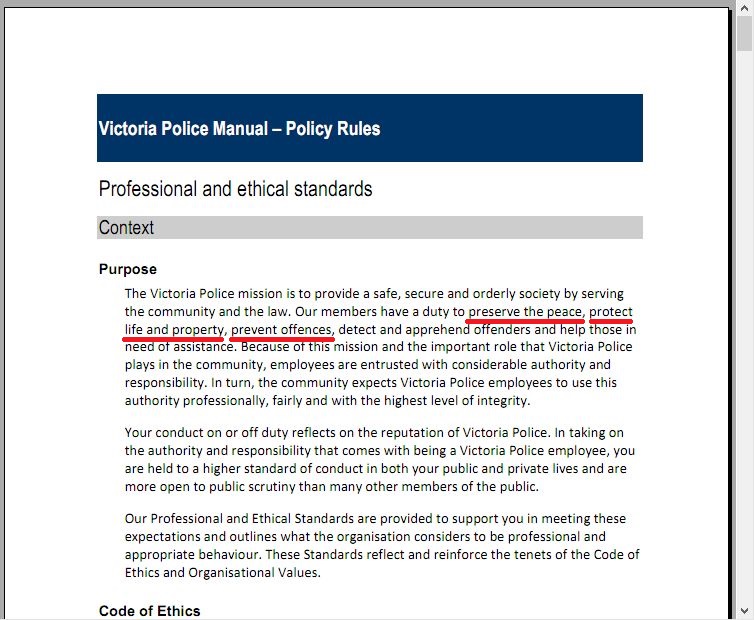
Victoria Police Manual – Policy Rules also states that the 

“members have a duty to preserve the peace, protect life and property, prevent offences…” 

and most importantly “apprehend offenders”, meaning 'persons' that commit criminal offences.

Road traffic offences in this colony are classified as criminal and not civil.


Quite simply put VicPol are going against their “Policy Rules”.

Police and the media go hand in hand in portraying a false narrative that the law comes down hard on dangerous or even unlicenced drivers, but the reality is much more shocking.

Documents have been seen, show that unlicenced drivers that have been caught have not been prosecuted, where even in socking circumstances they have caused accidents, yet have not been pursued by police.

It is also noted that a certain migrant minority is left untouched.

The source requires to be anonymous, as the publishing of any documents may reveal the identity of the person exposing police corruption.

09 July 2025

What police don’t want you to know about speed measuring devices


The colony’s police forces do not act honourably or honestly when it comes to measuring motorist's ‘speed’ or more accurately, velocity.

In Victoria, many officers do this ‘illegally’ where they get away with it in court.

Victorian driver’s get conned by police and the courts and they don’t even know it, as it’s all about the generation for revenue for the government, that’s all.

An allegation of travelling quicker than a predetermined limit is not treated as a civil offence but rather a criminal one meaning the law is stacked up against you from the start.

As always, in a criminal offence the burden of proof, beyond reasonable doubt, is entirely on the prosecution meaning every aspect of the allegation must be proven.

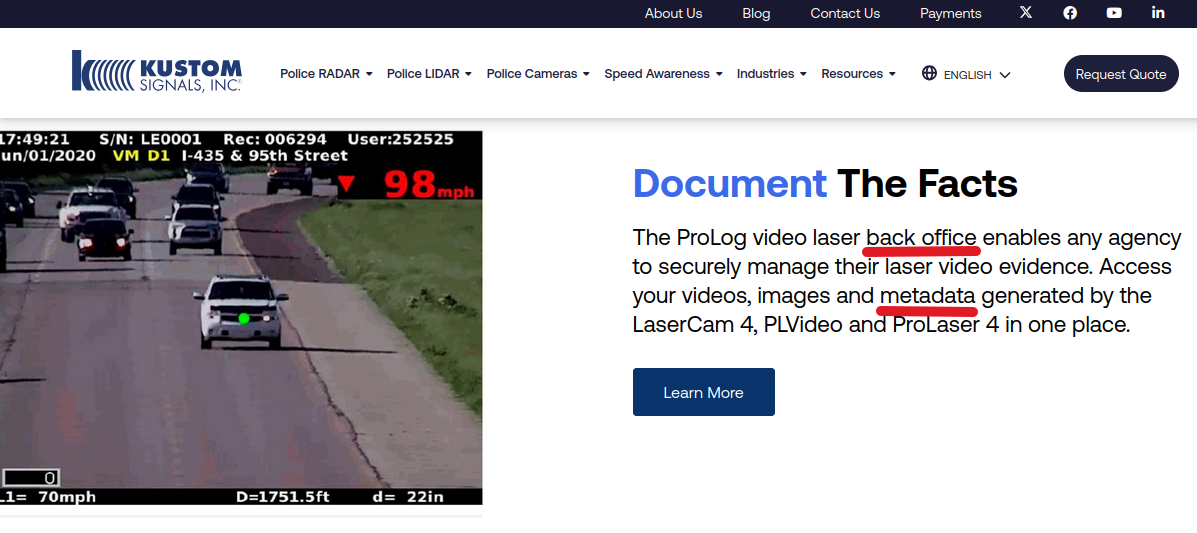
Victoria Police generally use the ProLaser 4 ‘High Performance Handheld LIDAR’ (LIght  Detection And Ranging), distance measuring device from KUSTOM SIGNALS INC, based in the United States.

What Victoria Police does is it conceals evidence if one decides to challenge the allegation of ‘speeding’.

When one recieves a "Preliminary Brief" vital infomration does not get provided to your 'person'.

Even when one request a "Full Brief" that information is also kept from you.

Therefore it is strongly suggested that a supoena is issued for the information.

What is this information?


This information is called 'metadata'.

This metadata is attached to every photo taken of an alledged speedster.

Victoria Police stated in court that the ProLaser 4 can hold 1000 instances of metadata.

This metadata is downloaded at the officer's workplace via the 'back office' through a USB cable plugged into the workstation.

Victoria Police is inherently corrupt, but the bigger problem is that they have the full support of the judiciary in their corruption.

Another aspect of the law that the police don't want you to know about is a little known law from 1984 called the INTERPRETATION OF LEGISLATION ACT 1984, as seen in the screen capture below:

In particular Section 43 which states the following, in relation to the measurement of distances:

In the measurement of a distance for the purposes of an Act or subordinate instrument, the distance shall, unless the contrary intention appears, be measured in a straight line on a horizontal plane. 

Unbeknown to many motorists this law has been in place for 41 years.

Keep in mind that the ProLaser 4 measures distance divided by time, therefore the above law applies.

The metadata from the ProLaser 4, also contains the parameters of taking a measurement at 0 degrees or a 'horizontal plane', and even if the vehicle they surveyed is factually yours.

A significantly high portion of police in instances of handheld and stationary detection do not follow the above mentioned law meaning they take measurements illegally.

Do they know about this law?

Of course they do, just like they know about the 'KABA' ruling from 2013 on random vehicle stops.

So if you're challenging an allegation of 'speeding' don't ask for the documentation, supoena it, meaning fill out a "Subpoena to produce - Form 42B" from the Magistrates Court of Victoria.

25 June 2025

LIES about fuel price, cost before and after US attack on Iran


People in corporations and governments lie to the general population every single day, where the lies will never stop.

Those in government have preplanned agendas that even span decades where the serfs are none the wiser, pity.


On Monday, the 23rd of June 2025, Rupert Murdoch’s publication mentioned that NRMA spokesperson stated that “drivers likely to pay 8 cents more a litre when fuelling up".


One would expect that to be nationwide, albeit a small difference from one state or territory.

On that day, in Melbourne unleaded fuel was 159.9 c/litre as seen by the receipt below, where certain identifying factors have been blocked out:


After the US attack on Iran, the price of fuel from the same supplier skyrocketed, or rather the motorists were bombed with a price of 219.9 cents per litre, as seen in the headline photo above.

That is an increase of 60 cents per litre or a 37.5% price hike.

The good motorists of Australia are being extored to pay for an overseas attack on another country with full support of this by our colonial govenrment.

Australia, the 'lucky' country... NOT!

24 May 2025

Where new traffic cameras are being installed across Victoria.


The government of Victoria is desperate for cash as a result of pissing it all away during COVID-19.

It is also unlawfully taxing its ratepayers for a Covid 'levy', but that is another post for another day.

There are 35 new cameras that are being switched on as part of the of the biggest digital upgrades, as they say, across Victoria's road network.

They say it's for 'safey' but it's not, it's true purpose is for revenue raising.

The cameras target speed and red light (alleged) offences.

As a side note 'owner onus' is not lawfully implemented, where the burden of proof in every aspect is on the accuser, i.e. the prosecution meaning the police.

Ask them to show you the lawful implementation of 'owner onus', in a subpoena.

A new red-light and speed camera located at the intersection of Dandenong and Clayton Roads in Clayton will start over the weekend meaning from the 24th of May 2025.

Camera Sites


Burke Rd & Whitehorse Rd (Cotham Rd), Deepdene (Kew)

Springvale Rd, & Ferntree Gully Rd, Wheelers Hill

Coburns Rd & Barries Rd, Melton

Raglan Rde & Caramut Rd, Warrnambool

Mickleham Rd & Alanbrae Tce (Haddon Hall Dr), Attwood

Seymour St & Argyle St (M1 Princes Hwy), Traralgon

Canning St (Cordite Dr) & Bellavista Dr, Avondale Heights

Dandenong Bypass & Perry Rd, Keysborough

Dandenong Bypass & Chandler Rd, Keysborough

Narre Warren – Cranbourne Rd & Princes Hwy, Narre Warren

Coopers St & Edgars Rd, Epping

Taylors Rd & Arthur St, Keilor Downs

Banksia St & Lower Heidelberg Rd, Eaglemont

Canterbury Rd & Middleborough Rd, Box Hill

Edgars Rd & Main St, Thomastown

Melton Highway & Gourlay Road, Hillside

Ballarat Rd & Station Rd, Deer Park 

Neill St & Lawrence St, Beaufort

Princes Hwy/Dandenong Rd & Williams Rd/Hotham St, Windsor

Stud Rd & Clow St, Dandenong

Pascoe Vale Rd & Somerton Rd, Roxburg Park

Plenty Rd & Metropolitan Ring Rd On-ramp

Keilor Park Dr & Old Calder Hwy / Calder Fwy On-ramp, Keilor East / Park

Wurundjeri Way & Flinders St, Docklands

Plenty Rd & Ambrose Treacy Dr, Bundoora

Mickleham Rd & Rylandes Dr, Gladstone Park

Pascoe Vale Rd & Barry Rd, Coolaroo

Dandenong Rd/Princes Hwy & Westall Rd, Clayton

Springvale Junction, Mulgrave

Dandenong Rd & Clayton Rd, Clayton

St Kilda Rd & Bay St, Brighton

Geelong Rd (Princes Hwy) & Barkly St, Footscray

Ballarat Rd & approximately 40 metres southeast of Marcellin Crt, Deer Park

Ballarat Rd & approximately 40 metres southeast of Meager St, Deer Park

Springvale Junction, Mulgrave

04 October 2024

The Great Aussie Motorist Fuel Rip-off!


Briefly, 

Australian motorists have been getting ripped off by their government and the petrochemical industry for decades, where realistically nothing has been done about it and nothing ever will be.

All that will ever flow out of the government's mouths is lies.

There's ALWAYS an excuse, as in a war here or there.

Why not lay the blame on cow's flatulence or that there is not enough sunshine on the solar farms?

The reality is that the government being a 'stakeholder', profits from high fuel prices therefore it is not in the best interest for so called 'authorities' like the ACCC (Australian Competition & Consumer Commission) or ministers to intervene.

The fuel price shown above is from Melbourne a couple of weeks ago where it went up 45 cents or 27% in one day from approx. $1.65 per litre with zero 'real' reason for it.

It seems that motorists are quite pleased with that price hike, as their silence is acquiescence.

No mass 'protest' about this?

Obviously life is too good in the (penal) colony.

20 June 2024

Corrupt police fining drivers illegally

To say that Victoria Police is corrupt and dishonest is an understatement.

They lie under oath in court without consequences.

They falsify statements with impunity.


This is little piggy is corrupt, issuing speeding fines illegally.


According to the law, the measuring of distance in the velocity (ie distance/time) variable, of a vehicle must be measured in a straight line on a horizontal plane, something that cannot be done when measuring up or down a slope/hill/incline.

This is something that Victoria Police have been doing for decades now, ‘illegally’.

Realistically there should be a class action lawsuit, but there will not be one, that's a guarantee.

Will this illegal action be stopped?

MOST definitely not!

Victoria Police will still keep on deceiving drivers that they were ‘speeding’.

One of the ways to 'deal' with this is to expose the corruption.

That’s life in a colony.

16 June 2024

Credit Score, Social Credit and now Driving Score? WTF? Your Phone is Telling The Insurance Co How You Drive!

A safety feature of the Life360 app tracked the driving habits of Kathleen Lomax and her family, including her daughters, Bridget, left, and Morgan.Credit...Andres Kudacki for The New York Times

You know you have a credit score. Did you know that you might also have a driver score?

The score reflects the safety of your driving habits — how often you slam on the brakes, speed, look at your phone or drive late at night.

While you can see your credit score, you will have a harder time finding out what your driving score is. But auto insurance companies can get it — and that could affect the rate you pay.

For the last two decades, auto insurers have been trying to get people to enroll in programs, commonly called usage-based insurance plans, that monitor their day-to-day driving so rates better reflect the actual risk. But privacy-minded consumers have been reluctant to sign up.

So the industry has taken a different tack, getting data about how people drive from automakers or from apps that drivers already have on their phones. Experts say most people have no idea the insurance industry can track them this way.

After The New York Times revealed that General Motors was sharing driving behavior with LexisNexis, customers filed dozens of lawsuits and the carmaker ended its contract with the data broker. But data is still being collected from other automakers and it is still being collected from apps.

Driving behavior analysis, or telematics, as the insurance industry calls it, could be better for consumers, leading to personalized rates that are more fair. Plus, if people have to pay more for their risky driving, they may drive more cautiously, leading to safer roads. But this will happen only if drivers are aware that their behavior is being monitored.

According to the companies collecting and selling the data, consumers agree to share their information with the insurance industry. But the murky consent process means people may not realize what they are opting into.

“Most consumers are put off by the idea of an insurance company riding shotgun,” said Michael DeLong of the nonprofit Consumer Federation of America.

The smartphone apps collecting driver data may not be obvious at first glance. One, Life360, is used by parents to keep track of their children. MyRadar offers weather forecasts. GasBuddy helps people save on fuel costs.

On GasBuddy, for instance, users can turn on a feature that rates the fuel efficiency of their drives, a feature “powered by Arity.” 

Brandon Logsdon, a spokesman for the company, said users “agree to Arity’s privacy statement before they opt in to the Drives function.”

But this agreement is in small gray font under a big red button labeled “Join Drives.” The tiny disclosure says simply that by clicking “Join Drives” you will share “certain information” with Arity and agree to Arity’s privacy statement, which is hyperlinked. The language does not explain what Arity is or does.

The company sells access to the driving scores of tens of millions of people. Auto insurance companies can “request a person’s individual driving score, which is delivered instantly,” according to Allstate’s website.

The scores “look at drivers’ performance behind the wheel, including how often they brake suddenly, speed or use their phones,” according to an Arity blog post aimed at insurance marketers, and can be used to target potential customers based on “10 different risk categories.”

Last month, Kathleen Lomax, a New Jersey mother who paid $100 annually for Life360 to track her husband and twin 18-year-old daughters, reached out to the company to ask if it was selling their driving data. An automated response, “crafted with the help of A.I.,” told her that Life360 did share driving behavior data with Arity.

“No one who realizes what they’re doing would consent,” said Ms. Lomax, who canceled her subscription.

A spokeswoman for Life360 wrote in an email that “personally identifiable driving data,” for Ms. Lomax and her family, were never shared with an insurance company, that a Life360 member must consent and that Arity was required to “take steps with its partners” to identify Life360 as data source when it was used to generate insurance quotes. In a statement, GasBuddy said Arity provides users “who choose to opt in with personalized offerings and enhanced services.” MyRadar did not respond to requests for comment.

Ms. Lomax ended up canceling her $100 annual subscription to Life360.Credit...Andres Kudacki for The New York Times

When a person shops around for auto insurance, the insurer needs to get consent to have access to the driving data collected by these apps, said Arity’s spokeswoman, Stacy Silver. But how explicit is that request? A spokesman for CSAA, a regional insurer for AAA members that uses Arity’s product in some states, said the consent to use smartphone data happened when it informed consumers that “we may collect third party data and reports.” That is standard language that insurers use to view a credit report, for example, and many consumers may click past it without reading closely.

Companies that create consumer reports are required by the Fair Credit Reporting Act to provide them upon request. Not all of the millions of people in Arity’s database can get their individual driving report, though; the company provides a report to a driver only if an insurance company has requested it as part of a quote.

Not all insurers are using Arity’s driving data. Spokesmen for GEICO and USAA said they collected driving behavior only from people who downloaded a dedicated smartphone app to track how they drove.

Allstate said it planned to “soon offer consumers the choice to get a personalized rate based on their driving history,” as collected by Arity.

Auto insurance pricing is complicated. A number of factors go into determining it, including credit history, gender, marital status, age, what car you drive and where you live, said Dale Porfilio of the Insurance Information Institute, a trade group.

“We are trying to predict the future, which, of course, nobody can know with certainty,” Mr. Porfilio said. “It’s a core tenet of insurance that the price of the policy should reflect the risk of the policy.”

He said the insurance industry had access to lots of data, and he described telematics, when drivers granted access to it, as “just one of the most recent variables that has come into play as a tool to align price to risk.”

One reason it may be particularly appealing right now, Mr. Porfilio said, is that traffic citation data, which insurers have long relied on to predict risk, is not as reliable as it once was. Driving has gotten more dangerous, but the police are giving out fewer tickets, a decline that some attribute to a law enforcement pullback after the pandemic and widespread protests over George Floyd’s death four years ago.

But the bigger appeal of telematics is that it could more accurately predict risk for individual drivers and be a fairer way to set rates. Most insurers will charge a 24-year-old man who lives in a busy city more than a 50-year-old woman who lives in the suburbs, an Arity promotional document states, but what if this particular man is a cautious driver who rarely uses his car while the woman is a road-rager who racks up the miles?

Alan Demers, founder of InsurTech Consulting, predicted that everyone would eventually have a driving score, and that good drivers — which most people think they are — might well prefer it.

“Don’t judge me based on everyone else,” Mr. Demers said. “Judge me based on me.”

On this point, advocates for consumers agree with the industry.

“There’s a lot of unfair discrimination in auto insurance,” Mr. DeLong of the Consumer Federation of America said. “Auto insurance companies use a lot of socioeconomic factors, like your credit score or your job or your education level, like whether you went to high school or to college or whether you’re married.

People with poor credit scores pay much more for auto insurance even if they have clean driving records, Mr. DeLong has found.

“Telematics has substantial promise for consumers, and it could be a way to better price auto insurance,” he said. Still, he had concerns that insurance companies could become overly invasive or use data in ways that lead to new forms of discrimination.

What time of day someone drives, for example, can be tracked. Significant time spent driving at night hurts a person’s score because of poorer visibility and drivers on the road who are more likely to be tired or inebriated. But that, Mr. DeLong pointed out, penalizes people who work the night shift and are more likely to be lower-income workers, such as janitors.

Mr. DeLong also objects to consumers’ being “unknowingly or unwillingly enrolled in these programs.”

Chi Chi Wu, a lawyer at the National Consumer Law Center, raised another concern: The law requires consumer reporting agencies such as Arity to make efforts to ensure that their data is accurate.

“They need to have procedures to figure out when the app is collecting data about you as the driver versus the passenger,” she said.

Ms. Silver, Arity’s spokeswoman, said Arity “uses advanced technology to determine if a person is driving or riding as a passenger.”


Last year, Rob Leathern, a tech executive in Texas, got a seemingly innocuous email from Toyota: “Good news, Robert! You’ve been identified by Toyota Insurance as a safe driver.”

The email promised “big savings” from Progressive and invited him to get a quote for his 2023 Sequoia sport utility vehicle. When Mr. Leathern clicked the link in the email, it took him to a Toyota Insurance website that told him to enter his ZIP code and “get a quote.” If he clicked the quote button, the website informed him, he would authorize a company called Connected Analytic Services to send his contact information, vehicle identification number and “certain vehicle driving data” to Progressive.

Mr. Leathern wanted to know what information was being collected about him. After a month of phone calls, emails and data privacy requests to Toyota and Connected Analytic Services — which turned out to be an insurance data broker — he got a report in January from Connected Analytic Services that detailed the previous six months of driving in his S.U.V. (Corey Proffitt, a Toyota spokesman, said that Connected Analytic Services is a Toyota affiliate that anonymously shares location and driving data with partner insurers, and that customers can manage what is shared about them in the data privacy portal of the Toyota/Lexus app.)

The report had two parts. A driving summary included Mr. Leathern’s mileage, how many times his car’s safety systems had been engaged and the number of times he had braked and accelerated at a rate “that insurers view as harder than necessary for defensive driving.”

There was also a Microsoft Excel file with time-stamped lists of his every offending event and the latitude and longitude for where they occurred. In the speeding tab, for example, there were more than 200 second-by-second entries for the handful of drives during which Mr. Leathern had exceeded 85 miles per hour.

“I had no idea they’d be collecting this data, let alone using it this way,” he said.

Ronald Davis, a spokesman for Progressive, said the insurer got identified driving data from a carmaker only when customers provided explicit consent to use that data to determine their rate.

In a presentation for investors in 2022, Progressive said data about how people drove was improving its pricing accuracy. It included a screen that a potential customer would see when seeking a quote. “Get a personalized rate based on your driving behavior,” the screen read, with a yes-or-no option to “use my existing driving data.”

A 2022 Progressive presentation showed the screen that potential consumers would see to opt in to a program using driving data collected by carmakers (or O.E.M.s, for original equipment manufacturers) to set rates.Credit...Progressive

“When quoting a new policy with Progressive, we specifically inform eligible customers that driving data is available from their vehicle manufacturer and ask them if they would like us to use that data in determining their rate,” Mr. Davis said. He noted that 70 percent of people who had chosen to share their behavior had gotten a discount.

In April, Connecticut’s insurance regulator issued a consumer alert warning that new cars may track people’s driving and affect how much they pay for insurance.

George Bradner, an assistant deputy commissioner at the Connecticut Insurance Department, said his agency supported the use of telematics and the opportunity for people to be rated on how they drove.

But his agency issued the alert because many consumers aren’t aware of the use of the data. He said insurance companies needed to be transparent and disclose the information they were using to rate people.

And consumers, he said, “need to be more vigilant about their protection of their privacy.”


  • Check the privacy settings on your car’s dashboard system and in smartphone apps.

  • If an app connects to your car, or gives you feedback about your driving, that’s a good place to start.

  • In some apps, such as Life360 and MyRadar, you can select this option: “Do not sell my personal information.”

  • Two apps you don’t have to worry about: Google Maps and Waze. Google, which owns both apps, said it doesn’t provide driving data that’s linked to individuals to third parties.

Source:NewYorkTimes

See also:

21 May 2024

“Your licence, please” – Corrupt police, courts and a ‘racist’ judge?


 The Anglo-Masonic government of the colony called Australia has caused and evidently still does cause harm to many ‘ordinary’ Australians, some actions visible while many are not.

The truth is that European migrants or now the derogatory term ‘wogs’ have been bullied, discriminated and degraded also held back from promotions, by Anglos in positions of power, just for being a wog.

A so called ‘judge’ whom people have to refer to as ‘Your Honour’ has lost his (alleged) honourable status, where he showed his true colours towards ‘ethnics’ with vexatious and ‘racist’ remarks, against Mr. Kyriazis.

Realistically, ‘judge’ Geoffrey Chettle (also referred to as judge Shittle, by some) should be removed from office.

IF someone called him by his nickname in court then surely there would be repercussions, a contempt of court perhaps, yet the ‘authorities’ are allowed to be belligerent, abusive and racist?

Abuse of power

So, Mr Kyriazis was found ‘guilty’ on two charges:

1). Failing to produce licence,

2). Give name and address to authorised officer.

There are problems with regards to those two charges.

On the first charge, when seen by the officer, it would have been safe to judge, without a trial by jury, that Mr. Kyriazis is over 26 years of age, where in Victoria a person is not required to carry a driver licence on him/her, as seen within law, that being an excerpt from the Road Safety Act 1986 Section 19, (8):


On the second charge, Victoria Police officers are also very familiar with the ‘Kaba’ cases, that being Kaba v Watson and DPP v Kaba, on the request of giving your name and address to an ‘authorised’ officer.

See reference:

https://policeaccountability.org.au/kaba-decision-on-random-vehicle-stops/

On the first charge, there is zero lawful standing to charge Mr. Kyriazis for ‘failing to produce licence’, where if it has gone through, it is truly a vexatious litigation and a corruption of the court or specifically judge ‘Shittle’, where a judicial review must follow.

This is another exposé of how truly corrupt the legal system really is.

Mr. Kyriazis experienced harassment and degrading behaviour from the judge and as a result causing stress and elevated emotional behaviour.

See link to article from Neos Kosmos

https://neoskosmos.com/en/2018/09/07/news/australia/legal-saga-over-mispronunciation-of-greek-name-kyriazis-as-mr-crazy/


Many experience passive aggressive behaviour from the judiciary, but are unable to recognise this.

08 April 2024

Uber admits breaking the law when it launched in Australia

Rideshare giant Uber has admitted illegally setting up operations in Australia, as it faces a multimillion-dollar lawsuit over claims it used secret spyware to lure drivers to try to “crush” its local rival.

Australian taxi-booking app GoCatch sued the American tech giant over allegations it engaged in corporate espionage and used secret spyware to lure drivers.

Australian taxi-booking app GoCatch sued the American tech company over allegations it engaged in corporate espionage and used secret spyware to lure drivers in a bid to “crush” its Sydney-based rival.

GoCatch, which was once backed by billionaire James Packer and investment banker Alex Turnbull, also alleged Uber was operating illegally when it launched its UberX ridesharing service in several Australian states in 2014.

A Victorian Supreme Court trial was on Tuesday told Uber had for the first time admitted it was breaking the law when it began operations in Australia.

“Uber has been consistently reluctant, in fact, refused to acknowledge this reality that it was illegal,” GoCatch lawyer Michael Hodge KC said in his opening remarks.

“They have done so until this statement of agreed facts.”

Ridesharing was legalised in NSW in December 2015, followed by other states, and Mr Hodge said the court needed to consider the significance of Uber’s 20-month headstart when assessing damages.

Uber is also accused of stealing GoCatch taxi drivers — who were accredited and booked via a mobile app — by employing “Surfcam” spyware which enabled the company to obtain details, including names and phone numbers.

Internal emails reveal then Uber Australia boss David Rohrsheim discussed wanting to “destroy” and “crush” GoCatch before they became “too legit”.  


Uber Australia boss David Rohrsheim discussed wanting to ‘destroy’ GoCatch before it became ‘too legit’. Picture: Neil Duncan

“I got my hands on a list of all GoCatch driver phone numbers. We are aggressively cold calling (without disclosing how we got their number) and won 56 of their drivers,” he said in an email from 2014.

“The inescapable conclusion is that GoCatch in particular is reaching critical mass and we now have a low-cost competitor to deal with,” he said in a different email.

Another employee stated: “Go Catch is *the* reason we’re launching taxi in Sydney. F--k those guys.”

Uber is also accused of misleading regulators, going as far as using an electronic “kill switch” to hide records while a search warrant was being carried out — a claim the company denies. 

GoCatch co-founder Andrew Campbell says it has been a ‘long process’ but he is glad the case has been brought to trial.

GoCatch co-founder Andrew Campbell said it had been a “long process” but he was glad the case had been brought to trial.

“Uber has never accepted responsibility for its conduct towards GoCatch. Uber’s first priority was to win at any cost using any method to destroy us as a competitive threat,” he said in a statement.

“We are fortunate to be in a position to go to Court as we believe that is the only pathway for Uber to be held accountable.”

In a statement, Uber, whose opening remarks are expected later in the trial, rejected any suggestion that it should be liable for the failure of other businesses to adapt to an “emerging competitive landscape”.

 “Uber is a fundamentally different business today than we were a decade ago. Since then, we have made significant changes to our leadership and how we conduct business, taking seriously our responsibility to be a collaborative, contributing industry leader,” it said.

Last month Uber, which is headquartered in San Francisco, settled a $272m class action with 8000 Australian taxi operators amid claims they had lost income after the company began illegally operating in Australia.

The civil trial, which is expected to run for 10 weeks before Justice Lisa Nichols, continues. 

05 December 2023

‘No science’ behind demands for phase-out of fossil fuels


Exclusive: UAE’s Sultan Al Jaber says phase-out of coal, oil and gas would take world ‘back into caves’

Sultan Al Jaber: ‘There is no science out there that says that the phase-out of fossil fuel is what’s going to achieve 1.5C.’ Photograph: Anadolu/Getty Images

The president of Cop28, Sultan Al Jaber, has claimed there is “no science” indicating that a phase-out of fossil fuels is needed to restrict global heating to 1.5C, the Guardian and the Centre for Climate Reporting can reveal.

Al Jaber also said a phase-out of fossil fuels would not allow sustainable development “unless you want to take the world back into caves”.

The comments were “incredibly concerning” and “verging on climate denial”, scientists said, and they were at odds with the position of the UN secretary general, António Guterres.

Al Jaber made the comments in ill-tempered responses to questions from Mary Robinson, the chair of the Elders group and a former UN special envoy for climate change, during a live online event on 21 November. As well as running Cop28 in Dubai, Al Jaber is also the chief executive of the United Arab Emirates’ state oil company, Adnoc, which many observers see as a serious conflict of interest.

Cop28 president refuses to commit to phasing out fossil fuels – video

More than 100 countries already support a phase-out of fossil fuels and whether the final Cop28 agreement calls for this or uses weaker language such as “phase-down” is one of the most fiercely fought issues at the summit and may be the key determinant of its success. Deep and rapid cuts are needed to bring fossil fuel emissions to zero and limit fast-worsening climate impacts.

Al Jaber spoke with Robinson at a She Changes Climate event. Robinson said: “We’re in an absolute crisis that is hurting women and children more than anyone … and it’s because we have not yet committed to phasing out fossil fuel. That is the one decision that Cop28 can take and in many ways, because you’re head of Adnoc, you could actually take it with more credibility.”

Al Jaber said: “I accepted to come to this meeting to have a sober and mature conversation. I’m not in any way signing up to any discussion that is alarmist. There is no science out there, or no scenario out there, that says that the phase-out of fossil fuel is what’s going to achieve 1.5C.”

Robinson challenged him further, saying: “I read that your company is investing in a lot more fossil fuel in the future.” Al Jaber responded: “You’re reading your own media, which is biased and wrong. I am telling you I am the man in charge.”

Al Jaber then said: “Please help me, show me the roadmap for a phase-out of fossil fuel that will allow for sustainable socioeconomic development, unless you want to take the world back into caves.”

“I don’t think [you] will be able to help solve the climate problem by pointing fingers or contributing to the polarisation and the divide that is already happening in the world. Show me the solutions. Stop the pointing of fingers. Stop it,” Al Jaber said.

Guterres told Cop28 delegates on Friday: “The science is clear: The 1.5C limit is only possible if we ultimately stop burning all fossil fuels. Not reduce, not abate. Phase out, with a clear timeframe.”

Bill Hare, the chief executive of Climate Analytics, said: “This is an extraordinary, revealing, worrying and belligerent exchange. ‘Sending us back to caves’ is the oldest of fossil fuel industry tropes: it’s verging on climate denial.”

“Al Jaber is asking for a 1.5C roadmap – anyone who cares can find that in the International Energy Agency’s latest net zero emissions scenario, which says there cannot be any new fossil fuel development. The science is absolutely clear [and] that absolutely means a phase-out by mid-century, which will enhance the lives of all of humanity.”

Prof Sir David King, the chair of the Climate Crisis Advisory Group and a former UK chief scientific adviser, said: “It is incredibly concerning and surprising to hear the Cop28 president defend the use of fossil fuels. It is undeniable that to limit global warming to 1.5C we must all rapidly reduce carbon emissions and phase-out the use of fossil fuels by 2035 at the latest. The alternative is an unmanageable future for humanity.”

Dr Friederike Otto, of Imperial College London, UK, said: “The science of climate change has been clear for decades: we need to stop burning fossil fuels. A failure to phase out fossil fuels at Cop28 will put several millions more vulnerable people in the firing line of climate change. This would be a terrible legacy for Cop28.”

Otto also rejected the claim that fossil fuels were necessary for development in poorer countries, saying that the latest report from the Intergovernmental Panel on Climate Change “shows that the UN’s sustainable development goals are not achievable by continuing the current fossil-driven high emission economies. [There are] massive co-benefits that come with changing to a fossil-free world”.

A spokesperson for Cop28 said: “The IEA and IPCC 1.5C scenarios clearly state that fossil fuels will have to play a role in the future energy system, albeit a smaller one. The Cop president was quoting the science, and leading climate experts.

“He has clearly said that the oil and gas industry must tackle scope 1 and 2 emissions [from their operations], must invest in clean energy and clean technologies to address scope 3 emissions [from burning fuels], and that all industry must align around keeping the north star of 1.5C within reach.

“Once again, this is clearly part of a continued effort to undermine the Cop presidency’s tangible achievements and a misrepresentation of our position and successes to date.”

The spokesperson said the presidency had operationalised the loss and damage fund with more than $700m, launched a $30bn private market climate vehicle, and brought 51 oil companies to agree decarbonisation targets and 119 countries to sign a pledge to triple renewable energy. “This is just the beginning,” the spokesperson said.

Al Jaber is also head of Masdar, the UAE’s renewable energy company, but his appointment as Cop28 president has been controversial. Shortly before the summit, leaked documents showed that the UAE had planned to use climate meetings with governments to promote oil and gas deals. Al Jaber denied having seen or used the talking points in the documents. Adnoc also has the largest net-zero-busting expansion plans for oil and gas, according to independent analysis.

The issue of a phase-out or phase-down is complicated by the terms not having agreed definitions and by the highly uncertain role of technologies to “abate” emissions, such as carbon capture and storage. “Keeping the Paris agreement targets alive will require a full fossil fuel phase-out, not a vague phase-down relying on unproven technologies,” said Otto.

More than 100 African, European, Pacific and Caribbean countries back a phase-out of unabated fossil fuels. The US, the world’s biggest oil and gas producer, also backs a phase-out. Others, such as Russia, Saudi Arabia and China, reject the call. Both options are on the table at Cop28, as well as proposals to only mention coal, or to not say anything at all about fossil fuels.

Cop26 in Glasgow in 2021 agreed for the first time to “phase down” coal use, but this had been watered down from “phase out” at the last minute, bringing the Cop26 president, Alok Sharma, to tears.

In his conversation with Robinson, Al Jaber also said: “A phase-down and a phase-out of fossil fuel in my view is inevitable. That is essential. But we need to be real serious and pragmatic about it.”

“Hold on. Let me just explain,” he said. “The world will continue to need energy sources. We [UAE] are the only ones in the world today that have been decarbonising the oil and gas resources. We have the lowest carbon intensity.”

This refers to the emissions from the energy used to extract fossil fuels, not the far larger emissions from burning the fuels. “There is no such thing as ‘low carbon’ or ‘lower carbon’ oil and gas,” said Otto.

Numerous commentators have said that negative or embarrassing revelations about Al Jaber and Adnoc increase the pressure on him to deliver a strong Cop28 deal. The Guardian reported recently that state-run UAE oil and gas fields had been flaring gas almost daily despite having committed 20 years ago to a policy of zero routine flaring.

The Guardian previously reported that Adnoc had been able to read emails to and from the Cop28 office until the Guardian raised the issue in June and that the UAE had also failed to report its oil industry’s emissions of the powerful greenhouse gas methane.

Harjeet Singh, at Climate Action Network, said: “Cop28 must deliver a decision on phasing out fossil fuels in a just and equitable manner, without any loopholes or escape routes for the industry to continue expanding and exacerbating the climate crisis.”

Cop28: Can fossil fuel companies transition to clean energy?
On Tuesday 5 December, 8pm-9.15pm GMT, join Damian Carrington, Christiana Figueres, Tessa Khan and Mike Coffin for a livestreamed discussion on whether fossil fuel companies can transition to clean energy. Book tickets here or at theguardian.live