13 January 2017

How to deal with the new Australian piracy law


The company called the 'Australian Government' told the mainstream media that there is going to be a crackdown on piracy "Big Time", and in turn the mainstream media passed on this message to the slave population.


This comes literally straight after the peasants were made aware that people in government are defrauding their slave population on a huge scale, more damage than any single 'pirate' ever could do.

So apparently Australia is full of pirates (the "haaar haaar mi maties", type), where one could say that all of them are in government. 

"Why's that?" could ask the beer gut footy lover.

'Cause they're not in office lawfully, nor the company called the 'Australian Government' is the de jure government of the people, as described in a document called 'An Act to Constitute the Commonwealth of Australia' which can be referred to as the Commonwealth of Australia Constitution Act, which is a set of rules for the people in 'government'.

The above mentioned original Act with the proper seal can be downloaded at:

So, you've been accused of a criminal act, an act of piracy they allege. 

You being the astute computer user connected to the internet, use your favourite search engine  (Ford 351 Windsor?) and upon your search query you find that you are pointed to a law called the Piracy Act 11 Will 3 c 7,  at https://en.wikipedia.org/wiki/Piracy_Act_1698.

"WTF!!! !!! !!! " you bleat. 


You have no access to any wooden ship, sword, frilly shirt and you most certainly do not have an eye patch, and are traveling in a fully abled body.

So WTF is this 'piracy' they're on about.

Well, you see a 'pirate' also today is a 'person' who watches a screen with some moving pictures on it, when a corporation holds them to ransom over this thing called time, where they decide you can watch those moving pictures at a later point in time according to your geographical location, while others can view those same moving pictures in their geographical location a lot earlier.

Makes PERFECT sense, right?

So, in a nut shell, a group of people from over the seas (pirates?), tell the lawmakers of this land to punish their slaves for viewing something earlier than they are told by people from over the seas.

So therefore these people from over the seas are discriminating against you because of your geographical location or is it that because you live in a colony of the British empire?

So anyway, what is this law they're talking about?

Well, it's called the Copyright Amendment (Online Infringement) Act 2015 of course, silly.

Law for Dummy Pirates 101

Really, Really briefly; prior to a thought written down on paper becoming a law (Act) the one step lower paperwork is called a Bill, as shown in the illustration below:


Now, in order for a (this) 'Bill' to become law it must obtain 'royal assent' and a few other bits and pieces come into play of that darn thing called paperwork.

We've been shown the reasons why this new law is not actually lawful (as opposed to legal).

Nevertheless in ANY criminal matter, you have the right (and should exercise that right) not to self incriminate, therefore you cannot answer any questions with regards to any accusation of 'piracy' (whatever that means), nor any admissions that your person carried out any actions relating to the operation of any alleged computer equipment.

Have you got the skills to prove that the Copyright Amendment (Online Infringement) Act 2015 is unlawful?

10 January 2017

'Australians ready to revolt' sentiment to be crushed by overwhelming police force?

(illustration: Peasants' Revolt 1381)


In a lecture headed by Noam Chomsky in 1989 of the title The Political Economy of the Mass Media - Manufacturing Consent, available for download at https://www.youtube.com/watch?v=f6JqFtDWfxI (1hr27m, 230MB), Chomsky mentions how two events seem rather remote from one another, whereas in reality you can tie them together to get the bigger picture of an agenda at play.

Over one month ago, in early December 2016, the mainstream media reported that the Government of Victoria is going to recruit approx 3000 extra police in order to combat a rise in violence.

The 'rise in violence' was created by the corporation conglomerate called the government, as it was a result of the government importing a migrant population that has (deliberately?) turned to crime.

Meanwhile, the people in government have created laws and 'loop holes' (pity there are not loop holes for an unlawful 'speeding fine') that allow them an 'age of entitlement' literally for the rest of their lives, even if they are expelled from government positions, as a result of fraud or theft.

So while this is occurring there is a huge financial drain from criminal trash element with the politically correct label of 'refugees' the government has let into the country on the social security purse.

As a result the underprivileged, weak and vulnerable are having their payments cut by the people in government, in order to balance the books for the arrival of the criminal element to be paid welfare payments.

To add further insult to injury, the government has implemented a computer program that falsely states that Social Security recipients owe debts to an organisation called Centrelink.

There are many issues of this type of action being unlawful which are mentioned in the blog post of the headline:
Pay or face the debt collector - what Centrelink the government or the media will not tell you, at
http://corpau.blogspot.com.au/2017/01/pay-or-face-debt-collector-what.html

While the above mentioned events may seem to be remote from one another, they are very closely related, as these actions and policies are carried out by a small group of people in government in order to oppress the masses.

One would not have to be an 'Einstein' or 'Rocket Scientist' to figure out that the serf / tax slave / herd population will have enough.

Warning: Conspiracy theory following;
It could be very easily perceived that the 'government' was fully aware that the people are fed up with the criminal actions of the people in the executive, and the government has prepared a police force to deal with any 'revolt' or rather insubordination of the slaves, under the 'extra police to protect you' banner.

Just another dodgy action buy criminals in power.


So how again are these actions by the people in government for 'peace, order, and good government' (Australian Constitution Act 1900) ???

09 January 2017

Health Minister Sussan Ley just another thief of public funds

Is the only reason Sussan Ley going to allegedly give the funds back is because she got caught?

How can you really trust the people in the executive with 'our' tax dollars?

There is a whole lot more who have not been caught out.

Will she face charges of theft?

Let's see what Australia's finest law enforcement agency will do?

In the mean time here's a meme:


In Australia you can go to prison to lose your life for not paying a fine, where theft from the public purse is rewarded with a big fat pension.

'Straya - The LUCKY country.

07 January 2017

"Terrorism" - Just another excuse to monitor your private and confidential data?


So who's the "enemy of the state" again? Why the people of course, silly!

Are the peasants considered guilty until proven innocent?

So what guarantees do you have that your 'judge' (border security person employed by not a 'government' but rather a company) is fair and impartial?

So how do you know if that thug at the airport is not going to use your social media accounts and passwords for their ulterior motives?

What laws are in place to protect you if a crime has been committed against your person by 'them' (Please post them in comments section)?

'Governments' are renowned for some of the most dodgiest actions known to man.

So how can you trust these people that start wars, operate in tax havens, and do not govern for "peace, order, and good government"?

See what happens when you want to travel to the "land of the free"...

in article from 27 Dec 2016 by theguardian.com of the headline:

US government collecting social media information from foreign travelers


The Customs and Border Protection has previously said it wouldn’t prohibit entry to foreigners who didn’t provide their social media account information. Photograph: Dave Einsel/Getty Images
The US government has begun asking select foreign travelers to disclose their social media activities as part of an expanded effort to spot potential terrorist threats.

The request functions as a prompt on the online Electronic System for Travel Authorization, or Esta, a visa waiver application that many visitors are required to submit before travelling to the US. The choices include platforms such as Facebook, Twitter, Google+, Instagram, LinkedIn and YouTube, and additional space for applicants to input their account names on those sites.

The Customs and Border Protection, which began the program last week, has previously said it wouldn’t prohibit entry to foreigners who didn’t provide their social media account information.
The government has faced a barrage of criticism since it first floated the idea last summer. Privacy rights activists say there are few guidelines about how the information, once obtained, is used or shared with other agencies.

The proposal filed with the US Federal Register states that the collection of social media data was intended to “enhance the existing investigative process and provide Department of Homeland Security (DHS) greater clarity and visibility to possible nefarious activity and connections by providing an additional tool set which analysts and investigators may use to better analyze and investigate the case”.

The Internet Association, which represents companies including Facebook, Google and Twitter, has argued that policy threatens free expression.

Michael W Macleod-Ball, chief of staff for the American Civil Liberties Union’s Washington office, told Politico last week: “While the government certainly has a right to collect some information ... it would be nice if they would focus on the privacy concerns some advocacy groups have long expressed.”

Over the summer, the ACLU and the Center for Democracy and Technology warned that the new request potentially offered government agencies “gateways into an enormous amount of [users’] online expression and associations, which can reflect highly sensitive information about that person’s opinions, beliefs, identity and community”.

The groups warned that the program would “fall hardest on Arab and Muslim communities, whose usernames, posts, contacts and social networks will be exposed to intense scrutiny”.

A spokesperson for the internet privacy group Access Now told Politico the group feared that the choice to hand over social media information was not really a choice at all, and that the program could act as an opaque entry point for more exacting probes.

“The process to enter the US is confusing, and it’s likely that most visitors will fill out the card completely rather than risk additional questions from intimidating, uniformed officers – the same officers who will decide which of your jokes are funny and which ones make you a security risk,” explained Nathan White of Access Now.

Current programmes believed to be deployed by DHS include the ability to scan a limited amount of social media posts.

The US government approves around 10m visa applications a year and had 77.5 million foreign visitors in 2015. Collecting social media accounts for all visitors could produce one of the largest government-controlled databases of its kind almost overnight.

06 January 2017

Pay or face the debt collector - what Centrelink the government or the media will not tell you

Centrelink has been caught out sending out tens of thousands of letters per week falsely claiming debts that their customers have allegedly accrued.

In addition to these false claims, it has now emerged that Centrelink is also unlawfully passing this alleged debt to a debt collector.

What is worse is that the corporation conglomerate called the 'Australian Government' states that the 'problem' does not exist.

Please note that your Centrelink / Social Security payments are inalienable, meaning are unable to be taken away from your 'person'.

They can only [lawfully] deduct funds upon your consent.


See the following law in relation to the above statement:


Social Security (Administration) Act 1999 - Sect 60


 Protection of social security payment
             (1)  A social security payment is absolutely inalienable, whether by way of, or in consequence of, sale, assignment, charge, execution, bankruptcy or otherwise.
             (2)  This section has effect subject to:
                     (a)  sections 61 and 238 of this Act; and
                    (aa)  Parts 3B and 3D of this Act; and
                     (b)  sections 1231 and 1234A of the 1991 Act.

Ref:  http://www.austlii.edu.au/au/legis/cth/consol_act/ssa1999338/s60.html

Also it is stated in the

Social Security Act 1991 - Sect 66

Age pension to be absolutely inalienable
 
66. (1) Subject to subsection (2) and section 1359, age pension is absolutely
inalienable, whether by way of, or in consequence of, sale, assignment,
charge, execution, bankruptcy or otherwise. Payments to Commissioner of
Taxation at recipient's request

(2) The Secretary may make deductions from the instalments of age pension
payable to a person where the recipient asks the Secretary:

   (a)  to make the deductions; and

   (b)  to pay the amounts to be deducted to the Commissioner of Taxation.
        Note: the Secretary must make deductions from a person's pension,
        benefit or allowance if requested by the Commissioner of Taxation -
        see section 1359. 
 
 
Ref: http://www.austlii.edu.au/au/legis/cth/num_act/ssa1991186/s66.html


Also note that you MUST be notified by mail that your debt is being sent to a debt collection agency.

As soon as that happens you MUST write back to Centrelink that you are disputing their claims, where they must provide all paperwork in relation to your matter.

Your dispute may go on for 1,2 or 7 years where in this time the debt collection agency is NOT allowed to take any action against your person e.g bad credit rating etc.

Should any monies be taken from your account where your Centrelink payments are made, then this is theft, where you should follow up with criminal charges against the 'persons' involved or head of the debt collection agency.

Also keep in mind that if your alleged debt is sent to a collection agency, the collection agency 'buys' your debt and you technically do not owe them anything, as you have no valid contract with them.

Your communications method with any of the above entities should be in writing.

Should you choose to speak over the phone you inform the other party that the telephone conversation is being recorded.

Victorians can stop harassing phone calls under 'Brodie's Law'.

People from other states or territories can tell the other 'harassing party' to stop, and take criminal action against the people on the other end of the phone should they continue.

You must take action if you have had an [unlawful] claim of debt against your person.

Throwing the letters in the bin is considered acquiescence by 'silence'.


There is more with regards to 'debt collection' that is not posted here, and it is up to the reader to research this topic thoroughly.

See article from 6 Jan 2017 by news.com.au of the headline:

Aussies panicking over Centrelink demands to pay up to avoid debt collector


Catherine Herir was wrongly told she owed more than $4000, and should start paying it back to avoid debt collectors. Picture: Supplied

DEMANDS for Centrelink payments are putting Aussies under intense pressure, with the Government agency even tweeting the Lifeline suicide helpline number. 
Like many Australians, Catherine Herir, from Brisbane, was sent a letter just last month telling her she owed thousands in overpaid unemployment benefits.

In FY2011 to 12, she claimed benefits after leaving her admin job for full-time study, but Centrelink’s new automated system — introduced in October to claw back money from claimants — had spread her wage across the whole year and calculated she needed to pay back $4500 she claimed while not working.

The 27-year-old told news.com.au she spent a month trying to sort out the issue online, making calls to Centrelink and chasing up old employers from five years ago.

“They suggested that I start a payment plan even before my review was complete to avoid being taken to a debt collector and they would reimburse me later if they found the debt was incorrect, which I refused to do because I knew it was wrong. Maybe that is what they are talking about their ‘recovery success rate’ because people start paying to avoid worse outcomes.

Centrelink has tweeted the Lifeline phone number after several of the vulnerable Australians affected said they were suicidal.Source:News Corp Australia

“I finally had enough and had a lengthy conversation with a Centrelink rep where the phone call went on for over an hour. I wouldn’t take no for an answer, so she did my review manually in minutes and then, sure enough, found I was not guilty at all. Human common sense overriding an incorrect computerised system.

“I was stressed and anxious about the debt and my case was straightforward, I couldn’t imagine any pensioner, person with a disability or illness trying to manoeuvre this system.”

Ms Herir’s ordeal is finally over, after she received a letter today confirming she owed nothing. The young woman is one of the lucky ones. Thousands of Aussies are being forced to pay back welfare payments because of suspected Centrelink computer errors.

News.com.au has been contacted by scores of scared and angry Australians who say they or their loved ones have been falsely accused of owing money to the social security program, and even pursued by private debt collectors. Several said they had begun paying the unexplained debt because of short timeframes given to sort out the mess, but others do not have a cent to spare.

They include people with autism, those in care, a woman undergoing chemotherapy, the elderly and people with other mental and physical disabilities.


Colleen McCormack, 36, said her first thought on receiving the demand for $3000 was of taking her own life.Source:Supplied

‘SUICIDE WAS MY FIRST THOUGHT’

Colleen McCormack, from Melbourne, suffers from chronic pain and has had multiple surgeries that forced her out of her job in the healthcare industry for most of FY2013-14. The 36-year-old told news.com.au that after receiving a Centrelink letter saying she owed more than $3000 she “cried all the way through Christmas”.

Ms McCormack’s documents show she was out of work on sick leave, yet the automated system said her earnings must apply to the whole year, and she was ordered to pay back $3000.

“Having mental health issues, suicide was my first thought,” she said. She wrote back explaining her situation, but two weeks after the initial request, she received a letter from a private debt collection agency demanding payment on behalf of Centrelink. She has now set up a GoFundMe page in a desperate attempt to get financial help.

Independent MP Andrew Wilkie yesterday said he had heard more than 100 complaints from “terrified” people, at least four of whom said they were suicidal.

Centrelink is paying three private debt collection companies to recover money from Australians.

Many have expressed fear and frustration at receiving the letters but being unable to explain their case to a human, with phone lines clogged, branches unable to help and an online system incapable of comprehending nuance and complexities.

Michael Griffin, from Brisbane, told news.com.au on Tuesday that after he was on the dole for three months in 2013, the automated system had gone back and averaged out his earnings for the year, assuming he was employed in those months and therefore owed just over $3000. The 34-year-old filmmaker labelled it “extortion” and calling it “the biggest issue in Australia” right now.


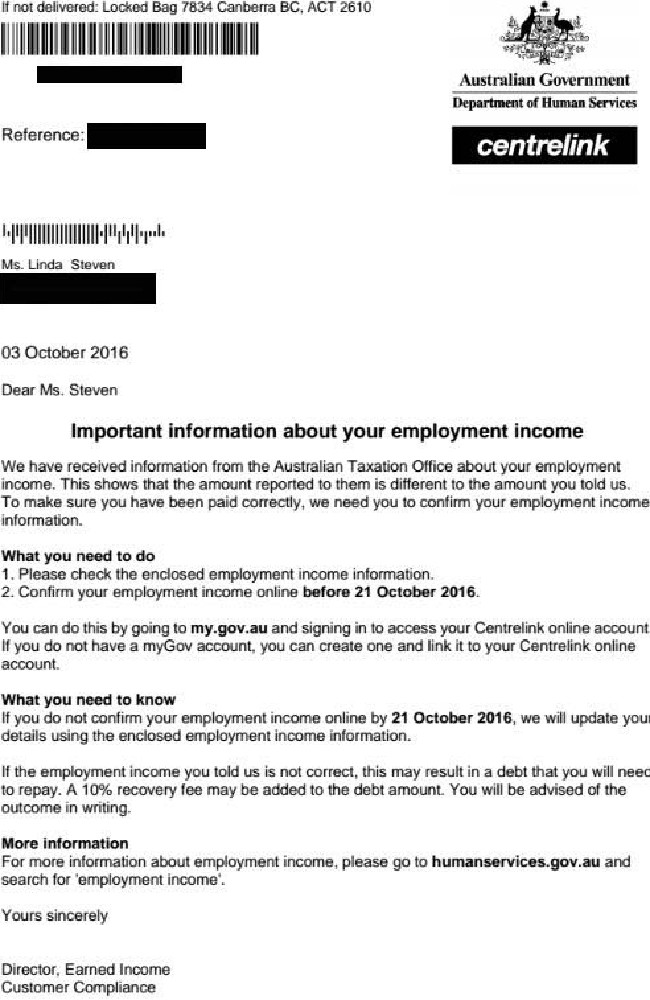
Linda Steven, 64 with a heart condition and high blood pressure, says the stress of being wrongly told she owes $8500 has been overwhelming.Source:Supplied

“I’m wondering if everyone’s going to get these letters,” he said. “It’s preposterous.”

Linda Steven, from rural NSW, was also asked to pay back her welfare payments of $8500 in FY14-15 because the system decided she was in work for months when she was not.

She printed out two years’ worth of her payslips and visited a Centrelink office where staff tried to help her change her employment dates online.

“It was soon discovered they cannot be changed because a debt has already been raised,” she told news.com.au. “The issue now has to go through a full administrative review process. Even though staff can look at my payslips and know I do not owe the money, nothing can be done.

“At almost 64 years old and suffering from high blood pressure and a heart condition I can assure you the stress was overwhelming at first. Not to mention the lengthy phone wait times and expenses.

“In the meantime, payment of the debt must still be made but they reduced the payment
that I must make to the minimum of $15 per fortnight for three months. Three months is the longest time they can reduce it for, and the staff member expressed the hope that my review would take place before then.

“So all the money the Government is hoping to claw back is in fact non-existent in a lot of cases, and is actually costing Centrelink more in trying to sort out the mess.”


Michael Griffin said what was happening was “extortion”.Source: Supplied

‘THESE ARE REAL DEBTS’

The system was brought in three months ago, with the government claiming it would recover $400 million in overpaid benefits owed to taxpayers by retirees, the unemployed, families, carers, parents, people with disabilities and indigenous Australians.

Social Services Minister Christian Porter on Tuesday maintained the automated system was working “incredibly well”. He told ABC radio less than one per cent of review letters had resulted in complaints and said they were not “debt letters” but “polite letters”.

The government has sent out 169,000 of the review letters regarding potential overpayment since July, and Mr Porter said one in five people who received one would not owe a debt.
“In 80 per cent of instances the debt is repayable to the Commonwealth, in the final 20 per cent of instances the matter is resolved, generally speaking, by people simply providing information online,” he said.


Department of Human Services general manager Hank Jongen, who has released his email for people to complain to him directly, told the ABC last night the letters sent out by Centrelink were “not debt letters”, and said there had only been just over 200 complaints.

“I really am surprised that people are seriously suggesting that when we are obliged under the law to recover outstanding debt when it is identified, that we are being asked to stop doing this,” Mr Jongen said. “I think you need to keep all of this in context.”

But Centrelink workers who told news.com.au they wanted to remain anonymous said the program was in chaos.

“The government is just cutting corners, calculating debts fast is their goal, and it’s just wrong,” said one. “Staff morale is so bad everywhere.”

HOW THE DEBT RECOVERY SYSTEM WORKS


The initial “polite letter” asking people to update their details online, in which they are warned of the 10 per cent recovery fee. Source: Supplied

• Centrelink sends people a letter warning of a potential overpayment and asking them to clarify their details online. It will also send an SMS.

ISSUE: Some people have moved or changed phone number and don’t receive the messages.

• You have 21 days from the date of the letter to update online.

ISSUE: Some have complex situations they can’t explain in the online system. Others were told their salary did not match that recorded by the ATO. Upon confirming the ATO salary, the system averaged it out for the year without realising they weren’t earning anything for many of those months. Others found the system recorded them as having two jobs because their employer was recorded under slightly different names by the ATO and Centrelink (e.g. Uni Melbourne and University of Melbourne).

• If there is a concern, you can call Centrelink or visit a branch to speak to someone.

ISSUE: Huge queues at branches, staff telling people to go back online, hours wait on telephone. Some also told news.com.au their jobs prevented them from contacting Centrelink during normal working hours.

• Once you update the information, Centrelink may ask you to provide supporting documentation, including bank statements, letters from an employer or payslips.

ISSUE: Some people no longer have the payslips from in some cases six years ago and/or their former employer no longer exists.

 Centrelink then sends people a notice if it thinks they have a debt. Source: Supplied


The notice comes with this explanation. Source: Supplied


You will also receive an online update — note this $1849 debt comes with a ten per cent recovery fee of $184.Source:Supplied

• You will then receive a letter stating the amount you owe, plus a “recovery fee” of 10 per cent. 

If you do not begin payments within two weeks, you may receive a letter from the debt recovery agency.

ISSUE: You may still believe the decision is wrong but once the debt is raised, you have to begin paying it.


Just two weeks after their payment due, people receive a letter from a private debt collection agency — in this case, Dun & Bradstreet. Source: Supplied

• If you think the decision is wrong you can ask for a review.

ISSUE: The reviews take months, and in the meantime, you may still be pursued for the debt. Some were told to start paying it back and be reimbursed later — but many say they do not have the hundreds of dollars to spare.

Readers seeking support and information about suicide prevention can contact Lifeline on 13 11 14

04 January 2017

Australian Government lies about Centrelink extortion

Approximately a month after the news of Centrelink extorting their 'customers' for debts that they have not accrued has made it into the public arena, Centrelink is still continuing with this action, to the tune of 20,000 letters per week.

What may be considered worse is that the people in the 'Australian Government' are lying, in that they are stating the problem does not exist.

How can you trust a government that provides deliberately false information to the people on such an important matter.

Could you trust this government to provide you with factual / truthful responses on lesser matters?

Centrelink is an unlawfully created 'business', a middle man between the corporation conglomerate called the 'Australian Government' and the welfare recipient.

To make things even worse Centrelink claims that they are above the law, by stating in their brochure that they are "exempt from most subpoenas".

See blog post of the headline:
Centrelink is exempt from most subpoenas - BOLLOCKS !

http://corpau.blogspot.com.au/2015/08/centrelink-is-exempt-from-most-subpoenas.html

How can you trust law makers that enact laws that make businesses above the law?

How is that making a law for "peace, order, and good government"
(page 9 of the Commonwealth of Australia Constitution Act).

If you received an extortion letter from Centrelink, you may want to sue the CEO of Centrelink Grant Tidswell.

It seems that the people in government are bunch of dodgy liars, doesn't it ?

03 January 2017

How secure is your private data on your fingerprint scanning Android phone?


Some companies may have you believe that you should buy a new phone every year.

Why? Is that technology really beneficial to your survival or theirs? Is a software or hardware enabled feature, packaged up in a 'new' phone not a dodgy sales practice?

Alright, alright, so you're a proud member of the brainwashed herd populace and have been conned into purchasing a new 'droid phone with fingerprint scanner from anything between $1200 - $1600 (depending on your resident country's dodgy taxing policy) 'cause you're a wannabe gangsta rapper and have secret stuffs on your droid.

Warning: Conspiracy theory line following;
Smartphones are made with back-doors as mandated by governments against the enemy of the state that being the mass population.

So, here's a screen capture from a piece of software that tells the user how easy it is to open up a 'secure' (pmsl) Android phone.


"Don worry" says Mr. Muppet wannabe gangsta rapper (more like crapper),
"I got mi a finga prin skanna"
It's going to be as useful as a rectal scanner, you moron!

You may have a short span of attention Mr. Crapper, but 'member the "conspiracy theory" from above?

Well, this piece of software reads the fingerprint id where all the user has to do is accept the read value, and they're in.... "simples" (see screen-capture below).


We hear that drug lords prefer the old Nokia GSM phones.

But wait, Australia's telco Telstra has shut down its GSM network on 1 Dec 2016.

Drat! Foiled again!!!

Free consulting note to authorities:
Drug lords less likely to use Telstra?


So how secure is your new Droid with fingerprint scanner?

A brief response (as it's the 'holidays' in 'Straya) - Not very!

Oh well, back to the drawing board for some.

01 January 2017

A government for the people versus one of a colony

The policy differences - a gov for the people -v- a gov of a colony(?):

On BBC World News on the ABC News 24 tv channel, the China24 news outlet stated that in 2016 the Chinese government addressed the problem of people living in poverty where (we say 'allegedly') 10 million people were lifted from poverty, according to the president's message.

The (Chinese) government said it has a long way to go, where there are still 50-60 million people that need help urgently.

MEANWHILE.....

The company called the 'Australian Government' states no such messages nor has any policy that actively (genuinely?) combats homelessness, unemployment, etc, instead it (e.g.) rapes the land of minerals (tax free) and further enslaves the mass population.

It has a 'slave labour' import policy under whatever banner be it 'refugees' / 'hu-man' rights / 457 or other BS visa numbers that ultimately leave the 'Aussies' out of work where further consequences arise.

A primary difference between a government for the 'people' and a government of a 'colony'.

Australia was settled as an economic project, a 'chartered corporation'.

This 'government' is NOT for the people's benefit, never was.

KNOW YOUR ADVERSARY !!! !!! !!!

28 December 2016

How to choose a VPN provider


In recent years the general public has been made aware how governments (read corporation conglomerates) have been acquiring [your?] data.

From web surfing history, online purchases, emails, phone records, texts including their content, literally your entire digital footprint is collected and stored.

Instead of enacting privacy laws that protect the masses governments have ramped up more laws that invade the so called privacy the people may have thought they had once upon a time.

The VPN (Virtual Private Network) is not a new invention, where it could be older than may of the users of social media sites, where in its early days it was associated with a workplace creating a secure tunnel over the internet for workers to communicate securely to their other offices.

In the early days of network hardware encryption companies like Cisco had the market sewn up, but as always, as time goes on, other companies have sprouted up and started to offer those services to the masses.

So how does one choose a company to provide a VPN service to a member of the masses?

Nowadays the above question has a few aspects: a technical one and a political and a legal one.

To make this post as brief as possible we're going to cut straight to the chase, and provide a few basic tips.

The companies to stay away from are the one's who operate in five, nine or fourteen eyes countries which are as follows:

Five: UK, US, CA, NZ, AU
Nine: Denmark, France, the Netherlands, Norway
Fourteen: Germany, Belgium, Italy, Sweden, Spain.

It does not matter what they write in their spiel, about how private they are, it's best to stay away from them.

As an example of government / company lies, a group of companies called the  'Australian Government' has stated that there are three levels of government, that being federal, state/territory and local, see attached photo:


There are only two lawful levels of government: federal and state /territory but alas, this is a digression.

It's good to chose a company that does not store cookies, or use external trackers or have external analytical services.

Third party email is also a weak point, as it can be compromised.

Stay away from companies :

- that keep logs,
- offer only PPTP,
- give out info from "court orders" in "other jurisdictions" (we should know how dodgy they can be).

Run some testing software to see if there are any leaks, or for how long your true IP address masked.

Refer to user forums for technicalities, rather than advertising material alone.


At the end of the day it also comes to trust, in that you trust the company that you are dealing with that they are telling you the truth e.g. that they do not store any logs of your activity.

There is no doubt that there could have been many more words written in this post on this topic.

If you have a shopping list of VPN providers, that can be crossed of from some of the basic info provided here, then you could be on your way into narrowing your choices where you might want to delve deeper into the technical details to make sure that the company is right for you.

26 December 2016

Australians losing privacy rights but snaring a Xmas bargain more important


With almost literally every new law being put into 'force' by the corporation conglomerate called the 'Australian Government' the serfs are being more and more exposed, losing their privacy right's where the rule of Roman law (which is contrary to a founding document called the Commonwealth of Australia Constitution Act 1900);  "Guilty until proven innocent" is coming out of the legal labyrinth into the public eye.

'Dodgy' laws can be put in place when the herd is asleep, for example at 2:30am, or when the footy grand finals are on, or even times of religious / festive season celebrations.

So how do the masses feel about that?

They're not fussed at all, they could not give a stuff.

They just want to survive at the lowest level of existence, (i.e. beer, footy, sex and roof over head) according to Maslow's hierarchy of needs.

No one's telling their government they do not want those laws invading their 'Human Rights' are they?

No one's being vocal to march on parliament to tell the law makers they 'suck' (colloquial term for where something bad might come from).

What the herd want is a real shopping bargain after Christmas on a day called Boxing day.

Just another distraction created by the corporation conglomerate to keep the herd populous occupied.

Just another 'Police State' law coming into action, on this colony of the British empire.

The 'government' states that it enacts the will of the people (not the 'minority' but rather the herd populace), and since the herd love their 'shopping' the corporation conglomerate gives them plenty of 'bargains', staying 'honourable' (cough cough) to their words...

Note: 

You may want to research if Australia's current Attorney-General George Brandis is in office 'lawfully'.

P.S. Also note the word from the headline being 'could'..

See article from 22 December 2016 by the Fairfax publication of the headline:

Australians' phone and email records could be used in civil lawsuits

Australians could have their private phone and email records used against them in civil litigation cases, with the federal government considering relaxing data retention laws.

Critics say it would pave the way for phone and email records to be mined for material to be used in legal action following marriage breakdowns and business disputes.

Many experts have warned that personal phone data could be mined for civil lawsuits. Photo: SeongJoon Cho
 
The Communications and Attorney-General's departments quietly announced they were conducting a review of national data retention laws five days before Christmas.

As part of the review, the departments are seeking feedback on whether there are particular kinds of civil proceedings, or other circumstances, in which prohibitions on metadata being released could be relaxed.


Attorney-General George Brandis said the mandatory metadata retention regime ''applies only to the most serious crime''.  Photo: Alex Ellinghausen
 
The review has alarmed technology experts, many of whom warned that personal data could be used for civil lawsuits when data retention laws were first introduced.

"The plan to use the data in civil cases is an outrageous overreach and goes against the safeguards initially introduced," technology and law expert Angela Daly, of the Queensland University of Technology, said. "Data retention should be rolled back, not extended."

Internet law expert John Selby, of Maquarie University, said the review raised the possibility that data retention laws, initially justified on national security grounds, could grow to include measures well beyond their original intent.

"Such provisions may have seen even stronger public resistance to the law if they had been included at the time," Dr Selby said.

Since October last year, Australian telcos such as Telstra and Optus have been required to store metadata logs of people's email, internet, mobile and landline use for up to two years. The contents are not recorded.

The Coalition used the threat of terrorism to justify introducing the laws in 2014, vowing that people had nothing to fear from their introduction.

"The mandatory metadata retention regime applies only to the most serious crime – to terrorism, to international and transnational organised crime, to paedophilia," Attorney-General George Brandis told the ABC in 2014.

But the Communications Alliance, which represents Australian telecommunications companies, the Law Council of Australia and others warned that stored data could become a target for civil litigants and those with malicious aims.

Communications Alliance chief executive John Stanton told a parliamentary committee last year: "Our concern is that ...[it] may generate a tsunami of action in commercial disputes, in marital disputes and in many other cases where the data is being mined."

A spokeswoman from the Attorney-General's office said that as part of the data retention laws, there would be a prohibition on courts releasing telcommunications data to be used in civil legal proceedings, which would take effect in April next year.

However, she said, the review would consider whether there should be exemptions to this, and pointed out a parliamentary committee last year said there were some circumstances, including international abductions or family violence cases, where having access to metadata could be valuable.

The committee recommended the government review the "exclusions" from access to metadata by April 13, 2017.

While there were already provisions in the Telecommunications Act that allowed telcos to be compelled to produce data relating to court proceedings, this only applied in criminal cases, Deakin University criminology lecturer Adam Molnar said.

"One has to be concerned about the recent call for submissions over the holiday period - it's hardly fulsome conditions for informed debate," he said. "And extending this into civil litigation is potentially opening up a whole new can of worms."

Submissions can be made to the review by January 13.