24 December 2022

Meta agrees to pay $725mn to settle Cambridge Analytica case

Proposed figure would be largest settlement achieved in a US data privacy class action and biggest paid by Facebook parent.

Meta said in a statement: ‘We pursued a settlement as it is in the best interest of our community and shareholders’ 

Meta has agreed to pay $725mn to settle a class-action lawsuit that claimed that the social media giant, which owns Facebook, Instagram and WhatsApp, allowed third parties to access users’ personal information.

The proposed amount would be the largest settlement achieved in a US data privacy class action, and the most Meta has ever paid out in a lawsuit, revealed in a court filing released on Thursday.

The long-running case was prompted by the Cambridge Analytica scandal in 2018, where a company whistleblower revealed that Facebook allowed the British political consulting firm to access the personal data of up to 87mn users. However, the class action lawsuit expanded the remit to include other third parties that may have inappropriately used Facebook data.

Meta’s settlement, which does not admit any wrongdoing, comes with the company hit by the slowest growth in revenues since going public amid fierce competition from social media rivals and a slump in digital advertising.

Last month, the social network led by chief executive Mark Zuckerberg cut 11,000 staff, about 13 per cent of its workforce, as part of cost-saving measures and recently reduced office space in the UK and US.

The class action lawsuit claimed that the company had allowed app developers and business partners to access users’ data without their consent. The estimated number of people affected in the case is between 250mn and 280mn people, representing all US Facebook users between 2007 and 2022, the filing said.

Meta said it had revamped its approach to privacy over the past three years. “We pursued a settlement as it is in the best interest of our community and shareholders,” it added in a statement.

Digital rights campaigners and whistleblowers previously accused Cambridge Analytica of using harvested personal data to influence the results of the UK’s EU referendum and the 2016 US presidential election and breaking campaign rules.

Meta paid a £500,000 fine to the UK’s data watchdog over Cambridge Analytica, which found no evidence that it misused data in an attempt to influence the Brexit referendum or help any Russian intervention in political processes but that it had failed to protect the personal information of its users.

The tech giant has also paid $5bn to resolve a US Federal Trade Commission probe into Meta privacy practices and $100mn to settle a US Securities and Exchange Commission investigation over claims it misled investors about the misuse of user data.

Multiple investigations by US state attorneys-general are ongoing.


Source:ft.com

20 December 2022

Royal Assent to Legislation

Royal Assent to Bills:

The Constitution requires legislation to receive "royal assent", by the Governor-General as the Sovereign's representative, or by the Sovereign directly.

See further details within email:


See Section 58 from the 'Commonwealth of Australia Constitution Act':


Please also note that in Victoria, a body called 'SARC' (Scrutiny of Acts and Regilations Committee) checks to see that the bills brought forward comply with a law called the Charter of Human Rights and Responsibilities Act 2006.

The Committee also scrutinises regulations and legislative instruments pursuant to sections 21 and 25A of the Subordinate Legislation Act 1994.  

All new law brought into Victoria from 2020 with regards to a particular health event must have passed through SARC and given the green light with regards to Human Rights, where it must be signed off.

Victorian Premier Daniel Andrews, Human Rights abuser:

From 2020 Victorian premier Daniel Michael Andrews began a human rights abuse campaign.


He even stated that people's views about human rights has "no basis on science, fact or law"

So, how does the Victoiran Equal Opportunity and Human Rights Commission fell about that?

Don't tell SARC about that either.

https://new.parliament.vic.gov.au/get-involved/committees/scrutiny-of-acts-and-regulations-committee/

And the law was thrown under a bus too?

https://www.legislation.vic.gov.au/in-force/acts/charter-human-rights-and-responsibilities-act-2006/015


Indiana sues TikTok citing safety and security concerns

Indiana sues TikTok, claiming it exposes children to harmful content.

Indiana’s attorney general sued TikTok on Wednesday, claiming the Chinese-owned company exposes minors to inappropriate content and makes user data accessible to China, in one of the strongest moves against the social media giant taken by a state.

Indiana’s lawsuit is the latest move to put TikTok and its parent company under scrutiny. As U.S. officials have sought to regulate TikTok, the platform in recent years has come under sharp questioning in Washington and been under investigation by a bipartisan group of attorneys general for its potential effects on youth mental health, its data security and its ties to China.

Filing two lawsuits in a state superior court, Indiana Attorney General Todd Rokita (R) argued that everything including people’s interests and their facial features are potentially accessible to the Chinese government. The suits claim that TikTok and its Beijing-based owner, tech giant ByteDance, have deceived consumers about their data security and suitability for young teens.

One suit alleges that China could use the vast amount of American consumer information tracked and collected by TikTok in the name of its own national security or “to spy on, blackmail, and coerce” users. The suit echoed long-standing U.S. government concerns that China could access American user data through ByteDance.

As Washington wavers on TikTok, Beijing exerts control

TikTok and ByteDance have also misled consumers about how safe the app is for children, Rokita’s office claims in the second lawsuit. The state’s court filings dispute the app’s 12-plus age rating and “infrequent/mild” designation for content about sex, drugs, alcohol and violence in Apple’s App Store.

Not only are entire corners of TikTok dedicated to trends and songs that involve sexual content, the suit argues, but the app’s autocomplete search feature and video-suggestion algorithm mean explicit clips are often recommended to users who may not even search for them. Sexually explicit content is banned by TikTok, but users often change one letter in a word to get around those rules.

“At the very least, the company owes consumers the truth about the age-appropriateness of its content and the insecurity of the data it collects on users. We hope these lawsuits force TikTok to come clean and change its ways,” Rotika said in a statement.

Home to millions of users, viral clips and a culture-shifting algorithm, the platform has captured two-thirds of American teens, a quarter of whom say they’re on the video-sharing app “almost constantly,” a Pew Research study found in August. The app’s unique “For You” algorithm learns a user’s tastes and then feeds video after video, sometimes with an accuracy that stuns users.

Why lawmakers are not buying assurances from TikTok on China

As the app has become a cultural phenomenon, U.S. policymakers have raised concerns about privacy and data, children’s online safety and national security. TikTok executives have said the app does not share information with the Chinese government and have attempted to quell fears from members of Congress about national security and transparency.

The company has said the data it collects is not stored in China and is not subject to Chinese law, claims disputed by Indiana in the lawsuit.

TikTok spokesperson Brooke Oberwetter said in an emailed statement to The Washington Post on Wednesday that “youth well-being” was part of TikTok’s policies, including age-limited features and tools for parents to control what children view.

“While we don’t comment on pending litigation, the safety, privacy and security of our community is our top priority,” Oberwetter said. “We are also confident that we’re on a path in our negotiations with the U.S. Government to fully satisfy all reasonable U.S. national security concerns, and we have already made significant strides toward implementing those solutions.”

The suits came amid steps by other states to limit TikTok’s access to their data. Also on Wednesday, Texas Gov. Greg Abbott (R) ordered state agencies to ban their employees from using the app on any government-issued devices. That followed similar directives last week in South Dakota and Maryland.

A TikTok spokesperson told The Post this week that state officials’ concerns “are largely fueled by misinformation about our company.”

The growing pushback against TikTok has included competition from fellow social media behemoths. Meta, which owns TikTok rivals Facebook and Instagram, hired a major Republican consulting firm to conduct a campaign to turn public opinion against TikTok, partly in a bid to distract from scrutiny of Meta, The Post found in March.

Facebook paid GOP firm to malign TikTok

Indiana’s lawsuit argues that TikTok “routinely exposes” consumers’ data “to access and exploitation by the Chinese Government and Communist Party,” partly through ByteDance’s ownership of the app, and misleads users about how safe their data is. Rokita’s office argues that TikTok’s assurances that data is not being sent to China are false, saying the data the app collects can be accessed by people and companies subject to Chinese law, including ByteDance.

“While TikTok vacuums up reams of this highly sensitive and personal information about Indiana consumers, it deceives and misleads them about the risks the app routinely poses to their data,” the state’s complaint says, later concluding: “TikTok is a wolf in sheep’s clothing.”

At the same time, TikTok, which requires users to enter an age of 13 or older to create an account, has short videos on everything including hallucinogenic mushrooms and bondage. The lawsuit cites lyrics of various popular songs, such as Cardi B’s hit “WAP” and dance moves including twerking as evidence that the platform contains content inappropriate for young teens.

Just typing the first two letters of certain TikTok trends will bring up search prompts for explicit content, the suit notes, often offering videos categorized under tags that are misspelled to avoid triggering the app’s content bans. Further, a mode in the app meant to restrict younger users from seeing vulgar videos is ineffective, still serving sexual content in response to searches, the Indiana attorney general’s office argues.

“TikTok intentionally falsely reports the frequency of sexual content, nudity, and mature/suggestive themes on the TikTok platform to the App Store because TikTok wants to keep and increase young users’ engagement with the TikTok platform,” the complaint says.

The lawsuit also raises concerns about how the platform polices videos related to child pornography, rape fantasies and abuse. Citing a Forbes investigation, the state alleges that users get around TikTok’s policy banning sexual or exploitative content by uploading content showing child sex abuse to private accounts and then distributing the log-in information so others can log in and view it.

On its website, TikTok says it is “deeply committed to ensuring the safety of minors” and prohibits any videos relating to child sexual exploitation or endangerment. Such videos are “subject to intervention from law enforcement,” the company says.

Drew Harwell contributed to this report.

Source: washingtonpost.com

19 December 2022

Windows 11 v 10 resource use

As time goes on Microsoft continues to data mine your computer use via its spyware tool marketed as an operating system called Windows.

Telemetry, phone home, backdoors, keylogging, etc have become more prevalent as the numbers rise in the version of Windows.

Here is a comparison of a version of Windows 11 that user’s computers comes preinstalled with that you must pay for, even if you do not want this product.

After a few minutes of ‘settling down’ the user’s/person’s personal computer uses 3.3 GB of RAM, 127 Processes, 1294 Threads and 44381 Handles


Noting also that the CPU (Central Processing Unit) idles at 1.53Ghz.

Windows 10 from 2019, shows a much leaner picture.


Processes are at 89, Threads at 719 and Handles at 27017, while only using 1.3GB of RAM.

Also the processor is working less harder at 1.02Ghz.

What sort of sloppy programming or how much spyware is in the extra 2GB of RAM?

Microsoft's archaic programming practice is based on a 50 year old language C, and its newer C++, where it even acknowledges that 70% of vulnerabilities stem from this.

If you’re serious about privacy and a more efficient operating system with no bloatware then Linux should be considered.

It’s so good that even Microsoft uses it instead of its own proprietary, closed source server operating system.

We do not recommend the use of Microsoft products, where even it’s Office Suite is irrelevant in today’s computing world.

Keeping in mind that Windows 8.1 used:


33 Processes, 460 Threads and 10630 Handles, while only using 1GB RAM.

17 December 2022

Microsoft should be in the courts re: limiting your program use/choice

Using Microsoft’s Windows product is a sure way to have your computer life being monitored where data is collected and passed on to other entities.

If you value your computing privacy, then alterative operating system such as Linux may suit your purpose.

But there is a huge problem with that, being that Microsoft is actively destroying the open-source community.

What’s also concering is the new trend by manufacturers to have ‘users’ or ‘consumers’ to subscribe to their services where previously there was no such demand from the consumer with regards to hardware, software or even vehicles.

Microsoft is acting in an anti-competitive manner, being detrimental to other software organisations, therefore stifling progression and should be sued in the courts.

See further details within:


15 December 2022

Wireless keyboards a privacy and security risk

When it comes to security many people may mention internet connections, WiFi, passwords etc.

But one of the important and overlooked aspect is the input devices or HID (Human Interface Device) as the computer likes to have it named, such as the mouse and keyboard and why not throw in a (electronic) pencil while you're at it.

Before chosing your next wireless combo, it may pay to see if the transmission is encrypted between the USB dongle and the input device.


You may want to look at something that has AES 128bit encryption


If you're after true peace of mind, then good a ol' trusty wired connection would suffice.

12 December 2022

Killer drones to be release on general population by police

This policy coming to the police state of Australia too?


The San Francisco Board of Supervisors will vote soon on a policy that would allow the San Francisco Police Department to use deadly force by arming its many robots. This is a spectacularly dangerous idea and EFF’s stance is clear: police should not arm robots.

EMAIL YOUR SUPERVISOR: don't let SFPD arm robots 

Police technology goes through mission creep–meaning equipment reserved only for specific or extreme circumstances ends up being used in increasingly everyday or casual ways. We’ve already seen this with military-grade predator drones flying over protests, and police buzzing by the window of an activist's home with drones.

As the policy is currently written, the robots' use will be governed by this passage:

 “The robots listed in this section shall not be utilized outside of training and simulations, criminal apprehensions, critical incidents, exigent circumstances, executing a warrant or during suspicious device assessments. Robots will only be used as a deadly force option when risk of loss of life to members of the public or officers is imminent and outweighs any other force option available to SFPD.”

This is incredibly broad language. Police could bring armed robots to every arrest, and every execution of a warrant to search a house or vehicle or device. Depending on how police choose to define the words “critical” or “exigent,” police might even bring armed robots to a protest. While police could only use armed robots as deadly force when the risk of death is imminent, this problematic legal standard has often been under-enforced by courts and criticized by activists.

The combination of new technology, deadly weapons, tense situations, and a remote control trigger is a very combustible brew. 

This occurs as many police departments have imported the use of robots from military use into regular policing procedures, and now fight to arm those robots.

In October 2022, the Oakland police department proposed a similar policy to arm robots. Following public outrage, the plans were scrapped within a week. 

The San Francisco Board of Supervisors will be voting on whether to pass this bill on first reading at their November 29, 2022 meeting, which begins at 2pm. You can find an email contact for your Board of Supervisors member here, and determine which Supervisor to contact here. Please tell them to oppose this. Here's text you can use (or edit):

Do not give SFPD permission to kill people with robots. This broad policy would allow police to bring armed robots to every arrest, and every execution of a warrant to search a house or vehicle or device. Depending on how police choose to define the words “critical” or “exigent,” police might even bring armed robots to a protest. While police could only use armed robots as deadly force when the risk of death is imminent, this problematic legal standard has often been under-enforced by courts and criticized by activists. For the sake of your constituents' rights and safety, please vote no. 


Source:eff.org


10 December 2022

Government Gazette Sheriff of Victoria

At law, the sheriff of any Australian state is an officer of it’s Supreme Court, and therefore must be gazetted as such.

Some people may even claim the now there is no such need, where a reference to the lawfully enacted legisation would be appreciated in the comments section of this post.


The position must also be ‘advertised’ as such.

In the case of Victoria, the Supreme Court obtains its power from the Supreme Court Act 1958 or is it 1986, which at the end of the day is subject to Chapter III of the Commonwealth Constitution Act.

Most people should know by now that the governments within Australia are corrupt to the core, not transparent, deceitful and plain and simple not ’honourable’ including people within the judiciary, that being the staff within the courts, including judges, magistrates, judicial registrars and also police and last but not least the so called sheriff (and his deputies).

The so called sheriff of Victoria has not been gazetted for quite some time, but for the purpose of this post, the period being looked into is from 2013 onwards.

For those reading this who are not from Australia, the sheriff is responsible for acting on alleged debts to the state or even corporations such as banks, which entails seizing of property, basically a glorified debt collector.

There is only one alleged sheriff per state where the rest are so called deputies.

Please note that , if there is no lawful appointment of a sheriff, there can be no lawfully appointed deputies.

In 2013, a person by the name of Mr. Brendan Facey assumed the position of the Sheriff of Victoria.


There was no lawful appointment nor gazetting of Mr. Facey (shown above) as the sheriff.

After Facey, the alleged sheriff was a Mr. Warwick Knight, where no public image is available, let alone any lawful appointment as an officer of the Supreme Court of Victoria nor any gazetting.


In correspondence, the government has stated that in 2022, the so called Sheriff of Victoria is a Ms. Julie Brown, as seen in excerpt below.


While a simple online search nets no results, neither does any reference to a Ms. Julie Brown within any government gazettes.

MANY people may be aware that the mainstream media’s focus on the actions of the sheriff pertain to action arising from unpaid traffic Infringement Notices, where warrants must be produced for the sheriff to act upon.

The so called sheriff also acts on other seizures, namely that of real estate for banks and 'financial institutions'

It has been established that there are no warrants arising from 'Infringement Notices' for the so called sheriff to act on, they do not exist, period.

See hidden video within Fines Victoria at 277 William St, Melbourne Victoria 3000:


Since there is no lawfully appointed sheriff in the above mentioned period and there are no lawfully issued warrants, there cannot be any lawful seizure of property by persons who identify themselves as a sheriff or deputy.

Please note Section 182 of the Supreme Court of Victoria 1958:

This is an expose of a multi billion dollar fraud against Victorians, which the authorities are keeping a secret and deceiving any and all who try to stand up against a fraudulent government.

See also:

Tasmanian magistrates not sworn in correctly for 30 years

Has the Supreme Court of Victoria been validly established?

Supreme Court Act 1958:

http://www.austlii.edu.au/au/legis/vic/hist_act/sca1958183.pdf

Supreme Court Act 1986:

http://classic.austlii.edu.au/au/legis/vic/consol_act/sca1986183/

Three ‘baseline’ Acts that define Australia’s legal framework are:

The Commonwealth of Australia Constitution Act 1900 (UK)

(The original Australian Constitution Act, passed by the British Parliament in 1900, presented to Australia ninety years later)

See: https://www.foundingdocs.gov.au/item-sdid-82.html

The Acts Interpretation Act 1901

See: https://www.legislation.gov.au/Details/C1901A00002/e5a7d8d8-06ac-41d9-a8ba-8ac57ecd1a40

The Judiciary Act 1903

See: https://www.foundingdocs.gov.au/item-sdid-92.html

Australian states are realistically warrant-less states.

09 December 2022

The lies and marketing hype of SSD manufacturers


Hard disk manufacturers NEED you to purchase their new products at the (high) introduction price in order for you to sponsor their R&D departments.

They will quote insane read speeds that are literally useless for 99% of the people they are reaching.


They will quote drives that are specficially designed for gamers or creators, which again is marketing BS.

The imporatant information that 'real' consumers need may be hidden from them in technical data sheets as opposed to front page advertising specs.

Quite simply put, you are being misled by the high sequential 7000MB/s read and 3000MB/s write speeds, where the more important figures that of random read and write numbers (as tested in PC Mark10 Quick Benchmark) or drive longevity need to be read with glasses on.

See more information within the videos by:

Tech Notice:


Linus Tech Tips:


For drive comparisons see:


04 December 2022

How unique am I on the internet?

There are many ways authorities can idenify you on the internet.

Your device's MAC (Media Access Control) address, your IMEI (International Mobile Eqipment Identiy) or IMSI (Internatonal Mobile Subscriber Identiy) numbers and the old favouraite your IP (Internet Protocol) address, which may as well be obselete by now.


In order to interact with the internet, one must use a browser, and browsers give away a LOT of information about your hardware and software choices.

Browser fingerprinting has been around for quite some time now.

Every single parameter, at least 60, about your hardware and software can be read and used to identify you.


From screen size, graphics card, keyboard layout to even if your menu bar is visible are all used against you.

Image source:privacybee.com


Maybe if everyone used a browser add-on called Chameleon, then we would be lost in a sea of penguins.

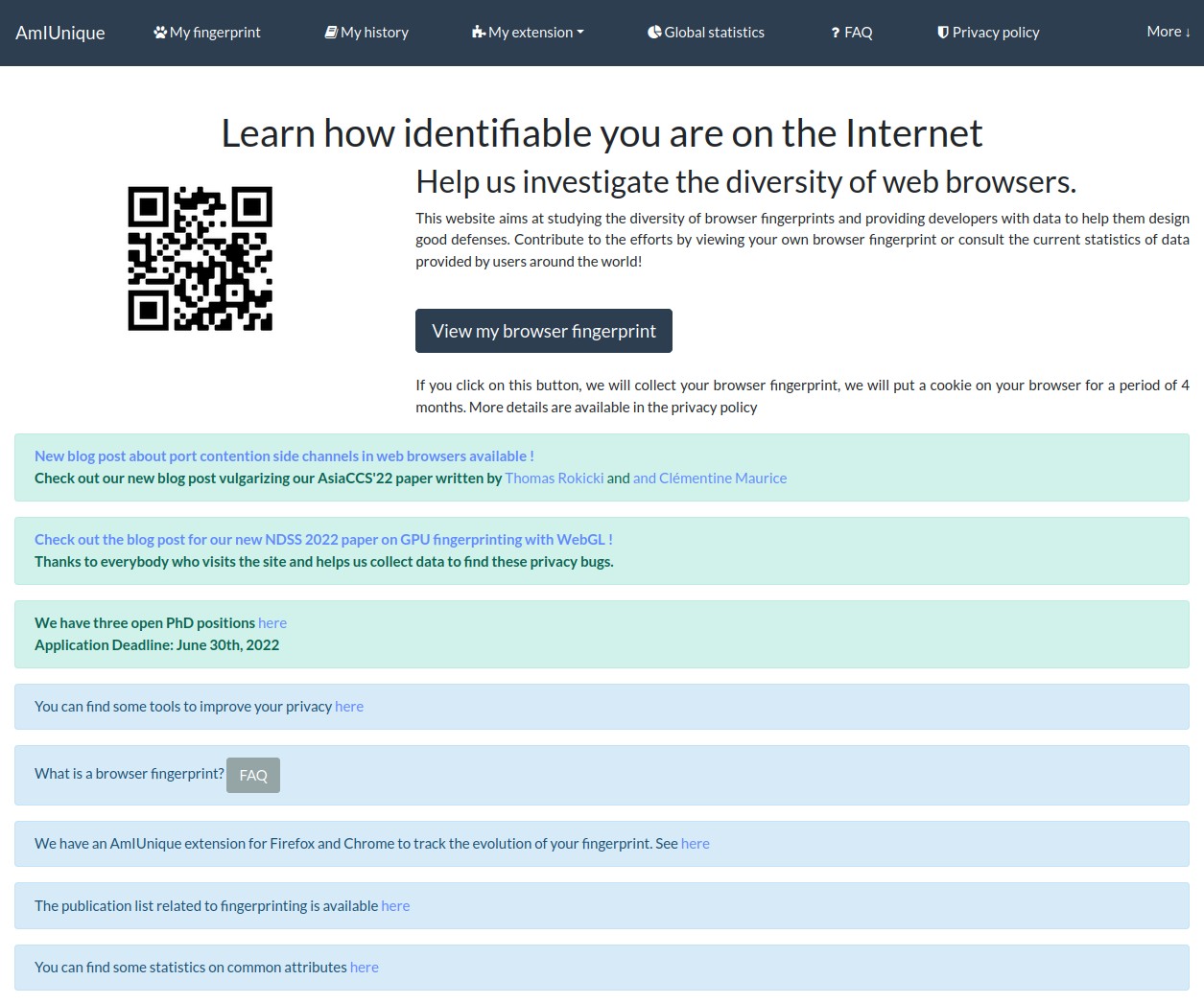
So how unique are you really? See: https://amiunique.org/