04 June 2022

The EU seems almost ready with the bill that would force all phones to use USB-C (including iPhones)


For years we have heard talks about the European Union enforcing a common charging port for all phones, even tablets and headphones. Reuters now reports that those talks are probably about to become reality, citing unnamed sources.

EU to reach deal for a common charging port on June 7


Oh my - we may finally be witnessing the end of the Lightning port (at least in Europe), if the proposal for a common charging port gets finalized and accepted as law. As you may already imagine, the common charging port will be USB-C.

On June 7, EU member countries and EU lawmakers are reportedly going to meet and discuss the proposal in question. You may have heard (or you may suppose, rightfully so) that Apple has been criticizing this proposal.

It may come as a surprise to some, but this single mobile charging port proposal was first introduced by the European Commission more than a decade ago. Its introduction was due to iPhone and Android users complaining about having to use different chargers for their phones.

And it seems this proposal is on its way to become law. According to Reuters' sources, next Tuesday will mark the final meeting between EU countries and EU lawmakers on this topic. One of the issues is whether or not to include laptops to this proposal. If this happens, it may impact Samsung and other device makers as well.

On top of that, EU lawmakers are striving to include wireless charging systems to be 'harmonised' by 2025, but some EU countries and the European Commission demand a longer period for technical reasons.

As for Apple, the company has previously criticized this proposal, underlining that if the proposal becomes law, it could cause more electronic waste. Why? Well, such a law could cause iPhone users to ditch their current Lightning accessories. Additionally, forcing users to change to new chargers would also create a mountain of e-waste.

But Apple may actually be moving towards USB-C connector anyway. Recent rumors about the iPhone 15 (yes, the iPhone 14 is not yet out, but nothing stops rumors about the iPhone 15 to surface anyway) indicate the 2023 iPhones may ditch the Lightning connector in favor of USB-C.


01 June 2022

Victoria the secretly ruled totalitarian police state

Victorians are ruled in secret without any transparency by a totalitarian régime claiming that there are not enough police.

Well that depends on what you as a government want to do.

If you 'just' want to keep the peace, then there are enough officers to service the civilian population. 

But if the government was to lock the population down in some point in time in the future, then there is not enough.

Excessive force is a normal modus operandi of Victoria Police.

Above illustration: ViPol using excessive force on a disability pensioner while laughing at him.


You realistically do not need 8 officers to surround one alleged thief in a shopping centre.


You do not need 80 police officers against one person on their way home.

Vodafone plans carrier-level user tracking for targeted ads


Vodafone is piloting a new advertising ID system called TrustPid, which will work as a persistent user tracker at the mobile Internet Service Provider (ISP) level.

The new system is in test phase in Germany and is intended to be impossible to bypass from within the web browser settings or through cookie blocking or IP address masking.

The mobile carrier plans to assign a fixed ID to each customer and associate all user activity with it. The ID will be based on a number of parameters, so that the system will be able to maintain persistence.

Then, the mobile ISP creates a personal profile based on that ID and helps advertisers serve targeted ads to each customer without disclosing any identification details.

Keeping the internet "free"

According to Vodafone, the problem that arises for its internet subscribers is that the "free" parts of the internet are threatened by stricter cookie blocking and privacy-boosting schemes.

Apple already blocks default tracking everywhere, which destroyed Facebook's business model, and Google is also expected to switch off its advertising cookie in Chrome by 2023.

These new models threaten the targeted advertising industry, and according to Vodafone, the danger of this is losing content and platforms currently supported by ads.

"Consumers appreciate the idea of a 'free' Internet, but this comes with a trade-off: publishers need a sustainable revenue model, meaning that it becomes essential to add subscription paywalls or rely on advertising to maintain free access to high-quality content," reads the explanation on the TrustPiD website, managed by Vodafone Sales and Services Limited.

The industry is looking for alternative tracking ways, and mobile ISPs are in a position to provide a solution that users are likely to find difficult to circumvent.

Concerns over privacy

Vodafone explains that TrustPiD will be generated through randomness, and its subscribers will have the option to manage their consent over accepting the tracking via the company's Privacy Portal.

For complete details on how the collected information will be used and who is going to receive it, check out TristPiD's privacy policy.

No matter the claims made there, however, having the ISP the power to assign persistent tracking IDs is concerning, and not everyone is willing to accept superficial assurances.

Patrick Breyer, member of the European Parliament and digital rights activist, has told BleepingComputer the following:

The online activities of an individual allow for deep insights into their (past and future) behavior and make it possible to manipulate them. These personality profiles, which even cover political opinion, sexual orientation, or medical conditions, are a risk to privacy but also to national security, where officials can be blackmailed, and also to democracy, where elections and referendums can be manipulated. A unique ID would allow for monitoring our entire digital lives. These schemes are totally unacceptable, and the trials should be stopped. Democracy is not for sale. - Patrick Breyer

Despite the objections, Vodafone is proceeding with a limited trial of TrustPiD system, and, according to Spiegel, Deutsche Telekom (T-Mobile's parent company) is also planning to test the "super-cookie."

For now, neither has disclosed what number of users are taking part in the pilot phase of TrustPiD, but Bild.de, one of the largest sites in Germany, has disclosed that it is taking part in the program.


31 May 2022

Corrupt police and the judicial system


Australia's first police force (the NSW police force) has criminal beginnings where even today the colony's state's police forces still commit criminal offences with impunity where the judicial system covers this up.

Too many times victims state that they have lost faith in the police and the judicial system, especially when the victims are NGEs (Non Government Entities), and even erroneously state that the system is broken.

The system is not 'broken' it's functioning perfectly as that's the way the architects designed it.

If you (the serf) kill a cop, then the system will allocate 'limitless' resources for 'justice' for the victim's families, whereas in the case of murdered serfs their families are too often met with police nonfeasance, unless maybe if you publicly expose them, remembering that silence is acquiescence.


The 'system' seconded a high profile known paedophile by the name of Lionel Murphy to oversee the operations of the Family Court, where he would often take trips during the cover of night to Brisbane to obtain more victims to abuse.

The Family Court database is a great resource of victims.

Of course the authorities would turn a blind eye to this, where Murphy would never see the light of day in any so called court or even of being accused by any victims as they have been silenced with threats by not only police but others in positions of power.

The business known as the Family Court of Australia also creates a slew of victims, where many suffer in silence, including those 'good' fathers that have committed suicide as a result of injustice or deliberately unfair orders by those who have a vested interest in destroying the family unit, as there are many businesses or institutions that feed off that destruction.


The death threats made against Ms Marshall would have come to fruition if she went down the rabbit hole of looking into the actions of those in power, rather than just the victims.

With that in mind she lives to report another day.

See also:

NSW police officers convicted of domestic violence have kept their jobs, despite force's claims of 'zero tolerance'

Victoria Police states while assaulting a minor "I can do whatever I want"

Queensland police officer charged with leaking domestic violence victim's address


30 May 2022

Magic Earth Privacy Policy

It's really that simple:

If you want to read more about it, then see here:

https://www.magicearth.com/privacy/

Where the statement read the following at the time of this post:

Privacy Policy

This privacy policy (“Privacy Policy”) governs how we, Magic Earth (“we”, “our” or “us”) use, collect and store information pertaining to you (“User”, “you”), user of Magic Earth mobile application (“App”).

Please take a moment to familiarize yourself with our privacy practices and contact us if you have any questions.

This Privacy Policy explains:
• What information we collect and why we collect it.
• Your rights and choices with regard to that information.
• The steps we take to protect that information.
• Limitations with regard to third party websites and content.
• How we transfer the information.
• How we may make changes to our Privacy Policy.
• How you may contact us.

INFORMATION WE COLLECT AND WHY WE COLLECT IT
“Personal Information” means any information about an identified or identifiable individual.
The information we collect is kept only for the purposes stated below, and for a limited period of time, after which it is destroyed.

We use the information about you that is automatically generated while you use our services, but we do not collect it. In many cases data is generated inherent to you using a computing device or inherent to transmitting data over computer networks, such as the Internet. This data includes IP-addresses, date and time of your requests, operating system type. We may also use real-time geo-location information of your device, search reference geographic position, routing and search preferences, crash reports and app version installed.

We do not store Personal Information generated automatically while you use our services.

We may collect data in a form that does not, on its own, permit direct association with any specific individual. We may collect information such as language, time-zone, search requests and routing requests, so we can improve the user experience and our services.

We may use the information we collect for the following reasons:
(i) Provide our services
• We use your information to provide navigation services, best route choices, traffic information, map updates, alerts, weather data and to provide information about locations on the map.

(ii) Maintain and improve our services
• We also use your information to ensure our app is working as intended, for technical diagnostics, to detect fraud and abuse and to improve our services. For example, we may use the route information to improve the accuracy of the navigation data.

(iii) Communicate with you
• We may use your information to communicate with you through push notifications. For example, we may contact you to provide service-related messages such as notifications, confirmations, updates, and security alerts. 
• We may keep a record of your requests in order to help solve any issues you might be facing;

(iv) Protect Magic Earth, our users, the public and for Legal reasons
• To enforce the Terms of Use or Privacy Policy;
• To comply with any applicable law and assist law enforcement agencies under any applicable law
• To detect abuse and illegal activity; to detect and prevent fraud, misappropriation, infringements, identity theft and other illegal activities and misuse of our services;
• To handle breakdowns and malfunctions;
• To take any action in any case of dispute, or legal proceeding of any kind between you and the App, or between you and other users or third parties with respect to, or in relation with the App;
• For purposes provided under this Privacy Policy and Terms of Use;
• To help improve the safety and reliability of our App.
• To create anonymous data (where such data does not enable the identification of a specific user).

A list with the information that we use, collect and store, along with the period of time for which this is retained, can be found here.

We do not sell or rent the information to marketers or third parties. We may, however, share or disclose the information as follows:
• Members of our group. We may share the information to any members of our group, subsidiaries and branch offices, to which it is reasonably necessary or desirable for us to disclose the information in order to carry out the above-mentioned information processing purposes.
• Compliance with laws and law enforcement. We will share the information if we, in our good faith judgment, believe it is necessary to: (i) investigate and defend ourselves against any third-party claims or allegations; (ii) comply with laws and legal process (including valid subpoenas, court orders, or government requests); (iii) take precautions against liability and protect the property, rights, and safety of our App users or others as required or permitted by law; (iii) enforce our Terms of Use or other agreements; (iv) prevent or stop activity we believe to be illegal, fraudulent, abusive, unethical or legally actionable; and (v) detect, prevent, or otherwise address fraud, the security or integrity of our App or equipment used to make the App available, or any other technical issues.
• Other Disclosures. We may disclose the information in other ways when we have your consent to do so.

YOUR RIGHTS AND CHOICES
Subject to applicable law, you may have the right to request access to and receive information about the data we collect about you, update and correct inaccuracies in your information, and have the information blocked or deleted, as appropriate. You also have the right to withdraw your consent to the collection of your Personal Information. You may at any time stop the collection of your information via the settings of your device, or by uninstalling the App. Note however that if you exercise your right of blocking or deletion, if you decline to share certain information with us, or if you withdraw your consent, we may not be able to provide to you some of the features and functionalities of the App.

To exercise your rights and choices to your Personal Information, please contact us by using the contact details provide below under “Our Contact Information”.

INFORMATION SECURITY
We maintain technical and organizational measures intended to protect the information that we collect against unauthorized or unlawful processing and against accidental loss, destruction or damage.

THIRD PARTY WEBSITES AND CONTENT
Our App may provide links to other websites for your convenience and information. These websites may operate independently from Magic Earth. Linked websites may have their own privacy notices or policies, which we strongly suggest you review if you visit any linked websites.

CHANGES TO OUR PRIVACY POLICY
We may revise this Privacy Policy from time to time. When we do, we will post the revised policy and the revised version will be effective when it is posted.

OUR CONTACT INFORMATION
If you have any questions about this Privacy Policy and the way in which we handle the information that we collect, or to exercise your rights and choices, please contact us at privacy@magicearth.com.

Magic Earth, Netherlands, De Smalle Zijde 3, NL-3903 LL, Veenendaal

29 May 2022

Australian Government tracking you less than Rupert Murdoch?

Well not quite.

The statement is technically false but factually true in the 'news' sense.

The Australian Government's Pravda or Xinhua News Agency equivalents for Russia and China respectively is the ABC (Australian Broadcasting Corporation).

Corporations vie for your data, where ultimately it's all about control, with an entrepreneurial mix of surveillance capitalism, a much better use of cannon fodder rather than the archaic practice of wasting good meat.

You (the product) are an almost endless supply of revenue for the corporations from the data you've generated during your life on your smartphone and other sources where you can be identified, even after you're long gone.


In the above sample, viewing 10 pages of news or rather information, the ABC tries to extract 3,360 pieces of information or 26.45MB worth of data from your smart phone.

In a web browser with blockers this threat can be mitigated, whereas in an (closed source) app you do not know what sort of 'nasties' they've programmed into the code, that's why they always push/entice/'force' you to use an app.


The 'Australian Government' and various other so called authorities 'force' you to use their app, as shown during the current (never ending?) so called global health situation, where you were required to use a smartphone with a tracking app otherwise you were excluding from conducting commerce in this colony.

You (the people) are in an abusive, domestic violence relationship with your government, but that's another topic for another post.

In any event Australia is part of the top tier 'Five Eyes' global data hoovering fascist states.

See how much Murdoch tracks you within the post:

Rupert Murdoch's News Corp a data collection corporation!

28 May 2022

The People's Court?


What are Australia's courts?

- Are they 'Chapter III' courts, as defined in the Constitution, as that's what they MUST be.

- Are they 'corporations' as mentioned by many?

- Are they as stated by the court themselves “The People's Court”?

MANY a respondent/accused has been yelled at by a judicial registrar, magistrate or even judge when questioning the sometimes shady actions of person behind the bar stating that the premises that they are in is "MY court", at which point in time the accused should stop the matter and require the person behind the bar to recuse themselves, as the accused in not going to obtain a 'fair hearing'.

So, let's take a closer look into the court system in Victoria, bearing in mind that this is a complex topic, where only a few aspects have been skimmed through.


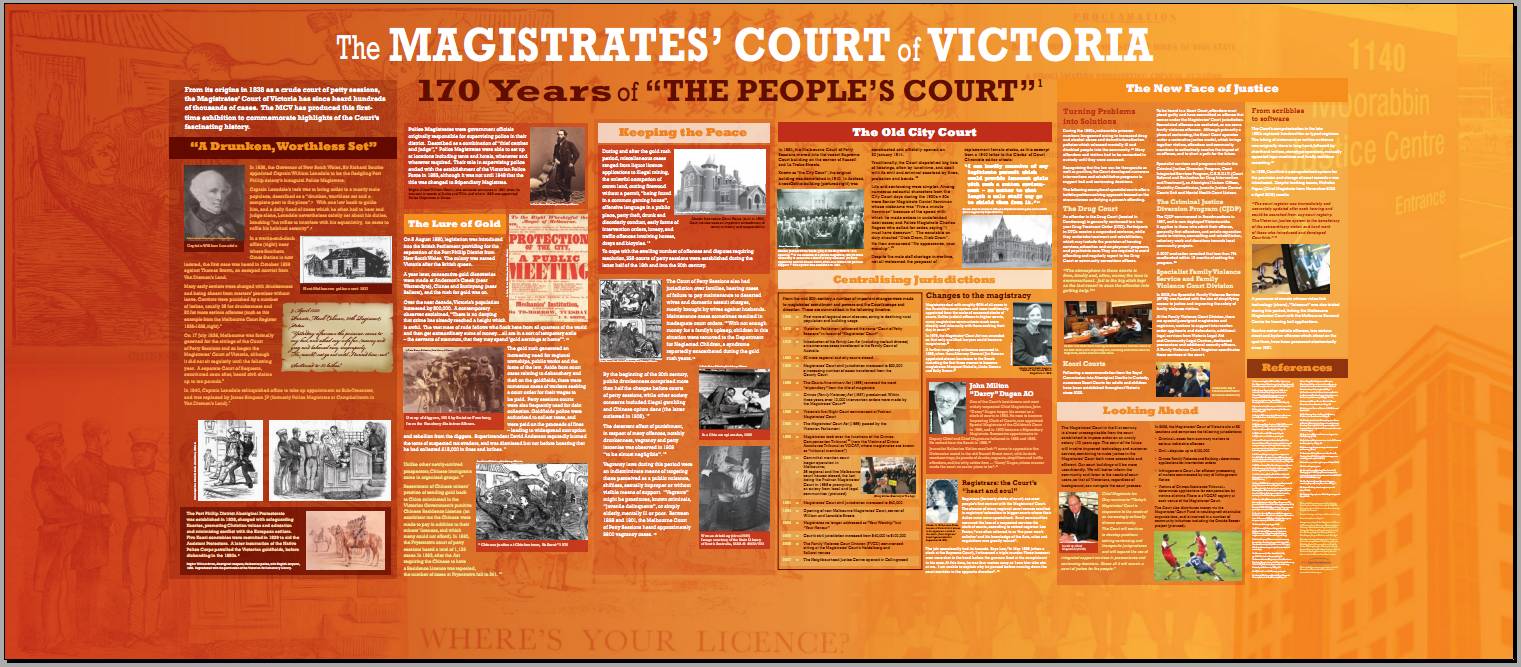
On the 14th of February 2020, a document called “MCV 170 Years of the People's Court exhibition (2008).pdf” is published as seen within the link:

https://www.mcv.vic.gov.au/news-and-resources/publications/magistrates-court-victoria-170-years-peoples-court-exhibition

From it's own documentation the Magistrates Court states that it was established in 1838, which should be reflected in an Act.

The current Court is 'born' under the Magistrates' Court Act 1989, where in 2008 the Court would be only 19 years old or in 2020 31 years old, yet the court states that it is 170 years old as of 2008.

Remembering that the Court is subject to Victoria's Constitution Act 1975.

There is a problem here as Victoria already had a Constitution prior to federation that being in 1855, where all law prior to federation is to be carried over.

The Victorian Constitution Act 1855 (UK) is an Imperial Act, and since the government of Victoria installed another Constitution in 1975, i.e. 120 years later, did it have the lawfully authority to repeal a UK Imperial Act?

In short, the answer is no, the government of the day did so, unlawfully.

As of November 2021, the people of Victoria are informed that the Magistrates' Court of Victoria conducts business in such a manner as to:

“Develop, maintain, and enhance key relationships with internal and external stakeholders to influence decision making processes and outcomes critical to the success of MCV, including court staff and judiciary, Court Services Victoria, and other Victorian government departments. “

So, let's get this very clear that the court stated that it has internal and external stakeholders to influence decision making processes and outcomes critical to its success.

Who are the internal and external stakeholders?

The only lawful 'stakeholder' (singular and not plural) should be the government under the Crown in right.

The stakeholders the Court mentions are financial services institutions, that have vested interest in the Court's profits arising from cases.

The 'MAGISTRATES COURT VICTORIA' is currently registered as an active business with the ABN 32 790 228 959.


A requirement by ALL business is that they must provide their ABN in business transactions but the 'MCV' does not.

Why is that?

Is there a clause in an Act that the MCV is exempt?

Hundreds of 'persons'/respondents/accused are being deceived per local 'Court' every single day, where the Courts act with impunity.

It seems that the 170 year celebration of the 'The People's Court' has come to a deceitful end many years ago.

The real question is will you (as a victim/respondent/accused) take part in this fraud, let them deceive you or will you take action against their deception?

And that's not even mentioning the 'Queen of Australia' and other taboo/scoffed at topics, that are a legitimate question of law or a 'Section 78B'.

See also :

Courts acting under dictation owned by financial services institutions


27 May 2022

Courts acting under dictation owned by financial services institutions

Australia's kangaroo courts are a joke at their 'customer's' expense.

The courts are corrupt to the core, where they have been usurped.

The legal requirement of a 'fair hearing' has been thrown under a bus.

The businesses referred to as 'Courts' are not longer acting independently or even acting solely under the Crown in right, but rather are run by stakeholders that influence decision making processes and outcomes critical to the “success” of the Court, as stated by the "MAGISTRATES COURT OF VICTORIA" in public document.

Straight from the 'horse's mouth'.

See document below:


The business known as the Court operates under the following conditions:

"Develop, maintain, and enhance key relationships with internal and external stakeholders to influence decision making processes and outcomes critical to the success of MCV, including court staff and judiciary,  Court Services Victoria,  and other Victorian government departments."

- What are the names of the "external stakeholders"?

- What 'influence' in decision making to they possess? 

- What is the definition or value of 'success' with regards to the operations of the MCV?

- What other influence do the stakeholders have over "Court Services Victoria and other Victorian government departments"?

- Who else has access on your 'private and confidential' information that resides within the Court?

So, realistically how can you have a fair hearing?

You can't, period.

See full pdf:


Rupert Murdoch's News Corp a data collection corporation!

Corporations w̶a̶n̶t̶ need you to use their apps on portable devices rather than a browser on a personal computer/laptop, as more data is 'hoovered' up that way.

When opening up the news.com.au site on a browser and reading 10 native articles, meaning not being directed elsewhere, Murdoch tries to obtain a whopping over 17,360 pieces of information (156 MB worth of data) from you.


When using their app, since is it closed source you do not have any knowledge of what sort of information is being siphoned from your smart phone, nor do you realistically have any control.

Most importantly they know exactly where you are (to within a few feet) from a new method of accurate geo-location that being via WiFi & Bluetooth scanning.

All this data collection is not used for your benefit, but rather theirs, that's why there is that heavy advertising for you to 'be on it' meaning the corporation's companion app.

We recommend using open source apps from sources like f-droid.org

25 May 2022

Australia's 2022 Federal election is a fraud!

This is just one aspect, that is part of the fraud, that the mainstream media are concealing. 

Did the Governor General act with the Advice of the Executive Council when issuing the Election writs?


There are many questions to be answered surrounding the issuing of writs for the federal election. Below is the government gazette evidencing writs were issued. Now the question is are the writs issued according to law? Is witnessing a document causing it to be issued? When the Governor General caused the writs to be issued did he do so on the advice of the Federal Executive Council in his role as the Governor in Council consistent with Section 32 and 63 of the Constitution?


COMMONWEALTH OF AUSTRALIA CONSTITUTION ACT  - SECT 12.

Issue of writs.

                   The Governor of any State may cause writs to be issued for elections of senators for the State. In case of the dissolution of the Senate the writs shall be issued within ten days from the proclamation of such dissolution.


COMMONWEALTH OF AUSTRALIA CONSTITUTION ACT  - SECT 32.

Writs for general election.

                   The Governor-General in Council may cause writs to be issued for general elections of members of the House of Representatives.

COMMONWEALTH OF AUSTRALIA CONSTITUTION ACT  - SECT 63.

Provisions referring to Governor-General.

                   The provisions of this Constitution referring to the Governor-General in Council shall be construed as referring to the Governor-General acting with the advice of the Federal Executive Council.


It is quiet clear when the Governor General acts in his role as Governor General in Council, he is to do so with the advice of the Federal Executive Council (s63), when this occurs the governor proclaims the advice, he cannot act in an alternate  capacity when acting 'In Council'.

 

It is clear this has not occurred when causing the writ to be issued.

Under section 61 of the Constitution of the Commonwealth of Australia, the executive power of the Commonwealth is vested in the Queen and is exercisable by the Governor-General. This power covers the execution and maintenance of the Constitution and the laws of the Commonwealth. The Federal Executive Council was established by section 62 of the Constitution to perform similar functions in 
Australia to those performed by the Privy Council in the United Kingdom, that is, to advise the Crown.
 
It is the formal, constitutional and legal body responsible for advising the Governor-General (as distinct from Cabinet). The Executive Council is the legal means of ratifying executive acts by or on behalf of the Governor-General. Sections 62 and 64 of the Constitution provide for the Council to consist of Ministers and Ministers of State and Federal Executive Councillors under summons. They are required to advise the Governor-General regarding the Government of the Commonwealth. Meetings are held regularly, when Parliament sits, usually at Government House in Canberra. However, meetings may be held in other locations (e.g. Parliament House) depending on the number of Executive Councillors present. For this reason, the location of the Federal Executive Council has been taken as the location of the Federal Executive Council Secretariat in the Department of the Prime Minister and Cabinet.
 
The location of the Federal Executive Council prior to 1936 is subject to further research, as for a time the offices of the Prime Minister's Department were located in Melbourne and Parliament House in Canberra (1927-1936). The Secretariat is responsible for organising meetings of the Federal Executive 
Council, ensuring that appropriate Cabinet approvals have been obtained, that appropriate inter ministerial consultation has taken place, that agreement has been reached and that the Executive Council documents reach the standard of quality required by the Council. Meetings of the Federal Executive Council may be convened by the Secretary to the Council after consulting the Governor-General is unavailable to preside at a meeting of the Council, the meeting may, with his prior agreement, be held in his absence. A quorum of the Council consists of: (a) the Governor-General and two Ministers; or (b) the Vice-President of the Federal Executive Council and two Ministers; or (c) three Ministers The work of the Federal Executive Council is mainly concerned with action to be taken under Acts of the Commonwealth Parliament. 

It therefore covers a wide spectrum of the Commonwealth's administration and includes such matters as:
 - the making of Proclamations and Regulations
 - the creation and abolition of government departments and positions
   in them
 - the issue of writs for the election of Members of the House of
   Representatives
 - the making and terminating of appointments to statutory offices on
   boards, commissions, councils and tribunals
 - the prohibition of import and export of certain commodities
 - the approval of compulsory land acquisitions
 - authorising entry into international treaties
 - authorising of government borrowings overseas
 - commissioning of officers in the armed services 

Business is submitted to the Executive Council by Minute; each Minute is accompanied by an Explanatory Memorandum. All Ministers, in their capacity as Executive Councillors under summons, may make recommendations for consideration by the Governor-General in Council. Consequently, if a 
Minister responsible for a particular Minute is absent or otherwise unavailable, the Minute may be signed by the Minister carrying out his or her duties or by another Minister on his or her behalf. 
This is provided for in section 19 of the Acts Interpretation Act 1901. 
Source: Commonwealth Government Directory, Volume 2, 
Federal Executive Council and Parliamentary Departments, March 1984.

 
In 2013 the ABC in the below story tells us writs are 'printed on heavy paper and has a traditional wax seal, quaint 19th century wording and font, and sets out the formal dates for all the required steps of the election'. 'The Commonwealth's writs are similar. They are definitely not the sort of document you print quickly in A4 from a laser printer.'

The writs for the six state Senate election are signed by each State's Governor. The drawing up of the writ and instruction to sign it are through the state's Executive Council, in effect on the advice of the Premier.


Various electoral Writs. 

Below is a copy of a writ for the 2012 Queensland election:


Gazette articles:
1974


2022


  Senate Writs

The 2022 New South Wales & Queensland Writ clearly provides the seal and endorsement required by the Commissioner but the other State writs are absent these requirements.

NSW


Queensland


 South Australia clearly has a seal embossed under the Governors signature


Western Australia have clearly hidden the seal in use and there fails to be a signature of the Premier.


Victoria and Tasmania have failed to seal the writs.

Victoria


Tasmania

ACT


Northern Territory


Writs for the House of Representatives

New South Wales


Victoria


Queensland


South Australia


Western Australia


Tasmania


Australian Capital Territory


Northern Territory


COMMONWEALTH ELECTORAL ACT 1918 - SECT 153

Writs for election of Senators

             (1)  A writ for the election of Senators shall be addressed to the Australian Electoral Officer for the State or Territory for which the election is to be held.

             (2)  Where a writ for an election of Senators is received by the Australian Electoral Officer for a State or Territory under subsection (1), the officer shall:

                     (a)  endorse on the writ the date of its receipt;

                     (b)  advertise receipt of, and particulars of, the writ:

                              (i)  in not less than 2 newspapers circulating generally in the State or Territory; or

                             (ii)  if there is only one newspaper circulating generally in the State or Territory--in that newspaper;

                     (c)  take such steps as the officer considers appropriate to advise each Divisional Returning Officer in the State or Territory of the dates fixed by the writ; and

                     (d)  give such directions as the officer considers appropriate to each Divisional Returning Officer in relation to the holding of the election.


COMMONWEALTH ELECTORAL ACT 1918 - SECT 154

Writs for election of members of House of Representatives

             (1)  A writ for the election of a Member of the House of Representatives or for a general election for the House of Representatives shall be addressed to the Electoral Commissioner.

             (4)  Where a writ for an election to be held in a Division, or each Division, in a State or Territory is received by the Electoral Commissioner under subsection (1), the Commissioner shall:

                     (a)  endorse on the writ the date of its receipt;

                     (b)  advertise receipt of, and particulars of, the writ:

                              (i)  in not less than 2 newspapers circulating generally in the State or Territory; or

Below the Governor General Acts under section 5 of the Constitution and seals with the Great Seal of Australia.


Below is a Commonwealth writ for the House of Representatives

showing there must be a seal next to the witness declaration,

The letters LS on the left represent where the seal is to be placed.


In 1998 there was an amendment to the Electoral Act via the Electoral and Referendum Amendment Act 1998, that on the face of it allows for preference votes (other than first preference votes) that in the opinion of the electoral officer can be used to preference the leading candidate most likely to be elected in that Division. This new amendment of 1998 allows for your vote to preference a candidate that was not the intention of the elector to occur.


ELECTORAL AND REFERENDUM AMENDMENT ACT 1992 No. 219 of 1992 - SECT 26

Scrutiny of votes in House of Representatives elections


26. Section 274 of the Principal Act is amended by inserting after subsection

(2) the following subsections:


"(2A) If, in a House of Representatives election, there are more than 2

candidates for a Division, the Australian Electoral Officer for the State or

Territory that includes the Division must, in writing, direct the Assistant

Returning Officers for the Division also to count such preference votes (other

than first preference votes), on such of the ballot papers, as, in the opinion

of the Australian Electoral Officer, will provide an indication of which

candidate is most likely to be elected for the Division.


"(2B) An Assistant Returning Officer to whom a direction is given under

subsection (2A) must:


   (a)  count the preference votes in accordance with the direction; and


   (b)  transmit to the Divisional Returning Officer any information required

        by the direction; in the manner specified in the direction.".