17 August 2022

'Dollar Dave' and the Reserve Bank: a tale of art, theft and human rights

Australia’s Aboriginal welfare problem of the 60s enabled widespread theft from Indigenous artists – including designs for the one dollar note. Reserve Bank of Australia.

David Malangi Daymirringu, Mortuary feast of Gurrmirringu, the Great Ancestral Hunter, 1963.
National Gallery of Australia, Canberra Founding Donors' Fund 1984 © David Malangi Daymirringu

This year (2016) marks the 50th anniversary of Changeover day: when Australia swapped from pounds to the new decimal currency. But the “C” in Changeover day might equally stand for Copyright day, for it marks the first Aboriginal copyright dispute.

In February 1966, Adelaide’s Advertiser newspaper revealed that the Reserve Bank had not sought permission from the celebrated Arnhem Land artist David Malangi when it reproduced his work on the new A$1 note.

Alongside the figures and kangaroos inspired by rock-paintings, the entire left-hand side of the note was copied from Malangi’s bark painting, Mortuary feast of Gurrmirringu.

While the media had a field day, the bureaucrats quietly tried to smooth things out. Malangi was found, then disappeared again. Finally, in a short ceremony in 1967, Malangi met “Nugget” Coombs, the then Reserve Bank Governor, who presented him with A$1,000, a medallion and a fishing kit.

Everybody seemed happy – and history records that Malangi henceforth proudly went by the name “Dollar Dave”.

But were Malangi’s cultural rights respected, and even more importantly, his human rights?

Did Malangi even own copyright over his own painting? Recently uncovered archival evidence raises troubling questions about the real nature of the settlement Malangi reached with the Reserve Bank.

Making a dollar

Malangi’s painting was acquired by Czech collector Karel Kupka in early 1963.

While passing through Sydney, Kupka passed on a photograph of the painting to the Reserve Bank’s Secretary, AC McPherson, who gave it to the bank’s designer, Gordon Andrews. 

David Malangi. 

Andrews reproduced much of the detail of the photographed painting for the new dollar design, which was not acknowledged.

Between April 1963 and February 1966, the Reserve Bank somehow forgot Malangi’s identity – seemingly a straightforward breach of his copyright.

However, things were not straightforward. In 1963, like most of the Northern Territory’s Aboriginal population, David Malangi was a ward.

The Commonwealth’s Director of Welfare, Harry Giese, was the guardian of his estate, and the trustee of his property. Malangi couldn’t buy or sell goods worth more than ten pounds without the Director or a welfare officer’s consent.

No person could purchase a painting or drawing from a ward except through an “approved institution”, or with the Director’s consent.

And under section 25 Welfare Ordinance, copyright in Malangi’s work was owned by the Director as trustee for the ward.

In order to buy Malangi’s painting, Kupka needed the “understanding co-operation” of the Welfare Branch, as well as the Methodist Mission at Milingimbi.

When Kupka returned to Darwin with his “first great collection from Arnhem Land” in 1963, he brought his pieces to the Methodist Overseas Mission storeroom in Darwin’s Knuckey Street. He then displayed them to the representatives of the Welfare Branch, to show them what he was taking away.

Why this bureaucracy? The official answer was that it was designed to combat rip-offs of Aboriginal art. Through the 1950s and 1960s there was a lively black market trade in Aboriginal objects or “relics”, bark paintings, “churinga” of stone and wood, and even human skulls.

Missions ran a lucrative trade in Aboriginal art, with most artists receiving a tiny portion of the profits. In 1965, a Legislative Councillor alleged that the trade in “native artefacts” was the “most lucrative business in the Northern Territory”, being one that was not affected by drought.

Independent Aboriginal artists like Yirawala had to smuggle their own paintings from their home mission to independent galleries.

According to Sandra Holmes, who ran such a gallery in Darwin, the authorities at Croker Island sold Yirawala’s paintings to interstate and international dealers, against the artist’s express wishes, and to his great distress.

Recognising Malangi

When it became aware of the story about Malangi, the Department of Territories in Canberra wrote – not to Malangi himself, but to the Northern Territory Administrator. It stated its willingness to,

pay the ruling price for Malangi’s work plus a fee to establish the right to reproduce them in any form in which we desire.

The Reverend Marcel Spengler, the Superintendent at Milingimbi, politely asserted Malangi’s rights. In a letter in March 1966, he asked for a royalty, adding that:

we have not been able to house Malangi and his family in a substantial cottage, and it might be a very good idea for an aboriginal from this area to be independent in the matter of housing.

With extreme caution, the Reserve Bank wrote that it would “acknowledge” Malangi’s contribution, adding that “Malangi’s role is not comparable with that of any other artist concerned in the design of the new notes but this would not preclude us from making an appropriate payment to him”.
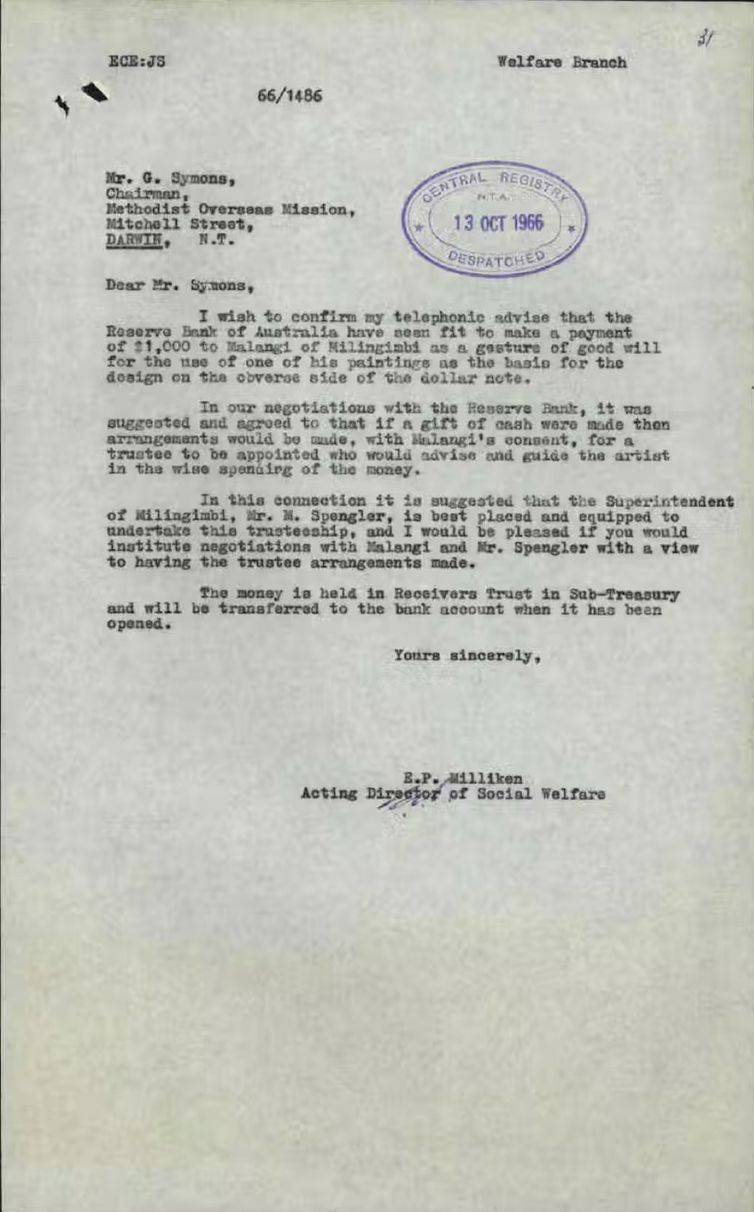

Letter discussing David Milangi’s payment. Australian Archives Canberra, author provided.

By the time the Bank sent a cheque for A$1,000, the Welfare Ordinance had been repealed.

This didn’t prevent the money from going to the Northern Territory Administrator, who paid it into a trust account “pending a suitable occasion on which the artist could be presented with a ‘personal token’”.

The government could no longer legally hold Malangi’s money in a trust account, or dictate to him how he should spend it. The legal controls that had existed over his work were undoubtedly well-intentioned. However, their effect was to facilitate official rip-offs and prevent artists doing anything about them.

Acknowledging a wrong

There was a post-script. In the Dry Season of 1968, almost a year after Dr Coombs’ presentation, Malangi indicated his intention to come to Darwin to make a reciprocal presentation of his own.

Such a presentation would be consistent with Aboriginal law, with the idea that each party gives the other something to right a wrong.

For example, in 2003 a group of Yolngu men from north-east Arnhem Land travelled to Darwin to conduct a “wukidi” ceremony at the Northern Territory Supreme Court.

This was a reconciliation for the famous Tuckiar case, in which a white police officer, Albert McColl, was speared at Caledon Bay in 1933. The McColl family travelled to Darwin and met Tuckiar’s descendants – an example of things being settled the proper way.

Malangi went to Darwin, and stayed at Bagot Aboriginal Community, under its superintendent’s benevolent gaze. A meeting was arranged with Dr Coombs for Tuesday 4 June.

There was a reception afterwards. In a note, Giese mentioned that he had arranged for Malangi to be “available, suitably dressed and on time with barks to meet Dr Coombs.”

A note on 6 June observed that, “Malangi met Dr Coombs, had barks and was not to his knowledge invited to reception.”

A later unsigned, handwritten note on an official document said: “Thanks for fixing this […] I did not see Malangi at the reception.”

It’s difficult to know exactly what Malangi was trying to do. If it was to reciprocate, according to Aboriginal law, then it would seem his gesture was not properly accepted.

Perhaps, even in 1968, the Aboriginal man did not have suitable clothes.

Source:The Conversation


15 August 2022

Google fined A$60m for misleading location setting on Android


Google has been sanctioned A$60 million (around $40 million+) in Australia over Android settings it had applied, dating back around five years, which were found — in a 2021 court ruling — to have mislead consumers about its location data collection.

Australia’s Competition & Consumer Commission (ACCC) instigated proceedings against Google and its Australia subsidiary back in October 2019, going on to take the tech giant to court for making misleading representations to consumers about the collection and use of their personal location data on Android phones, between January 2017 and December 2018.

In April 2021 the court found Google had breached Australia’s Consumer Law when it represented to some Android users that the “Location History” setting was the only Google account setting affecting whether it collected, kept and used personally identifiable data about their location.

In actuality, another setting — called ‘Web & App Activity’ — also enabled Google to grab Android users’ location data and this was turned on by default, as the ACCC noted in a press release today. Aka, a classic dark pattern. (Actually Google deployed nested dark patterns, plural, as we detail below.)


The regulator estimates that users of around 1.3 million Google accounts in Australia may have viewed a screen found by the Court to have breached the Consumer Law.

“This significant penalty imposed by the Court today sends a strong message to digital platforms and other businesses, large and small, that they must not mislead consumers about how their data is being collected and used,” said ACCC chair, Gina Cass-Gottlieb, in a statement.

“Google, one of the world’s largest companies, was able to keep the location data collected through the ‘Web & App Activity’ setting and that retained data could be used by Google to target ads to some consumers, even if those consumers had the ‘Location History’ setting turned off.”

“Personal location data is sensitive and important to some consumers, and some of the users who saw the representations may have made different choices about the collection, storage and use of their location data if the misleading representations had not been made by Google,” she added.

Per the ACCC, Google took steps to correct the contravening conduct by 20 December 2018, meaning consumers in the country were no longer shown the misleading screens.

At the time of the court ruling last year, Google said it disagreed with the findings and that it was considering an appeal. But, in the event, it decided to take the lumps.

(These are not as painful as they might have been if the infringements had occurred more recently: The ACCC notes that the majority of the sanctioned conduct occurred prior to September 2018 which is before the maximum penalty for breaches of the Consumer Law was substantially increased — from $1.1 million per breach to — since then — the higher of $10 million, 3x the value of any benefit obtained or, if the value cannot be determined, 10% of turnover.)

The Court has also ordered Google to ensure its policies include a commitment to compliance, and requirements that it train certain staff about the country’s Consumer Law, as well as to pay a contribution to the ACCC’s costs.

Google was contacted for comment on the sanction. A company spokesperson sent us this statement:

We can confirm that we’ve agreed to settle the matter concerning historical conduct from 2017-2018. We’ve invested heavily in making location information simple to manage and easy to understand with industry-first tools like auto-delete controls, while significantly minimising the amount of data stored. As we’ve demonstrated, we’re committed to making ongoing updates that give users control and transparency, while providing the most helpful products possible.

Dark patterns inside dark patterns

The ACCC’s press release includes some screengrabs showing Google notifications to Android users that the court found to be misleading — which includes three versions of Google’s Web & Activity setting screen shown to consumers setting up a Google account on their device that do not mention the word “location” at all.

Instead, on one — which appeared between April 30, 2018 and December 19 2018 — Google instructs consumers that the setting “saves your searches, Chrome browsing history and activity from sites and apps that use Google services”, before nudging them to retain a pre-selected option to “save my Web & Activity to my Google account” (aka, opt into Google’s tracking) by suggesting: “This gives you better search results, suggestions and personalisation across Google services.” But nowhere does it explain that the user is agreeing to be location tracked.

If Android users chose to try to turn off “Location History” — i.e. via a totally separate setting that did not actually enable them to prevent Google’s location tracking — they could also be shown a confusing pop-up querying their decision to “Pause Location History?”, as Google put it, warning them the decision would “limit functionality of some Google products over time”.

It’s hard to know what even the point of this was, since the setting did not empower consumers to entirely prevent Google snooping on their location, so probably it was mostly there to spread FUD.

The text in this notification concludes with a further confusing line — telling the user to “remember, pausing this setting doesn’t delete any previous activity” — and pointing them to yet more settings where Google suggests they could “view and manage this information in your Location History map”. This was presumably intended to send them down a pointless rabbit hole — while drawing their attention away from the Web & Activity setting where Google had hidden another location tracking setting.

Other versions of the Web & Activity setting which the court found misleading Android users between early 2017 and late 2018 include one which contains a full five possible actions a user could take — a surfeit of choice obviously intended to bamboozle them into leaving the ‘on’ setting as is, since it’s so drastically unclear what anything else available on the screen means.

“If you use more than one account at the same time, some data may get saved in your default account. Learn more at support.google.com,” runs one prominent piece of cryptic Google small print — without actually hyperlinking the URL in question to send the consumer to where they might actually ‘learn more’ (or, well, quickly realize there is nothing much to learn and certainly no ‘off’ switch there).

This chunk of small print mostly appears intended to shield consumers from reading the actual description of the Web & Activity setting’s function — a setting which, remember, is defaulted to ‘on’ — since this very salient information is buried below it (and above a more eye-catching tick-box). But even here Google is not clear: Again, it does not use the word ‘location’ at all; there’s only an indirect reference to “Maps” buried in a list that foregrounds ‘faster searches’ and ‘customized experiences’ to nudge consumers to agree.

By using the name of its popular Maps product as a stand in for location Google appears to be suggesting that Android users need this setting to be on if they want to use Maps — rather than making it plain that the setting refers to its ability to track their location.

The same setting screen also includes a pre-ticked check-box next to yet more text that states: “Include Chrome browsing history and activity from websites and apps that use Google services” — so Google is seemingly unbundling tracking settings, presumably as a back-up in case one of these pre-checked settings gets unchecked, meaning it can at least grab data via the other.

After that there’s more small print, lodged under the bland rubric “data from this device”, which reads: “Control reporting of App Activity from this device”. However this text is not instantly visually linked to any setting the user is able to interact with — so anyone glancing at it might assume it’s not pointing them to an option at all and skip over it.

Airgapped below, towards the very bottom of the screen, is a hyperlinked option to “MANAGE ACTIVITY”. This text is bolder — being in ALL CAPS. So does draw the eye. Yet what even is this? Why does the user have to wade into fresh Google submenu hell to try to turn off tracking, as this option seems to be implying? Surely they can just toggle the ‘on’ switch at the top of the settings screen to do that…

Of course everything baked into this dark pattern layer cake is pushing the consumer far away from any understanding of what’s actually going on with their data in order that they give up and leave the default tracking on. Truly a masterclass in deceptive manipulative design.


Screengrab: ACCC

A big reboot?

While Google’s statement today on the ACCC sanction seeks to imply that all misleading location tracking stuff is in the past, the company is facing an ongoing investigation into the same practices in the European Union — open since February 2020 — where it could be on the hook for a more sizeable fine if it’s found to have infringed the bloc’s General Data Protection Regulation (as penalties can scale as high as 4% of global annual turnover).

Consumer watchdogs in the EU actually filed complaints about Google’s deceptive location tracking back in November 2018. So Google will still be able to claim it’s moved on — whatever the outcome.

A draft decision by Ireland’s DPA, which is leading the investigation, is expected this year — although a final decision could be pushed into 2023 since it must be reviewed by the bloc’s network of DPAs and agreement reached on any enforcement.

But there’s more — earlier this summer, European consumer rights groups filed a new series of complaints against Google — accusing the advertising giant of deceptive design around the account creation process that they say steers users into agreeing to extensive and invasive processing of their data.

The complaints highlight how many more ‘clicks’ are required by Google to let users opt out of its tracking vs handling it the keys to their data… so plus ça change right?

The plodding pace of European privacy law enforcement suggests Google can expect several years’ grace before any corrective orders land — leaving consumers exposed in the meanwhile.

But there’s some harder reform on the horizon: EU lawmakers recently agreed to include a ban on online platforms designing and deploying deceptive/manipulative and/or confusing interfaces in a forthcoming flagship update to the bloc’s digital rulebook.

The Digital Services Act (DSA) is generally intended to dial up responsibility and accountability around digital services by steering governance.

On dark patterns, much will hinge on the specifics of the DSA text, and its interpretation, clearly — and there may still be wiggle room for powerful platforms to find ways to use sharkish practices to rob consumers of their rights and agency. But a key feature of the law is it entails an active role for the European Commission in enforcement (against larger platforms — so called VLOPs).

This includes empowering the EU’s executive to step in and issue guidance on best practice in areas like interface design. Combined with a new ability to bare teeth at repeat offenders — as it gets empowered to hit VLOPs with beefy fines if they break the DSA’s rules — so some of the EU’s consumer-focused regulation could, suddenly, get rather harder to ignore. (The DSA will start applying from next year.)

Penalties for breaches of the DSA can scale up to 6% of global annual turnover. So the cost and risk of stealing people’s data are certainly rising. Whether it’ll be enough to give tracking giants pause for thought — or, what’s really needed, force meaningful reform of privacy-hostile business models — remains to be seen.

Source:techcrunch.com

10 August 2022

Windows devices with newest CPUs are susceptible to data damage


Microsoft has warned today that Windows devices with the newest supported processors are susceptible to "data damage" on Windows 11 and Windows Server 2022.

"Windows devices that support the newest Vector Advanced Encryption Standard (AES) (VAES) instruction set might be susceptible to data damage," the company revealed today.

Devices affected by this newly acknowledged known issue use AES-XTS (AES XEX-based tweaked-codebook mode with ciphertext stealing) or AES-GCM (AES with Galois/Counter Mode) block cipher modes on new hardware.

While Microsoft mentions the data loss risks on affected systems, the company does not elaborate on what customers should expect if they're hit by this issue.

Issue fixed in May and June Windows updates

Microsoft says the issue was addressed to prevent further data damage in preview and security releases issued on May 24 and June 14, respectively.

However, these Windows updates also come with a performance hit since AES-based operations might be two times (2x) slower after installing them on affected systems running Windows Server 2022 and Windows 11 (original release).

Scenarios impacted by the performance hit might include BitLocker, Transport Layer Security (TLS) (specifically load balancers), and disk throughput (especially for enterprise customers).

"We added new code paths to the Windows 11 (original release) and Windows Server 2022 versions of SymCrypt to take advantage of VAES (vectorized AES) instructions," Microsoft said when describing the cause of the issue.

"SymCrypt is the core cryptographic library in Windows. These instructions act on Advanced Vector Extensions (AVX) registers for hardware with the newest supported processors."

Workaround for the performance hit

Customers experiencing performance degradation are advised to install June 23 preview update (Windows 11Windows Server 2022) or the July 12 security update (Windows 11Windows Server 2022) for their OS version as a workaround.

Microsoft says these Windows updates will restore initial performance metrics once installed on affected devices.

"If this affects you, we strongly urge you to install the May 24, 2022 preview release or the June 14, 2022 security release, as soon as possible, to prevent further damage," Microsoft added.

"Performance will be restored after you install the June 23, 2022 preview release or the July 12, 2022 security release."

Comment:

h_b_s

"Data damage" the new marketing gloss over for "data loss" and "filesystem corruption". Don't be fooled. It's yet another case where Microsoft's bungled agile development practices have screwed the pooch. Their testing harnesses are entirely inadequate to support the massive legacy code bases they have to support in the time scales they need to release.

Source:bleepingcomputer.com

Digital ID parties at Dictator Dan's


Dan Andrews support teams are having a digital identification chip implanted into their bodies in order to conduct cashless transactions and celebrating this fact preemptively that it will be 'mandated' on the Victorian population after his election win in November 2022.

Information has been obtained from a source close to Andrews with regards to what he is planning after an election win.

Cashless transactions are a priority of the 'Nanny State' agenda authorities around the world are implementing on the serfs.


'Tap & Go' has been a feature of your physical (credit/debit) card for a while now, where data is only exchanged between two devices, where that data's initial journey is to the financial services institution where it gets distributed to unknown entities to you.

With the advent of the smart phone together with apps, the tap & go feature has been embedded in the phone, but now other parties can have access to data emanating from your phone.


This is great news for 'advertisers', who can be quite easily masquerading as government actors or 'NGOs' (Non Government Organisations) and corporations that support this nanny state style of commerce.

The smartphone is so large and cumbersome and is so 'last year' where you can also use a smart watch for cashless transactions.

Why use a smart watch as it is large cumbersome and so 'last month' compared to a smart ring.


What the Andrews government will do is 'promote' the use of an implanted RFID chip for those who wish to participate in the trial.

Remember the CallerID 'trial' in Victoria that became a standard?

The Australian population has also participated in another trial, as stated by the health minister Greg Hunt on the 21st of February 2021, where now the serfs are urged to get a 'quadrella' of shots, which the judiciary is exempt from (What??? !!! ???? Don't Judicial Lives Matter too???), but that is digression.

See Hunt's statement:

The world is engaged in the largest clinical trial, the largest global vaccination trial ever, and we will have enormous amounts of data. “

within the link:

https://www.health.gov.au/ministers/the-hon-greg-hunt-mp/media/interview-with-david-speers-on-abc-insiders-on-the-covid-19-vaccine-rollout

This nanny state agenda will not come into force akin to the frog in boiling water trick.

Over time, services will be decreased for those who do not have a cashless transaction method available to them, limiting their movements and participating in the 'digital economy' (or rather society) the governments are now starting to promote heavily.

As you have seen over the past few years Victoria has a be test bed, a PsyOp as to what governments and corporations can get away with.

Your silence and participation is acquiescence.

08 August 2022

Data breach disclosure law in Australia


The colony has taken quite some time to enact law that may protect consumers/workers/public servants with regards to the I.T world in particular that of data breaches, which have been going on for a few decades now, and the lack of reporting them.

The law is ultra quick to act with regards to gazetting speed measuring equipment which is heavily relied upon for revenue raising, under the pretext of safety.

On February 22, 2018 the Federal Government’s new Scheme for the mandatory reporting of cybersecurity breaches that result in the loss of personal data came into effect. Every private and public company with annual turnover of $3 million or more, listed or not, is now required to report a cyber breach to the Office of the Australian Information Commissioner (OAIC) and notify affected customers as soon as they become aware of a breach.

The threshold for notification under the new Act is more onerous than most other global jurisdictions, with the test based on whether the breach “is likely to result” in serious harm to an affected individual. Mandatory reporting relieves companies from having to make judgement calls about materiality – ANY breach that ‘is likely to result in serious harm’ to an individual will be reportable. This could occur when there is unauthorised access to, disclosure or loss of customer information held by an entity. Such information includes personal details, credit reporting information, credit eligibility information, and tax file number information. Companies must report the breach within 72 hours.

On 22 February 2018, the Privacy Act 1988 (Cth) (the Act) was amended to introduce a mandatory data breach notification regime, the Notifiable Data Breaches scheme (NDB scheme). Australian Privacy Principle (APP) entities bound by the Act must now report specified breaches of privacy.  

Such data breaches must be notified to the Office of the Australian Information Commissioner (OAIC). In addition, individuals that are likely to suffer serious harm as a result of that breach must also be notified. Businesses need to act quickly to contain and address such privacy breaches, and practitioners need to be aware of the requirements and the time frames for action.

The Privacy Amendment (Notifiable Data Breaches) Act 2017 (Cth) amended the Act to bring into force the NDB scheme. The legislation introduces a set of onerous reporting obligations for those already bound by privacy obligations under the Act. The OAIC is already reporting a flurry of activity in this area. This article outlines the provisions of the NDB scheme and provides examples of how it may apply in practice.

The new data breach notification regime will apply to those already bound by the Act, including businesses with an annual turnover of $3 million or more. Such entities are called APP entities.

news.com.au behind the scenes data collection


One of the most important metrics in data collection is that of your identity or your device's identity which can then be used to identify your 'person'.

Corporations want or rather need you use apps for their online content (also classified as 'entertainment') in order to profit from you.


In the case of Rupert Murdoch's 'news' empire, a catchy phrase was coined "be on it", meaning be on the platform, as in download the app, even though using a browser will suffice.

In the above example we can see that a request is made to obtain your device identity prior to viewing a video.

You can either allow or block this.

If an app was downloaded, then this permission would be automatically granted and bother parties Google and the 'entertainment' empire would have your device identity, which would then identify you.

A recommendation would be not to download entertainment company's apps where open source apps are recommended, rather than the closed source apps that corporations hide privacy invading data grabbing code.


06 August 2022

Puma Biotechnology data leak reveals link to Pfizer

MANY pharmaceutical corporations are deceitful during the best of times let alone during an alleged global crisis.

News media companies, some of which are called 'entertainment' (e.g. Nine Entertainment in Australia) can also be quite deceitful via omission of 'facts' or information to the public.

In a court ruling in the United States in November 2021, the drug that is used to medicate people cannot be technically called what the news media and authorities call it, as it does not confer immunity.

See link: https://constitutionwatch.com.au/the-covid-19-injections-do-not-confer-immunity-and-therefore-do-not-meet-the-definition-of-a-vaccine/

Did Australia's mainstream media inform you of this?

The corporation that is selling the drug in Australia, had to publicly disclose its 80,000 pages of documents, as ordered by a United States court.

See link: https://phmpt.org/pfizers-documents/

Did Australia's mainstream media draw attention to these documents?

Data shares are another important source of information, either by whistleblowers or other means.

On the 29th of July 2022, data from Puma Biotechnology was put online.


A quick search via your favourite search tool should show results that Puma Biotech. is not so squeaky clean, where they are involved with Pfizer who is supplying a drug to Australians.

Yet again the question is asked; Did Australia's mainstream media inform you of this?

It's quite clear that the information required for people to make up their own mind with regards to (unlawful) health directions by authorities is deliberately left out, where instead the focus is on an entertainer's buttocks.

Enough silicon to satisfy the current chip shortage by Kim K alone?

05 August 2022

How to stop Micro$oft from collecting your data during Win 11 installation

A Big EFF YOU to Microsoft and their data collection during a Windows 11 installation.

Google is no longer a 'search engine' company nor is Meta (nee Facebook) a 'social media' platform where they are both data collection corporations that sell data to governments and non-government organisations even AI processed data (yielding results like political affiliations, beliefs, demographic, etc) under the banner of advertising Goliaths

Similarly Microsoft is no longer an operating system manufacturer but rather a data collection giant, under the banner of a software corporation.

As the Windows version increases so does the data collection on the user.

With Windows 11 there is a way to 'force' the installation without the 'mandate' for a online user account.

With Windows 10 the process is much easier, where there is an option, where it's not immediately visible in Win 11.

See tutorial by JayzTwoCents:


There are also other products that preserve your privacy within Windows.

They are:

O&O ShutUp10++ : https://www.oo-software.com/en/shutup10

WPD - Privacy dashboard for Windows : https://wpd.app/

W0Privacy : https://www.w10privacy.de/english-home/


LinkedIn - The West's equivalent to China's social monitoring system

Some may be told that China's Social Credit System is bad and maybe even an isolated form of surveillance on the plebs.

The monitoring, cataloguing and grading of the corporate slaves in the West has been going on for decades, even before the internet going 'commercial'.

LinkedIn is just one 'public' social media platform where its database can (and is) used for nefarious reasons.

See explanation as told by Rob Braxman (odysee link) in the video of the title: Perils of LinkedIn:


It's all part of the 'Nanny State' agenda!