A look into Corporate fraud in Australia, Stranglehold of Monopolies, Telecom's Oppression, Biased Law System, Corporate influence in politics, Industrial Relations disadvantaging workers, Outsourcing Australian Jobs, Offshore Banking, Petrochemical company domination, Invisibly Visible.
It's not what you see, it's what goes on behind the scenes. Australia, the warrantless colony.
Note: Site has more info in desktop mode or 'web version' as seen at bottom of page, when on smartphone.
COMMONWEALTH OF AUSTRALIA (ABN: 122 104 616)
Australia's Prime Minister (CEO) Tony Abbott : "Australia is Open for Business"
Since 1788 Australia has become an ‘open range’ prison camp, where surveillance of the inhabitants was always high on the agenda.
As technology progressed so did the surveillance on the population, until the pinnacle of surveillance occurred via tower triangulation of mobile phone users and the advent of the Five Eyes (Anglosphere) global surveillance network.
As time goes on more surveillance occurs on the general population together with data collection.
The general population is deliberately conned/put into a false sense of security, with the term ‘anonymised’ data collection, alluding that data collected about that person from that person’s device does not identify that person.
Australia’s privacy law was never designed to truly protect anyone from the serf pool, where even if it does look good on paper, any court action may seem futile.
Officially, in Victoria, a person has privacy rights under the Privacy and Data Protection Act from 2014, even though we have been connected to the WWW (World Wide Web) for over 20 years prior.
That's how deliberatly lacking the governmernt is in allegedly protecting the people.
Does the government take 20 years to implement revenue (as opposed to safety) devices such as speed cameras after their inception?
The above mentioned Act does not apply to that person’s health information, or how 'Commonwealth' agencies use the data, meaning the can (and do) misuse it, it's just that 'we' (the people) cannot prove this as the government will not allow us to have access to how they use our data.
Most worrisome, it also does not apply to ‘private organisations’ (i.e. companies and charities), meaning any person that holds an ACN (Austalian Company Number) or registered charity which in fact could serve as a data collection front, even thought these entities are allegedly covered by other privacy law.
Personal information can include:
your name;
email address;
postal address;
phone number;
signature;
fingerprint;
photographs or surveillance footage of you;
comments written about you; or
your financial details.
To be considered personal information, the information or opinion must be recorded. It will be considered personal information regardless of whether it is true or not.
Some personal information is considered particularly sensitive, and these types of information are subject to higher protections under the PDP Act.
This includes information about your:
race or ethnicity;
political opinions;
membership to a political association;
religion;
philosophical beliefs;
membership to a professional or trade association;
membership to a trade union;
sexual preferences or practices; or
criminal record.
Australia is a 'Nanny State' or secretive police state, and any illusion of privacy is exactly just that, an illusion.
A false representation of the people at La Trobe uni.
A huge problem, that is swept under the carpet by staff and campus security and external authorities, e.g. police, is that of harassment and assault of women at La Trobe University.
La Trobe uni is not what it used to be where it was a university for ‘our’ (i.e. Aussies parent’s) students, where now it is corporatised putting priority on overseas intake, as there is more money to be made than from Australian students, as it’s all about ‘the economy’.
La Trobe uni is now overflowing with trash, low (moral) value humans from India, Pakistan and the Middle East, humans that the Australian Government has brought in that society does not need nor actually want.
Information about campus life was provided by a woman on the condition of anonymity, where in a shocking recollection, she mention an incident where she was encircled and harassed by eight men of Indian appearance where she barely escaped without getting injured.
She explained that occurrences of this calibre are not ‘isolated’ incidents but campus security that is also ‘outsourced’ by people of similar ilk take no action.
A place where one can get assaulted.
Horrendous actions like this have led women to leave their education at La Trobe behind and seek alternative solutions.
“This is not a good look for Australia” she stated, and not a safe place to be.
The mainstream media amplifies domestic violence perpetrated by men against women, yet there is no focus on low quality immigrants that come into Australia, bringing their ‘rape’ culture into the colony.
Keeping in mind that all the government cares about is the economy, but what is good for the economy may not be good for the people.
Will the importation of trash stop?
No, the government will double down, i.e. import more, for the ‘economy’.
The colonialisation of this land has quite sordid beginnings and even tough after some settling down the immigration policies by those in government over the years are quite questionable to say the least.
Years ago, the catch phrase by the authorities was to allegedly stop the “boat people”, a similar scenario for people living here before 1788.
So these boat people were to start off on this land by committing a criminal act, that being entering illegally.
Well that is no longer the case, as times have changed, where ‘we’ (the people) no longer have “boat people”, i.e. criminals entering this nation, but rather we now have “plane people” meaning criminals entering this nation by plane, where there is allegedly more control on who steps foot on this Australia’s soil.
Irrespective of this so called control, immigration policy over the past generation or more has deliberately brought in disproportionately huge criminal elements from places like India the Middle East and Africa.
What’s worse is that when or rather if caught, there is very little the authorities do, and certainly there is no deportation to “go back where you came from”.
Basically these creature are here to stay to cause more dis-ease/harm in the community.
‘Social media’ sites like YouTube, that are owned by advertising corporations, have devoted content creators like ScammerPayback, Scambaiter, Kitboga, Jim Browning, just to name a few, that expose criminals from the Indian region but in reality the local authorities are (deliberately) doing too little, as most of the victims are Westerners.
‘Indian’ (Indian/Bangladeshi/Pakistani/Nepalese, etc) scammers are no longer the stereotypical call centre criminals committing fraud over the internet, where in Australia they have diversified into the building and services, people moving and real estate industries, just to name a few.
The building industry is rife with low quality (Indian/Pakistani/etc) as well as Middle Eastern 'builders', where the word is not to touch any property that is worked on by them.
So what are the authorities doing about it? Pretty much - nothing, or rather handing out more builder's licences to criminal operators.
If people think they have a right to ‘free speech’ now, they are sadly
mistaken.
You are only allowed
to write/post what governments and corporations allow you to.
Eric Arthur Blair’s
Nineteen Eighty-Four is kindergarten material compared to what is
being enacted today.
Corporations like
Google work with the FiveEyes governments in censoring,
removing/deleting videos from their platforms, in this case YouTube
in effect ‘removing’ history.
"I will rip out your heart"
A clip that was posted on YouTube features censored words, where attention was paid to one word.
Is this word vulgar or 'politically incorrect'?
Does this word 'hurt' people's feelings or offends a minority?
What is so heinous about this word that the 'public' cannot see it in its pure unadulterated spelling?
Well the word is "heart".
Not only is the subtitle censored but also the audio is edited
It's irrelevant whether it is self censored or whether the platform censored it, the problem is that it was censored.
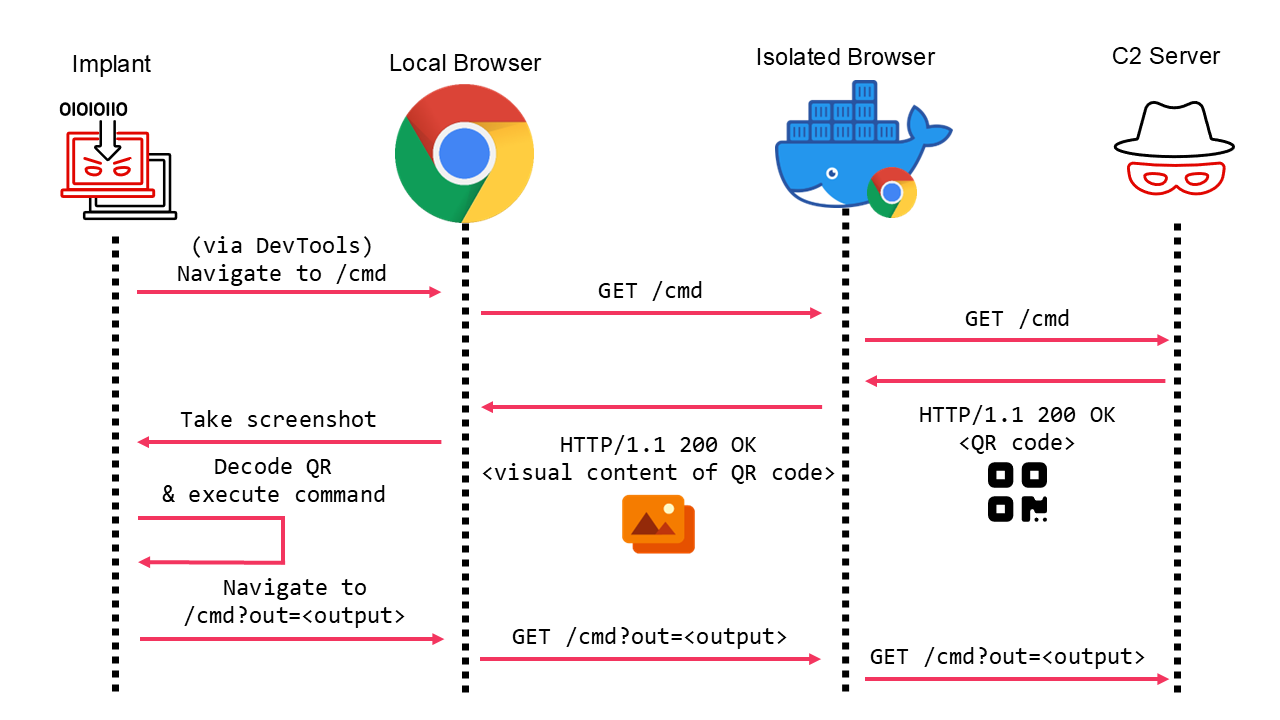
Cybersecurity firm Mandiant has unveiled
a groundbreaking discovery that demonstrates how threat actors could
potentially bypass browser isolation technologies using QR codes as a
covert command-and-control
(C2) communication channel. The research, disclosed on December 8,
2024, raises significant concerns about the effectiveness of current
browser isolation security measures.
The
novel technique, developed by Mandiant's Red Team, leverages
machine-readable QR codes embedded within web pages to establish
unauthorized communication channels. This method proves effective
against all major types of browser isolation solutions, including
remote, on-premises, and local implementations, potentially compromising
organizations' security infrastructure.
"The
discovery highlights a critical weakness in what many organizations
consider a robust security measure," explained a senior researcher at
Mandiant. "By utilizing QR codes as a transmission medium,
attackers can effectively circumvent traditional browser isolation
protections that are designed to separate user browsing activity from
the corporate network."
The
proof-of-concept implementation demonstrated by Mandiant researchers
utilizes Google Chrome in headless mode, integrated with Cobalt Strike's External C2 feature.
The malicious implant operates by rendering web pages in a headless
browser, capturing screenshots of embedded QR codes, and subsequently
decoding them to extract command data.
However,
the technique does come with notable limitations. The researchers found
that the QR code-based C2 method is constrained by a maximum data
capacity of 2,189 bytes, primarily due to streaming quality issues.
Additionally, the communication process experiences significant latency,
with each request taking approximately five seconds to complete, making
high-throughput operations like SOCKS proxying impractical.
"While the current implementation may not be optimal for large-scale data exfiltration, it proves the concept that browser isolation
can be circumvented through creative means," stated a Mandiant Research
Team. "This should serve as a wake-up call for organizations relying
solely on browser isolation as their primary defense mechanism.
"In
response to these findings, Mandiant has issued several recommendations
for organizations to strengthen their security posture. These include
implementing comprehensive traffic inspection mechanisms to detect
anomalous patterns indicative of QR code-based C2 activity, conducting
regular domain reputation checks, and deploying advanced URL scanning
solutions.
Security
experts emphasize the importance of adopting a multi-layered "defense
in depth" strategy rather than depending on a single security solution.
"Organizations need to understand that no single security measure is
foolproof," noted a cybersecurity analyst familiar with the research.
"This discovery reinforces the need for comprehensive security
strategies that combine multiple protective layers."
The
revelation has prompted increased attention from the cybersecurity
community, with several organizations already beginning to evaluate
their browser isolation implementations in light of this new threat
vector. Security vendors are also expected to develop countermeasures to
detect and prevent such QR code-based bypass attempts.
As
organizations continue to rely on browser isolation technologies as
part of their security infrastructure, Mandiant's discovery serves as a
crucial reminder of the ever-evolving nature of cyber threats and the
importance of maintaining robust, multi-layered security defenses.
Urged to up security after 'Salt Typhoon' hackers breach providers worldwide.
Australia has issued a joint warning with its international partners
as the United States accuses China-backed hacking group Salt Typhoon of
targeting telecommunications networks in dozens of countries and
recording phone conversations of American political figures.
The advisory was issued on Wednesday
by cyber defence watchdog the Australian Signals Directorate (ASD) and
its Australian Cyber Security Centre (ACSC), alongside security agency
counterparts from the US, Canada, and New Zealand.
The notice urged telecommunications companies to increase their
network security in the wake of some US residents having their phone
conversations, text messages, or related call and text records accessed.
For many people, this allegedly included metadata being stolen —
which can include information on the dates, times, locations, and
recipients of calls and text messages.
"We believe a large number of Americans' metadata was taken," a US
official told local journalists on the condition of anonymity, as Reutersreported.
"We do not believe it's every cell phone in the country, but we
believe it's potentially a large number of individuals that the Chinese
government was focused on."
At least eight US telecommunications providers have been affected by
the cyber espionage campaign, and hackers were likely to maintain some
access to US networks, according to the White House.
The wide-ranging incursion came to light earlier this year, and while
the threat has remained since, the true extent to which Salt Typhoon
hackers still had access to critical networks around the world remained
unclear.
The Australian government has not confirmed whether Australian telecommunication networks have been breached.
US senator Mark Warner, chairman of the country’s senate intelligence committee, told The Washington Post in November that the attacks were the "worst telecom hack in our nation's history — by far".
Chinese officials have denied responsibility and have previously
described allegations of state-based hacking as disinformation, or false
narratives.
Australian organisations urged to boost cyber security
Telcos and organisations working to defend communications
infrastructure in Australia should “strengthen their visibility and
harden devices against [People’s Republic of China]-affiliated and other
malicious cyber actors”, ASD said in a statement.
“Our US partners have observed these actors compromising networks of major global telecommunications providers.
“Actors have focused on large US internet backbone routers, such as provider edge and customer edge routers.
“The compromises and malicious activity target exposed and vulnerable
services, unpatched devices, and under-secured environments.”
ASD said it encouraged Australian organisations to maintain "high
visibility” networks so that cyber defenders had “detailed insight into
network traffic, user activity, and data flow” to help them detect
potential threats.
The Australian government has accused China of being behind numerous
cyber attacks and related security incidents in recent years.
'Very senior’ US figures allegedly had calls hacked
Telephone calls involving “very senior” US political figures had been
targeted and recorded by Salt Typhoon hackers this year, the White
House alleged on Saturday.
Anne Neuberger, the US deputy national security advisor for cyber and
emerging technology, said while the metadata of a large number of
Americans had likely been stolen, officials believed “the purpose of the
operation was more focused”.
"We believe ... the actual number of calls that they took, recorded
and took, was really more focused on very senior political individuals,"
she said, as Reutersreported.
Neuberger did not reveal the names of anyone who was targeted, but
said the US was “still investigating the scope and scale” of the hacking
campaign.
The New York Times
reported in October that phones used by then-presidential candidate
Donald Trump, members of Trump's family, members of president Joe
Biden’s administration, and officials at the US State Department had
been targeted by China-linked hackers.
Asked about US reports of potential telecommunications attacks on 28
October, a spokesperson for China’s Ministry of Foreign Affairs, Lin
Jian, said, “China urges the US to stop various types of irresponsible
moves to blame the victim, stop cyberattacks globally, and stop using
cyber security issues to vilify China.”
Neuberger said on Saturday that Biden had been briefed on the US
government’s latest findings and the White House "has made it a priority
for the federal government to do everything it can to get to the bottom
of this".
US government officials reportedly told NBC News
that citizens could use encrypted messaging apps — the likes of which
include Facebook Messenger, Signal, WhatsApp, and Telegram — to minimise
the chance of their communications being intercepted.
A US senate commerce subcommittee hearing is expected to discuss the Salt Typhoon hacking on 11 December, local time.
Privacy is something valued by all of us, at least to some degree.
Arriving home at the end of the day, it’s important to know that what
goes on behind closed doors is not being monitored by authorities or
some other party.
Equally, we may not want all of our personal communications with
friends, partners and family members to be available without proper
justification by some government employee, or our intimate images to be
accessible to others without our consent.
In the 1949 novel Nineteen Eighty-Four, George Orwell imagined a dystopian future
where telescreens monitoring citizens in both the public and private
realms were ubiquitous. And while this idea might send shivers down the
spine, the reality is that it’s not far from the truth in 2018.
Indeed, authoritarian leaders of days past could only have dreamed
about having access to information as private and pervasive as metadata and the vast amounts of personal information contained in our mobile phones and other devices.
The use of CCTV cameras in public places has been well-established in this country for decades now. And soon, these cameras are set to be linked
to a national database containing all Australian driver licence and
passport photos, enabling almost-instantaneous biometric matching.
The 2013 Snowden leaks revealed just how far-reaching government
digital surveillance has become, along with its deep encroachment upon
people’s privacy. The documents revealed that the NSA, along with other Five Eyes nations, were involved in colossal global surveillance programs on their own people.
It doesn’t bother me
Many in the community simply shrug off the ever-increasing whittling
away of the basic right to privacy, as it’s supposedly being carried out
in the name of protecting us against terrorists. “If you’ve got nothing
to hide,” they assert, “then you’ve got nothing to fear.”
But these people may want to think again, as the removal of a basic
right is incremental, and, once it’s gone, the legislation and policies
that withdrew it can be very hard to knock down.
Distorting the discussion
Chair of the Electronic Frontiers Australia
policy team Angus Murray said the nothing to hide argument is a
“fundamentally dangerous” proposition, as it creates the premise that
“privacy is only invoked where criminals are involved.”
“Unfortunately, the nothing to hide rhetoric has created a situation
where this fundamental right has been somewhat distorted,” Mr Murray
told Sydney Criminal Lawyers®.
According to him, the starting point to the argument should not be
grounded in “criminality or the criminal justice system,” but “rather it
should be about a fundamental human right not to be subject to
arbitrary interference in private life.”
“This is particularly pervasive in the context of mass surveillance,”
he continued, “wherein law-abiding citizens have their private life,
often unknowingly, interfered with on the pretence that this is in their
best interest, or more correctly, it’s not in their worst interest.”
And the digital rights advocate should know. Electronic Frontiers
Australia has been at the frontline of monitoring the encroachment upon
the rights of Australians in the digital environment since 1994.
The Australian right to privacy
Article 17 of the International Covenant on Civil and Political Rights
enshrines the right to privacy in international law. Being a signatory
to the agreement, Australia has committed to uphold the rights contained
in the document at the international level.
But, at the domestic level, Australia doesn’t have a bill
guaranteeing citizens’ basic rights under the law, and therefore there
is no general recognition of privacy being a fundamental right. Indeed,
Australia is the only democratic nation in the world without a national bill of rights.
The federal Privacy Act 1988
is the principle piece of legislation protecting Australians’ personal
information, although, it’s long been criticised for providing
inadequate protections against data breaches.
The Office of the Australian Information Commissioner is the body responsible for enforcing the provisions of the Act. It announced last month
that the federal Department of Health had breached privacy laws after
it published de-identified health records of 2.5 million Australians
online.
It was subsequently found the data could be re-identified. And the commissioner made the announcement a year and a half on.
Your life’s in a databank at ASIO
The federal Coalition government has been implementing policies that
have grave implications for citizens’ privacy. Its mandatory data
retention regime, which requires all telcos and ISPs to store their
customers’ metadata for the period of two years, came into effect on October 13 2015.
The metadata that is stored relates to the time and date of calls,
emails, text messages and internet sessions. It reveals who an
individual has been in contact with, and their location at the time. And
privacy experts warn that a lot can be ascertained about a person via
this information.
Currently, warrantless access to this data is reserved to 21 law enforcement agencies led by ASIO.
Mass surveillance
On October 5 last year, all state and territory leaders signed off on
the Turnbull government’s National Facial Biometric Matching
Capability, which is a database that will store all Australians’ drivers
licence and passport photos.
This mass hoarding of most of the population’s images will then be
linked up through an exchange, so that it can be instantaneously
macheted to identify people captured on CCTV cameras in public places.
The legislation to enact this system was introduced into parliament last month, and is currently under the review of the joint parliamentary committee on intelligence and security. When the program was announced, the prime minister claimed it had nothing to do with mass surveillance.
And in July last year, Turnbull said his government was proposing
new laws that would require social media and technology companies, such
as Facebook and Google, to allow Australian security agencies access to
people’s encrypted messages.
Staring into the sun
Those who simply scoff at this encroachment upon our privacy,
declaring that they have nothing to hide, are missing the point. If you
mine any individual’s data in a thorough way, it’s sure that you’ll find
something that looks suspect.
The deniers are similar to climate change sceptics. Long-term changes
to weather are almost imperceptible on a daily basis, just like the
erosion of the right to privacy, so the benefits of new technologies are
easy to utilise, whilst refraining to consider the detrimental impact
they’re having.
Equating privacy with guilt
“Too many wrongly characterize the debate as security versus privacy,” US computer security expert Bruce Schneier explained.
“The real choice is liberty versus control.” And with a network of CCTV
cameras linked to facial recognition technology, the ability of
authorities to control will be overwhelming.
As far as Murray is concerned, the nothing to hide argument sets off
the debate around privacy on “an ill-founded footing,” as those who are
most vocal about the need for the right to privacy to be upheld are
somehow cast as suspects.
“A person does not require something to hide to care about their
privacy and the burden should not be reversed onto citizens to
demonstrate that they have nothing to hide,” Mr Murray concluded.
“This should be a matter for law enforcement in the course of lawfully obtaining a judicial warrant.”
In any event you can read the heavily redacted document that Australian taxpayers paid for:
See also a narrative on this document:
Keeping the serfs in the dark - another day in the colony.