06 June 2019

Police allowed to 'alter' evidence


Australia is a dangerous place for journalists, whistleblowers (i.e. people exposing corruption or criminal activity by those in position of authority), as well as for the general population otherwise known as the 'public' or more accurately the serfs.

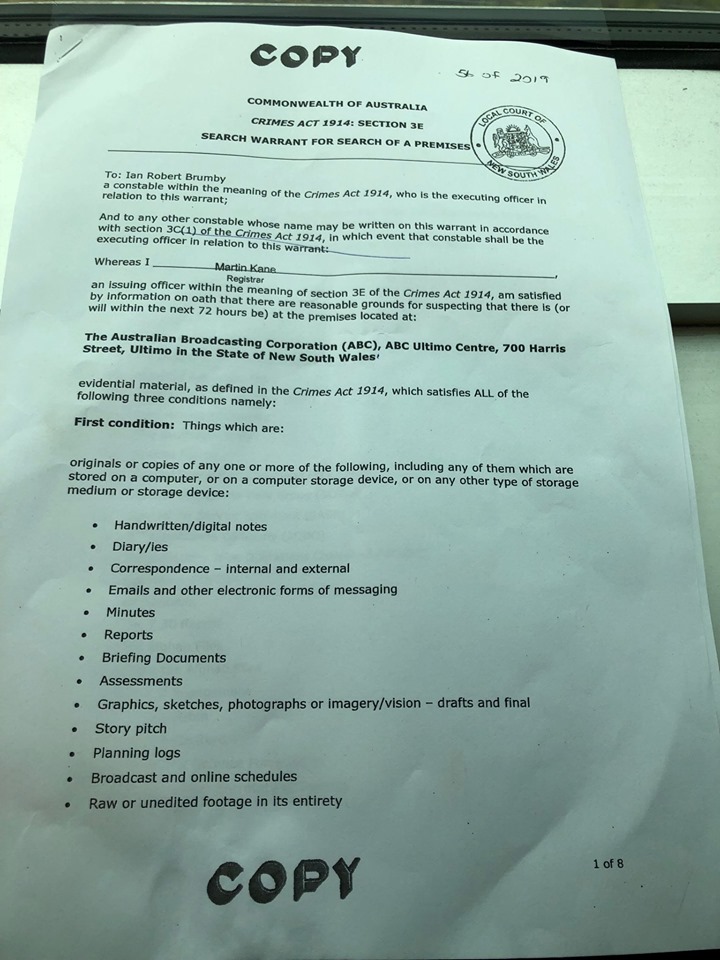
With the recent events of the federal police raids on journalists exposing the 'Afghan Files'  where documentation of unlawful killing of men and children occurred by the hands of the Australian Government where they wanted to cover this up, the corrupt courts apparently have issued a carte blanche so called warrant, where those in authority can modify add or delete documentation, in reality tampering with evidence with total impunity.

 The police state of Australia is in full swing now.

Was the federal police raid on the ABC enacted out with a lawfully issued warrant?

See attached first page of the warrant:

(Source: supplied)

PLEASE NOTE:

In Victoria, many motorists have had their livelihood destroyed by the so called sheriff and his deputies, taking action on alleged warrants, as a result of road offences, where in reality they do not exist, where the officers would ONLY present a spreadsheet style summary claiming that is all that was needed to take action.

04 June 2019

It's illegal to expose the government's criminal activity in the police state of Australia

They lie that the courts are the "people's court".

They lie that there are 3 tiers of government, i.e. law making bodies, that being federal, state and now apparently 'local government'.

They were exposed in subverting the High Court of Australia by removing the U.K. Monarch.

Now they're on the assault on people exposing corruption in government under whatever pretext, where the courts are stacked against the serfs.

See article from 4 Jun 2019 by news.com.au of the headline:

Radio star Ben Fordham targeted after Australian Federal Police raid political editor Annika Smethurst’s home over spy story


After raiding the home of a high-profile journalist, the Federal Police is now going after broadcaster Ben Fordham over his reporting.


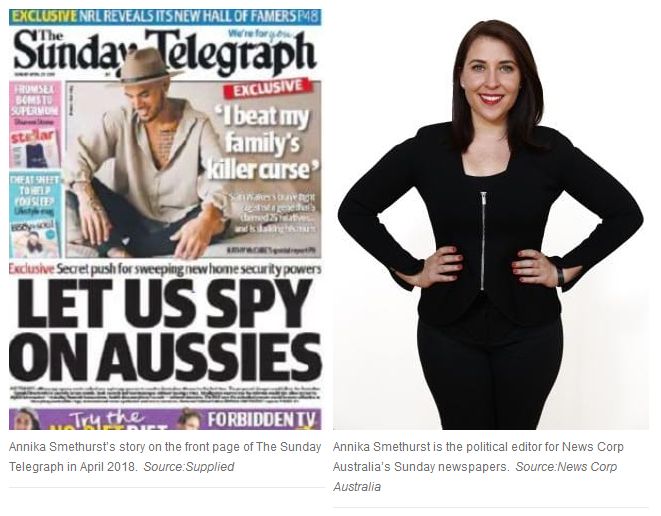
Annika Smethurst’s home in Canberra is being raided by Australian Federal Police officers. Picture: AAPSource:News Corp Australia

Just hours after the Australian Federal Police raided the home of high-profile journalist Annika Smethurst, broadcaster Ben Fordham has revealed he’s also being targeted for his reporting.

The 2GB Drive presenter and Sky News contributor revealed he was the subject of a probe over his story yesterday about six asylum seeker boats attempting to reach Australia.

An hour after his report went to air yesterday, his producer was contacted by an official from the Department of Home Affairs to advise the material was “highly confidential”.

“In other words, we weren’t supposed to know it,” Fordham told listeners today.

“We were told Home Affairs would investigate the disclosure and they would like me to assist that investigation.”

He was contacted again last night by “senior officials” and again this morning, when he was told Home Affairs had initiated an investigation that could lead to an AFP criminal investigation.


2GB Drive presenter Ben Fordham reveals his reporting also has him on the AFP’s radar. Picture: John FederSource:News Corp Australia

The revelation came as Fordham spoke about the raid today on the Canberra home of Smethurst, the Walkley Award-winning political editor of News Corp Australia’s Sunday titles, including The Sunday Telegraph.

“The timing of this raid is interesting to me because only yesterday afternoon I found out I was potentially facing a similar raid,” Fordham said.

While he was told that he wasn’t the subject of potential charges, Home Affairs wanted him to assist in identifying his source.

“It was explained to me that only a limited number of people had access to the information we broadcast,” he said.

“The chances of me revealing my sources is zero. Not today, not tomorrow, next week or next month. There is not a hope in hell of that happening.”


Annika Smethurst confirmed reports her home is being raided by AFP officers but could not comment further.Source:News Corp Australia

The “heavy-handed” raid of Smethurst’s home this morning by several AFP offices has sparked widespread outrage.

The search warrant extended not just to her dwelling but also her mobile phone and computer.

The Daily Telegraph reports the raid concerns a report published in April last year that revealed the departments of Defence and Home Affairs were considering new powers allowing Australians to be monitored for the first time.

Ms Smethurst’s original article included images of top secret letters between Home Affairs Secretary Mike Pezzullo and Defence Secretary Greg Moriarty.

News Corp Australia, publisher of news.com.au, has condemned this morning’s raid.

“The Australian public’s right to know information about government laws that could impact their lives is of fundamental importance in our society,” it said in a statement.

“This raid demonstrates a dangerous act of intimidation towards those committed to telling uncomfortable truths. The raid was outrageous and heavy handed.

“News Corp Australia has expressed the most serious concerns about the willingness of governments to undermine the Australian public’s right to know about important decisions Governments are making that can and will impact ordinary Australian citizens.

“What’s gone on this morning sends clear and dangerous signals to journalists and newsrooms across Australia. This will chill public interest reporting.”

Federal police officers leave Annika Smethurst’s home after conducting a raid. Picture: Kym SmithSource:News Corp Australia

Annika Smethurst is a Walkley Award-winning journalist. Picture: AAPSource:News Corp Australia

The top secret correspondence contained in Ms Smethurst’s original story reportedly outlined a proposal to allow government spies to “proactively disrupt and covertly remove” onshore cyber threats by “hacking into critical infrastructure”.

The proposal would also give the cyber spy agency, the Australian Signals Directorate, powers to snoop on the emails, bank accounts and text messages of Aussies, with the approval of the relevant home affairs and defence ministers.

Law currently prevents the agency from monitoring Australian citizens.

Broadcaster Ben Fordham has been contacted three times in 24 hours over a report he presented yesterday. Picture: Getty ImagesSource:Getty Images

The Australian Lawyers Alliance said the law should protect journalists and their sources from “harassment by police and security agencies”.

“Annika Smethurst’s story was clearly within the public interest,” ALA spokesman for criminal justice Greg Barns said.

“This intimidating behaviour by the police poses a serious risk to our democracy, and undermines the accountability of the government to the people that it serves.

“Scrutiny of government agencies by the media is critical to a democracy, and it is very concerning that these security agencies seem to want to avoid any examination.”

The group Digital Rights Watch has also slammed the raid, describing it as a “gross abuse of national security powers”.

“It’s incredibly worrying to see AFP officers carry out a raid on the home of a political journalist working to reveal an important public interest issue — a potential massive expansion of domestic capacity in Australian spy agencies,” the organisation’s chairman Tim Singleton Norton said.

“We fear the powers given to the AFP to seize and search Annika Smethurst’s digital footprint represent a considerable risk to bold Australians who choose to expose wrongdoing in the public services.

“This is a gross abuse of national security powers — using them to reinforce a culture of secrecy and lack of accountability in our law enforcement apparatuses.”

In a statement, the AFP confirmed a search was under way at Ms Smethurst’s home.

“The matter relates to an investigation into the alleged unauthorised disclosure of national security information that was referred to the AFP,” the statement read.

“Police will allege the unauthorised disclosure of these specific documents undermines Australia’s national security. No arrests are expected today as a result of this activity.”

The Media, Entertainment and Arts Alliance, the union for journalists, said the raid was “an outrageous attack on press freedom”.

“Yet again, we have an example of a government aiming to punish those who have brought to light vital information,” the MEAA’s media president Marcus Strom said.

“Australians are entitled to know what their governments do in their name. That clearly includes plans by government agencies to digitally spy on Australians by hacking into our emails, bank accounts and text messages.

“It is an outrage that more than a year after the story was reported in April 2018 but just days after the federal election result, the Federal Police are now raiding a journalist’s home in order to seize documents, computers and a mobile phone in order to track down the source.”

The MEAA called on Scott Morrison and his government to “show its support for press freedom”.

The digital rights organisation Electronic Frontiers Australia also expressed its condemnation.

“This is an obvious attempt to bully and intimidate journalists reporting on the latest attempted power grab by the already over-powerful Department of Home Affairs,” it said in a statement.

A number of Ms Smethurst’s colleagues in Canberra have also expressed their concern.

David Crowe, chief political correspondent for The Sydney Morning Herald and The Age newspapers, and current president of the Federal Parliamentary Press Gallery, took to Twitter to describe the raid as “a huge concern”, adding that her report “was clearly in the public interest”.

Amy Remeikis, political reporter for Guardian Australia, described the AFP search as “seriously messed up”.
Samantha Maiden, The New Daily’s political editor, said she asked Home Affairs Minister Peter Dutton about Ms Smethurst’s original story.

“He suggested the idea they were planning to spy on Australian citizens was ‘nonsense’ … today her house was raided … AFP are going through her belongings.”

A spokesperson for Mr Dutton referred all queries to the AFP.

Shadow Home Affairs spokesperson Kristina Keneally said news about the raids came while Labor’s frontbench was meeting.

“We don’t have any information to add at this point,” Senator Keneally said. “It’s incumbent on the government and the AFP now to speak more on this matter.”

Centre Alliance Senator Rex Patrick attacked the raid, saying it was a “heavy-handed effort to browbeat the media”.

“Ms Smethurst’s journalism exposed important aspects of government plans to extend surveillance powers for national security agencies,” Senator Patrick said.

“That reporting informed parliamentary and public debate and is to be commended.”

He said the execution of the search warrant at her home — not at her office — more than a year after the report was published “reeks of intimidation and retribution”.

“Home Affairs Minister Peter Dutton and Home Affairs Secretary Mike Pezzullo clearly hate media scrutiny,” Senator Patrick said.

Ms Smethurst has twice won the Walkley Award for Scoop of the Year, first in 2015 for her expose of Bronwyn Bishop’s use of taxpayer funded helicopters and again in 2017 for her reporting about Health Minister Sussan Ley’s travel expenses.

03 June 2019

Cell phone user's location data can be bought for $300


A Motherboard investigation revealed in January how any cellphone users’ real-time location could be obtained for $300. The pervasiveness of the practice, coupled with the extreme invasion of people’s privacy, is alarming.

The reporting showed there is a vibrant market for location data generated by everyone’s cell phones—information that can be incredibly detailed and provide a window into people’s most sensitive and private activities. The investigation also laid bare that cell phone carriers AT&T, Sprint, and T-Mobile, and the many third parties with access to the companies’ location data, have little interest or incentive to stop.

This market of your personal information violates federal law and Federal Communication Commission (FCC) rules that protect people’s location privacy. The market also violates FCC rules prohibiting disclosure of extremely sensitive location information derived in part from GPS data that is only to be disclosed when emergency responders need to find people during an emergency.

We expected the FCC to take immediate action to shut down the unlawful location data market and to punish the bad actors.

But many months later, the FCC has not taken any public action. It’s a bad sign when minority FCC commissioners have to take to the pages of the New York Times to call for an end to the practices, or must send their own letters to carriers to get basic information about the problem. Although some members of Congress have investigated and demanded an end to the practice, no solution is in sight.

Earlier this year, the major cell phone providers promised that they have ended or will end the practices. Those promises ring hollow after they promised to end sale of the same location data in 2018.

In light of this inaction, consumers must step up to make sure that their location data is no longer so easily sold and that laws are enforced to prohibit it from happening again.

Although much of the reporting has focused on bounty hunters’ ability to obtain anyone’s location information, documents created by the companies that accessed and sold the data show it was used for many other purposes. This includes marketing materials for car dealerships to buy real-time location data of potential buyers, and for landlords to find the locations of their potential tenants.

Even more troubling, stalkers and bounty hunters appeared to be able to impersonate law enforcement officials and use the system to find people, including victims of domestic violence.

EFF wants to stop this illegal violation of the location privacy of millions of phone users. So please tell us your stories.

If you believe these companies unlawfully shared your cell phone location information, please let us know. In particular, it would be helpful if you could tell us:
  • Who obtained your cell phone location information?
  • How did they get it?
  • How did they use it?
  • When and where did this happen?
  • What cell phone provider were you using?
  • How do you know this?
  • Do you have any documents or other evidence that shows this?
Please write to us at geolocation@eff.org.

Source: eff.org


02 June 2019

How to catalogue the next generation


As we all should know, there is no such thing as something for free, as this allegedly 'free' item or service does contain a cost value attached to it.

The authorities in this colony called Australia are conjuring up new ways to document, monitor and control their tax slave population.

What better way to get the young and naive to 'give up' their private and confidential blueprint to their existence than with a health scare that can be averted for 'free' if you give the authorities your DNA, which will be later used against you by insurance companies, to not insure you for a possible future illness that you may or may not contract, as just one example.


You may or may not know that to the authorities, you are literally a number, an expendable resource, where (in the workforce for example) if you are no longer capable of performing your task, or you are an unnecessary expense you can easily be replaced, at a cheaper rate to the employer, especially with imported slave labour on the rise, that the Australian authorities are so fond of.

If the authorities really did care about you, wouldn't this be shown in their actions, like zero homelessness, or protecting the vulnerable like Courtney Herron?

If they really did give a stuff about cancer wouldn't for example, cigarettes or McDonald's items be banned from sale?

30 May 2019

When you sleep your iPhone is programmed to send your private and personal info

(illustration: popular apps contain hidden trackers)

Annually surveillance of the mass population is a multibillion dollar industry, where is it wrapped up under so called advertising or hidden by governments under multi layered shelf corporations.

The push for smartphones and most importantly apps is enormous by governments and corporations alike, as these devices put data syphoning outside of the user's control.

Apps can and do contain 'malicious' code which extracts user data and sends it wherever the programmer has decided to send the data without the user's knowledge and most importantly without consent.

Websites on the other hand can be more easily scrutinised as to where the programmer sends the 'consumer's' (more accurate terms: data generator, corporate slave) data, but the policy is not to program, websites but rather provide apps for them.

Do you really need to read a Rupert Murdoch news site via an app, where the web address will suffice?

The Bank of Melbourne created a smartphone app, which in reality opened up a web browser on the user's smartphone in reality making that app totally useless and an unnecessary cost to the bank's customers.
Realistically apps are detrimental to your online privacy and your personal data.

Please note that even though today there are encryption programs available for communications purposes, mobile phone technology given to the masses was (deliberately) designed not to be private nor secure.

We do not recommend the purchase or use of Apple products.

Did you pay, over 2k, for them to spy on you ??? !!! ??? (PMSL)


See the topic called Surveillance Self-Defence by the Electronic Frontier Foundation at:


See article from 29 May 2019 by The Sydney Morning Herald of the headline:

Do you know who your iPhone talks to when you're sleeping?

29 May 2019

Sheriff cashing in on expired warrants

WARNING: The Victorian government is involved in a crime spree, where the unsuspecting motorist is the victim.


There are a few technicalities where the so called sheriff is acting upon seizures of goods or motor vehicles unlawfully, to be more specific, without the correct paperwork being presented, where also one of the main 'technicalities' is that the deputies are cashing in or trying to cash in on expired (alleged) warrants.

According to the law, in particular the Infringements Act of 2006, under Part 6, Section 94, warrants are VOID after 5 years.


Source: http://classic.austlii.edu.au/au/legis/vic/num_act/ia200612o2006207/

MANY people have been duped by the officers who state that the person MUST pay the alleged 'outstanding' warrants, where on a spreadsheet style, a summary is presented where some of the alleged warrants are expired by four or five years.

IF your person has been defrauded of funds by the so called Victorian Sheriff, then you may want to seek a remedy.

Please note that ANY so called warrant MUST exist in its correct format, where an execution copy is to be attached.

28 May 2019

Why your biometric unlock is not so 'secure' in the colony called Australia


At the moment in the I.T. industry, biometric (face, fingerprint) unlocking of your smartphone is touted being most secure, but unfortunately this may not be the case under many circumstances.

The brand new (on Australian shelves) Samsung Galaxy S10 has the face unlock feature built into the phone, where unfortunately for the 'consumer' the unlocking feature is not so secure as shown in the link below:


Some people (excluding the footy bogans) may have noticed that the authorities are ramping up the police state policy in this colony we call Australia.

In a deliberate misinformation campaign, only a handful of police 'mishappenings' are ever reported by the mainstream media, where the victims of police criminal activity are not in control of their actions or have had their smartphone confiscated in order not to record criminal activity committed by the police.

(disability pensioner brutally assaulted by Victoria Police)

It's at this point in time where your face id or fingerprint scanning feature of your phone becomes a liability rather than an asset, where when one is (quite often) incapacitated, either being illegally beset upon by eight officers, or just plain vanilla knocked out, one's phone can be easily unlocked.

Another 'plus' for biometric id is the 'free' (well technically, corporate slave sponsored) data it generates which is then taken to further enhance government public scanning programs.

Pattern, picture of PIN unlock is still considered more secure especially with any interaction with Australia's law enforcement (which can go pear shaped very quickly through no fault of your own), unless of course the officers involved are practicing Roman Catholics of yesteryear, where a 'little' torture goes a long way, like the judicial system did back in the day.

26 May 2019

Fingerprinting iPhones - identifying your unique phone's 'fingerprint'

Governments will use whatever technology is available to surveil their primary enemy, that being their very own domestic population, their tax payers, the people that they are allegedly supposed to serve.

THE best surveillance device at this point in time, is the smartphone that the masses fully sponsor in order for corporations and government players to spy them.

With the current sensors crammed into smartphones, data is generated to uniquely identify the device together with its user and the environment independent from location services.

See article from schneier.com of the headline:

Fingerprinting iPhones

This clever attack allows someone to uniquely identify a phone when you visit a website, based on data from the accelerometer, gyroscope, and magnetometer sensors.
We have developed a new type of fingerprinting attack, the calibration fingerprinting attack. Our attack uses data gathered from the accelerometer, gyroscope and magnetometer sensors found in smartphones to construct a globally unique fingerprint. Overall, our attack has the following advantages:
  • The attack can be launched by any website you visit or any app you use on a vulnerable device without requiring any explicit confirmation or consent from you.
  • The attack takes less than one second to generate a fingerprint.
  • The attack can generate a globally unique fingerprint for iOS devices.
  • The calibration fingerprint never changes, even after a factory reset.
  • The attack provides an effective means to track you as you browse across the web and move between apps on your phone.
* Following our disclosure, Apple has patched this vulnerability in iOS 12.2.
Research paper.