28 April 2023

How your phone tracks you and how to throttle the tracking


When it comes to privacy in today’s modern world it is virtually non existent for the general population.

Today’s most widely used surveillance device by the governments and corporations is the self sponsored ubiquitous mobile phone, which bugles the location a lot and invades the privacy of the user.

A personal computer (even a laptop with inbuilt camera & microphone) can be more easily configured to mitigate data collection, where a mobile phone also leaks bio-metric data including the surroundings.

Sensors that give the above information can be turned off in Developer Options of AOSP.

Since at lest the 4th generation iPod touch, Apple used its sensors (3-axis gyro, accelerometer) combined with known database of Wi-Fi router locations to obtain the user's location very accurately.

That’s why there is a huge push from governments and corporations for the general population to use smartphones and apps which also harvest ‘private & confidential’ user data.

The reality is that the general population is tracked & monitored 24/7 by the ‘5-eyes’ global surveillance network, which also the ‘9-Eyes’ & ‘14-Eyes’ nations are part of, where this surveillance is not for the benefit nor protection of the people.

MANY people may be of the the erroneous belief that the surveillance began since the introduction of smartphones or the inclusion of GPS chips into the phones, but in reality tracking occurred with the introduction of GSM phones via cell tower triangulation and audio via deliberately ‘flawed’ or insecure communications protocols.

Spying via mobile phones is supported at two levels, the hardware layer, that being the baseband modem and the application layer meaning programs or ‘apps’.

The PC world has not been left out in the cold, ‘malicious’ code, no ‘backdoor’, no ‘administrative’ portal has been put into Intel branded CPUs that went undetected for many years, where there is no action to remove this ‘computer in a chip’ by Intel.

The humble ‘landline’ didn’t get left out either.

For example in the United States, all phone records have been ‘outsourced’ to an Israeli corporation called Amdocs, where in Australia Telstra also worked with Amdocs in a discrete deal and location.

A lesser mentioned fact is that Israel is a top tier surveillance state with products like Cellebrite, and educational institutions designed for the sole purpose of hacking.

Israel is also involved in surveillance technologies within hardware manufacturers such as Intel and in software from Google, Microsoft, Meta (nee Facebook) and many other ventures.

In the mobile phone arena, people are given the illusion that they have a choice, you know the red pill or the blue one or Apple & Google, where in this duopoly the data goes back to the same people.

Other ‘competitors’ e.g. BlackBerry or Microsoft have been shut down for the purpose of easier administration having the duopoly only to contend with, just like in anything else, from politics e.g. East v West, North v South, Liberal v Labor to supermarkets Coles v Woolworths.

While there are other manufacturers of privacy related phone tech, they do not influence the market enough to make an impact, but nonetheless they still exist.

Apple’s hardware and software is so locked down where even replacing a faulty camera module or battery may render your device unusable, not very good if it’s truly ‘your’ device.

In the Android world it’s a bit better where a base version of Android, devoid of Google's and manufacturer's spy or bloatware called AOSP (Android Open Source Project), is available for certain phones.

This ‘de-Googled’ operating system cut off other newer ways of spying on people, that being via Wi-Fi Scanning and Bluetooth Scanning, and also ‘Contact Tracing’ which is embedded in the retail smartphones such from e.g. Samsung, LG, Sony, Nokia, Motorola etc.

In AOSP, there is no Contact Tracing or 'Exposure Notifications' programming for apps to later reference, unlike in retail phone's Android or Apple's iPhones. 

One can also ‘de-Google’ a Google phone (how ironic) via GrapheneOS, another flavour of AOSP only compiled for Google Pixel phones.

Because the internet today cannot function without Google (a legal topic that should be fought out in a multi-billion dollar lawsuit) in order to get some more modern useful functionality like apps and notifications the AOSP community has you covered.

In order to better spy on you, corporations (and governments) want/need you to login to your phone, e.g. mail services by Google or Microsoft or Social Welfare services e.g. ‘myGov’ in Australia.

These actions are not recommended if one is truly concerned about one’s privacy.

AOSP has created an app called microG that has anonymised your usage with Google and negated any requirement for you to login to Google on your phone.

Unlike Google’s core services app (Google Play Services, com.google.android.gms) microG does not obtain data from your contacts SMS or phone apps.

Hidden in the microG setting, there is a setting that is not available in the standard Android phones, that being in Location Module which includes the Mozilla Location Service setting which can be configured to disable Wi-Fi data & Cell data being sent to the geolocation service.

This is another way to stop data collection on you.

You can also obtain apps from Google’s Play Store, again without the need to login to Google, with the use of an app called Aurora Store, but keeping in mind that most of the data collection is done via apps.

Developers that respect your privacy, offering their programs up for scrutiny put their applications in an ‘open source’ app store called F-droid.
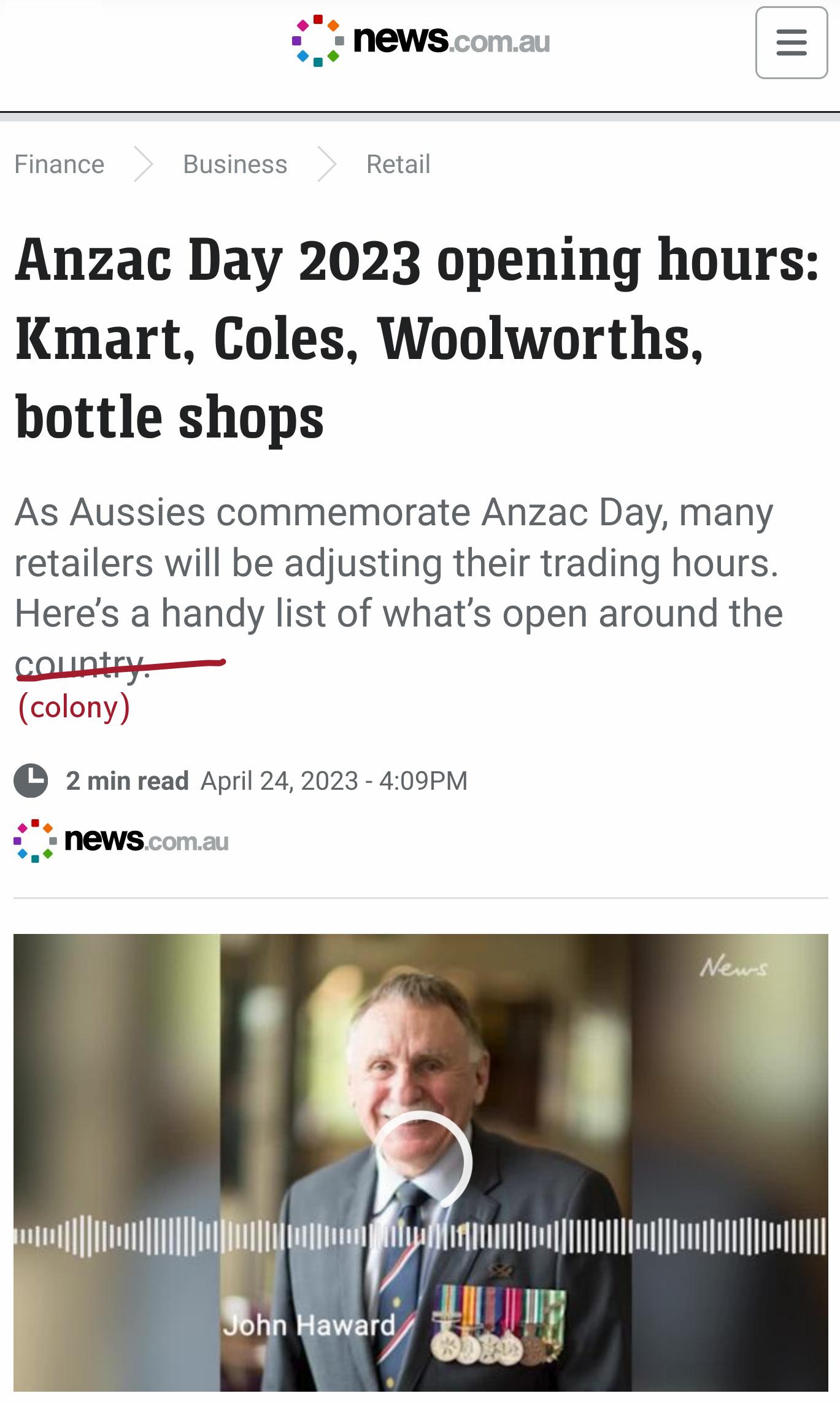
25 April 2023

What’s important on ANZAC Day?


Every year it’s the same, where the nation stops to commemorate the perils of war, right?

Nope!

Only a few hours are set aside, an inconvenience to those who are at the lowest level of Maslow’s Hierarchy of Needs.

After all that’s what Australia is all about, the ‘economy’.

Got to keep those mice turning that wheel perpetually.


You, the corporate fodder (or more appropriately known as ‘consumers’) have to keep spending, to keep the economy going, ‘their’ economy.

You’re told not to hoard (old terminology; save up) cash in order to purchase a television or vehicle, but rather get a loan for it to keep the banks and financial institutions profiteering from usury (refer to the Statute of the Jewry) on the fruits of your labour, a modern day accepted form of slavery.

But isn’t hoarding what the global elite do? 

They amass vast sums of cash, lock up art in private collections, and even keep stolen artefacts from their thieving ways, the British ‘monarchy’ as just one example.

What’s not important on ANZAC Day?

For you to know that what is known as World War I, was actually a ‘cousin’s’ war, where the offspring of the serfs were seen as cannon fodder and thus put in their appropriate use case scenario for the entertainment and financial gain of the global elite.

True sociopaths are in control.

What’s more disgusting is that people accept this, but then again, the majority of people are not supposed to think.

See Manufacturing Consent excerpt by Noam Chomsky:


What business did Australia have in going over the seas to kill people of other nations?

Well, the colony is at the disposal of the Imperial empire’s whims, of course.

It’s a breeding ground for resources to be used however fit the empire sees.

Let’s take the example of Indigenous Australians.

Because of their excellent skill sets they where used abroad by the British.

How were they repaid? What did the British think of that?

Well the actions speak for themselves, with the detonation of an atomic bomb in Maralinga.

Have we forgotten about that? 

Maybe we aren't supposed to teach our children, of the poisoning of people and landscapes that governments and corporations do, or your so called ‘recycling’ isn't going to change centuries and millennia of cyclic whether patterns, but rather keep the focus on consumerism?

Hoping McDonald’s is open so we can have a 5 burger deal for lunch only, where for dinner it's KFC for a family size bucket of junk for one to consume. 

22 April 2023

Government in contempt of Supreme Court ruling, re: C-19 fines


The colony has a very rich history of abuse by those in government.

In the 1800s Imperial law (No it wasn’t 1788, contrary to popular belief) was established on this land, but those in government ignored it completely.

So much so that when Britain found out, the empire installed the Colonial Laws Validity Act in 1865.

While much has changed since then, some things never do, that being the illegal or unlawful behaviour of those in control of the general population.

The general population are being terrorised by those in government from many fronts.

The state’s premiers dictated to police, (an illegal action) to issue notices to people for so called C-19 ‘Infringements’ where exorbitant amounts were listed.

The problem there was that those in government did not follow the law in order to put into place lawfully enacted infrastructure in order to issue the said fines.

MANY people have caught on via the help of social media platforms and other forums, culminating in court action against the government.

Even though the Supreme Court of New South Wales issued a ruling, the people in government have not heeded to this, therefore being in contempt.


We should all be aware if the plebs are in contempt of a court ruling, there are consequences.

It’s up to you to hold them accountable and make them pay.

So far the people in government have had no consequences as a result of a breach of the court ruling.

See case file:


20 April 2023

Federal Police CAUGHT ON CAMERA fabricating evidence

WARNING: Never trust the police.

The police lie, tamper with evidence and provide false statements in court.

The police are not there for you, nor are they your 'friend'.


The best part of all this is that they are allowed to get away with this.

Where those police personnel charged with criminal offences?

19 April 2023

Supreme Courts Rules COVID Fines Invalid as the Penalty Notices Did Not Specify the Offence


The overbearing law enforcement approach to the COVID pandemic, which had a focus on criminalising those who didn’t follow health restrictions, via the widespread imposition of draconian fines that were issued seemingly with no discretion and in the most absurd of circumstances.

Following the passing of the pandemic, as people went back to business as usual, however, many civilians had to deal with these outstanding fines continuing to hang over their heads as the average COVID infringement notice amounted to $1,000,

So, the Redfern Legal Centre (RLC) challenged the legitimacy of COVID fines issued to three clients, who sought declaratory relief from the penalties they were subjected to, in accordance with section 69 of the Supreme Court Act 1970 (NSW), with the outcome likely to affect thousands in NSW.

Brendan Beame, Teal Els and Rohan Pank all claimed that the penalty notice they received failed to fall within the bounds of the meaning of such a notice, which are set out in section 20 of the Fines Act 1996 (NSW) (the Act). Although Pank had his fine dropped prior to the case going ahead.

And on appearing in court last November, the remaining pair sought acknowledgement that the NSW fines administration commissioner couldn’t serve an enforcement notice regarding their fines, that their partial covering of the fines be refunded and that the state pay their court costs.

For the crime of picnicking

Beame received his penalty notice in the sum of $1000 on 6 August 2021 penalty notice, which specified the location and time of the offence, as well as a description of it which read “Fail to comply with noticed direction in relation to section 7/8/9 – COVID-19 – Individual”.

Offence code 95638 was also listed, which, contained in section 10 of the Public Health Act 2010 (NSW), is the offence of failing to comply with a public health order in section 7, 8 or 9 of the same legislation.

This offence carries maximum penalties of 6 months imprisonment and/or a fine of up to $11,000.

Section 7 of the Public Health Act provides the minister with the power to isolate inhabitants, reduce risks and prevent movement into an area in relation to a health risk. Section 8 can require individuals undertake medical examination, while section 9 deals with authorities posing such health risks.

Brendan’s crime was having a picnic at Bronte with five others, four of whom were from other households. And in an internal review, Beame put it to Revenue NSW in December 2021, that as the notice didn’t specify a specific offence it was “contrary to law”: a claim that was rejected.

The offence of watching kids play  

Els was fined $3,000 on 28 August 2021 over having participated in an outdoor gathering of more than two people at a reserve on Tonbridge Street in Ramsgate, “an area of concern”, on 28 August 2021.

The penalty notice specified offence 97722, which is contrary to section 10, as it relates to a failure to comply with “a direction given by Minister in section 7 order for participating in outdoor gathering”. The notice doesn’t mention the related legislation or specify what the breach was.

Els made two applications for internal review with Revenue NSW in 2021 and 2022. The first stated that she’d been in the park with her child, supervising them exercising with other kids, while the second asserted it was “unfair and unjust” that the notice failed to state what she’d done wrong.

A change of heart

RLC senior solicitor Samantha Lee submitted two affidavits to the court, which included the number of fines issued similar to those of the plaintiffs, and while the defence objected to this, NSW Supreme Court Justice Dina Yehia determined it was relevant during the 29 November 2022 hearing.

These details set out that, in terms of the Els notice, another 162 people were fined $3,000 for “unlawfully participating in outdoor public gathering”, while 32,648 penalty notices were set out in a similar manner to Beame’s notice.

A month prior to proceedings, the defendants, the NSW police commissioner and the NSW fines commissioner, argued the fines were valid, as section 20 of the Act doesn’t require detailing of a specific offence or the legislative provision and what did appear on the notices should suffice.

Yet, on the day prior to court, the defendants agreed the notices were inadequate and the partial payment that Beame and Els had made be refunded, although a declaration about the invalid nature of a specific division of the Act should not be provided, as it would limit issuing any fines under it.

Those declarations

According to Justice Yehia, the question turned to whether the court should make the requested declarations even though the commissioner had conceded he would not be issuing further penalty notices to the plaintiffs and, indeed, the money paid in relation to the fines would be refunded.

“Where the subject notices have been declared invalid, the plaintiffs are plainly entitled to the consequential orders,” her Honour noted, adding that these would provide certainty, vindicate the plaintiffs’ claims, and they’d serve to notify the public of the resulting consequences of the decision.

But, while the justice considered that declarations regarding the notices in question falling outside the bounds of section 20 and the fact the plaintiffs were refunded should be issued, the requested declaration that would find fines can’t be issued under part 3 division 4 of the Act should not.

Reasons of the court

Despite the defence suggesting that the invalidation of the penalty notices under scrutiny ruled out any need to provide reasons, Justice Yehia considered it was necessary to provide, as they’d deliver “certainty in relation to the basis for the invalidity” of the penalty notices.

Section 3 of the Act defines a penalty notice offence as “an offence under a statutory provision for which a penalty notice may be issued”. While, contained in part 3 division 2 of the Act, section 20 states that “the penalty notice offence must be specified in the notice”, along with the fine amount.

Section 22A of the Act then incentives an individual to promptly pay their fine, in order to avoid further liability for wrongdoing in court. Therefore, according to Justice Yehia, its “imperative” that the offence is specified on the notice in order to follow the suggested path to avoid this. 

Another key reason for a detailed offence being laid out in the notice is that section 23 of the Act outlines that the fine amount cannot exceed the maximum penalty triggered by an offence, but this is impossible to verify if the recipient fails to understand which actual offence they’ve breached.

And a further issue is that section 24A outlines how the recipient of a fine can apply to have a decision internally reviewed, however this process is again complicated when the person to submit the review application doesn’t have a clear idea of the offence they’re supposed to have committed.

In respect of section 20, “the statutory context and purpose favours an interpretation whereby the penalty notice offence must be clearly and unambiguously specified in the notice itself”, Justice Yehia made certain.

The broader implications

Justice Yehia first handed down her decision, finding both penalty notices to be invalid, during the November 2022 hearing. Although her full findings weren’t published until 6 April this year.

As a result of her initial decision, over 33,000 COVID fines issued in NSW, or more than half, were revoked last December.

And following the release of her Honour’s findings two weeks ago, Redfern Legal Centre considers the ruling could invalidate the remaining 29,000-odd fines issued during the pandemic.

“The government must now do the right thing and withdraw all COVID-19 fines that were issued, including withdrawing those offences for which individuals elected to take to court, any Work and Development Orders and reimburse fines already paid,” RLC senior solicitor Lee said in a statement.

Source:nswcourts.com.au

17 April 2023

What’s really killing your phone battery life

MANY phone manufacturers may boast that their newest wares will last on a single charge for the whole day.

Wow! What an accolade, a technological breakthrough!

So what sort of battery is needed for this ‘smart’ phone to last a day? 4000mAh, 5000mAh?

Battery drain on an AOSP phone with a 3000mAh battery.

Sure the processing power as well as the screen size has increased dramatically over the years where they are most taxing on your battery, or are they?

So called tech reviewers on various ‘social media’ platforms will spruik the manufacturer’s newest wares in order to boost their income, so their reviews will not be without bias.

One deliberately overlooked aspect by the tech ‘gurus’ is the software, as realistically this is what makes or ‘breaks’ any computer.

Governments and corporations have ramped up their attack on people’s privacy (and technically therefore security), where this is the case across all ‘mainstream’ platforms.

In the smartphone operating system world, surveillance of the ‘user’ (or product) has increased under a health pretext, where the user has unlawfully, no opt-out choice, which is something that is deliberately not reported by any mainstream news sources.

You MUST be surveilled, and that’s it, period. It’s for your own good, allegedly.

We do not recommend any person to make their decisions on technology from mainstream media outlets.

Phone manufacturers, including Apple, load their hardware with ‘spyware’ baked into the operating system, in seemingly innocuous settings that go under the labels of Wi-Fi Scanning and Bluetooth Scanning.


Another computer that gives away your location is the baseband modem, which is active 24/7 when a SIM card is inserted, but this topic is not part of the scope of this article.

In these OEM (Original Equipment Manufacturer) devices, this setting contributes significantly to battery loss, as this process runs in the background, pinging cell towers and devices 24/7 and ‘phoning home’ to corporations and governments your precise location many times a minute.

Your so called privacy is thrown under a bus the moment you use a computer or phone, where one can only mitigate some of the data the authorities obtain.

With reference to Android powered phones, some manufacturer's phones can run the basic open source, non spyware loaded version of Android called AOSP (Android Open Source Project).

With this bare bones operating system one can turn off the two settings mentioned previously, at the  end user and developer levels, where they are truly off.


There are limitations to using this version of the operating system, where one can search forums on this topic.

The AOSP is available from developers of LineageOS, e foundation or GrapheneOS.

Others have got into the privacy bandwagon, with ‘generic’ hardware and a fork of LineageOS, under the label BraxOS on a BraX2 smartphone.

We do not recommend the use of Apple products if privacy is of concern to you.

14 April 2023

11 April 2023

FBI Glossary for Flagging 'Violent Extremism'

Victoria Police brutal violence against news photographers is not considered 'violent extremism' by government.


See the FOIA obtained by the Heritage Foundation Oversight Project:


Pity there is no action describing Victorian premier's Daniel Michael Andrews of 'violent extremism' where Victoria Police was ordered to shoot the general population in the back, while the constituents were exercising their so called right to free speech.

Australia is a fascist totalitarian state, but that is kept under wraps by the world's mainstream media.

10 April 2023

NSW Police Turned Their Body Cameras Off Before Fatally Shooting Mentally Ill Man


NSW police tactical operations officers didn’t have to shoot Todd McKenzie dead on a July evening in 2019. Yet, following a nine-hour siege, five officers stormed his Taree home, where he was alone, and shot the 40-year-old man, having a mental health crisis, three times in the back.

Evidence heard in the first week of his inquest has a local officer, who was attending a man having a schizophrenic episode, proceeding to aggravate McKenzie, suggesting that he was “speaking dribble”, lying and a drain on the country, while he further taunted Todd to step outside for a fight.

Over the second week of the coronial inquiry, testimony revealed that when Tactical Operations Regional Support officers arrived at the scene, they then ordered local police to turn off their body-worn cameras, despite Taree officers having been recording for the previous two and a half hours.

The police approach taken to McKenzie, which resulted in a lone man armed with only kitchen utensils being killed in his home, is a tragedy in itself. But it also highlights the issue with the criminal justice system being employed to regularly police and detain people with mental health issues.

Beginning on 27 March, the three-week inquest was delayed, as an attempt by police to suppress procedural details and officer names was challenged by Todd’s parent’s legal representatives, the National Justice Project, which asserted such information could be vital in preventing future deaths.

From left to right: Neil Wilkins, barrister Self Rumbewas, June Wilkins, National Justice Project director George Newhouse and Jason Hesse


Ensuring a lack of accountability

“If the local police thought to turn on their body-worn cameras when they spoke with Todd, why couldn’t all those present have cameras running, particularly when police officers breached the front door of Todd’s house?” questioned National Justice Project director George Newhouse.

“Todd was not a terrorist. There were no hostages,” the principal solicitor made clear. “In fact, Todd was alone in his own home when NSW police decided to breach his house and security – you have to ask yourself why police would need to turn off their body-worn cameras in a life-or-death situation.”

In responding to a question from counsel assisting the coroner this week, a Taree senior police constable told the court that “obviously the tactical guys wanted all body-worn switched off”, as if it was par for the course.

Then, at 9.50 pm on 31 July 2019, with McKenzie’s home having been long surrounded by police, five tactical operations officers entered the house and went on to shoot the Taree man three times in the back, after, it’s claimed, he lunged at the police with a kitchen knife.

“If we had some more video evidence of this tragic event, today we would know much more about what happened that night,” Newhouse added in his 5th March statement. “NSW police must mandate the use of body cameras, at all times, as a vital tool for accountability and learning.”

Taunting the subject

NSW police claims that special officers, on entering the premises, initially used a stun gun on McKenzie to no avail, AAP News reported on 30 March. And after he was shot in the back three times, the 40-year-old man was then rushed to Manning Base Hospital, where he died.

One police negotiator gave evidence during the inquiry, relating to how she’d responded to McKenzie having episodes in the past, stating that he’d never been violent before, that he was “always cooperative with police”, and that he’d “never been confrontational”.

However, NJP put to the court that during the standoff, a general duties officer having taunted McKenzie, saying “confronting and derogative things”, is likely to have escalated the situation, and it was in direct contravention of the approach specialist officers are trained to take.

Early on during the siege, McKenzie had told general duties officers that his great-grandfather was an Anzac soldier, and he was in possession of his medals. And the officer in question then proceeded to contradict these assertions and goaded the man to come outside with his knife.

Criminalising the mentally ill

Police responding to McKenzie’s mental health episode is no anomaly, in fact, it’s the norm. A similar case occurred recently in Queensland, which saw police shoot down First Nations man Aubrey Donahue just last month, after they’d been called to respond to his threats to self-harm.

Over the year following McKenzie’s death, NSW police began trialling PACER (Police, Ambulance, Clinician, Early Response) at ten police districts across Sydney. The PACER program aims to provide a joint law enforcement and mental health response at such incidents.

However, PACER has yet to have been rolled out statewide and regional areas, like Taree, remain outside of its scope.

In 2018, Greens Senator David Shoebridge, whilst serving in NSW parliament, obtained police statistics, which reveal that over the previous two decades, NSW police officers had shot and killed 35 individuals, 19 of whom were people with a mental health condition.

This issue is not confined to law enforcement being deployed to mental health crises, however, as it also involves huge numbers of people suffering such issues being incarcerated, rather than receiving professional treatment, and this is especially so for First Nations people with mental health issues.

Todd’s aunt Margarette Hill and mother June Wilkins at Lidcombe Coroner’s Court in July 2022

An avoidable tragedy

McKenzie’s aunt Francene Reo told reporters on the day after the shooting that, “It’s something that has been happening again and again and again, when you have somebody who has an acknowledged mental health problem, they have an incident, and they end up dead.”

In representing McKenzie’s mother, June Wilkins, and his stepfather, Neil, NJP says it’s important to establish whether the police aggravated the situation and ascertain whether there was adequate engagement with the family and mental health professionals in the lead up to his death.

“The NSW police have to deal with what happened. There have been so many inquests before this one, but things in NSW police don’t seem to change,” McKenzie’s parents said last week.

“Todd was kind and gentle. He wouldn’t have hurt anybody if left alone.”