17 June 2023

Police & FOI Work Together to Block Citizens’ Access to Their Own Data


It has been reported that the Queensland Freedom of Information Office (QFOI) and the State’s Police Force (QPS) are working together to prevent citizens from accessing their own personal data.

Restricting access to information

The Queensland Police Records and Information Management Exchange (QPrime) database stores a range of personal information about Queensland residents.

Officers from the QPS and QFOI sat down for a meeting last year to discuss the ‘nature or the breadth of the applications that were being received and the consequences of the breath of those…’.

The government agencies say they ‘identified there were much broader public policy implications to be considered in terms of what documents get released’, before agreeing that citizens should be block from accessing information about themselves on the database.

Right to access personal data

Privacy advocates has slammed the ‘behind closed doors’ meeting as well as the decision of the agencies to ‘quietly agree’ not to release the data.

They point out that in a democracy, it is fundamental for citizens to have access to personal data held by government agencies in order to make the state accountable for misconduct and help safeguard against abuses of power.

They are concerned by the fact the meeting and its resolution occurred in the absence of consultation with other organisations or agencies, making it appear the QPS and QFOI are ‘in cahoots’ with denying citizens important rights to information that is being held about them – information that can expose illegal monitoring and investigations, among other things.

President of the Queensland Civil and Administrative Tribunal, Justice Martin Daubney, has launched a scathing criticism of the conduct, stating:

‘It’s starting to sound awfully like the police and the [QFOI] sat down behind closed doors to set matters of policy… Can you just sit back and think about how this looks? If it were to be the subject of discussion, I don’t know, on the front page of a metropolitan daily, you know, how would that look?

“There’s this old-fashioned thing called the rules of natural justice and giving people the opportunity to be heard.”

Access to information

Queensland privacy laws currently require government agencies that hold personal information to grant individuals access.

One of the reasons for this rule is that people should be allowed to check and review their own information, and request that it be changed. There are limited exceptions to this rule, including where it is against the “public interest”.

Since 2016, the QPS has been routinely refusing access on this ground.

If police refuse to release information, the next step is to apply for access to access through the QFOI – which is meant to be an independent body that reviews contested information access decisions made by state government agencies.

No blanket refusal

The QPS has released a statement to the effect it does not have a policy of ‘blanket refusal’ to access.

It claims the ‘right to information’ is still assessed on an individual basis, and that refusal only occurs if release would “likely be contrary to the public interest as it causes significant detriment to the QPS law enforcement activities”.

Concealing police corruption?

However, the chairman of the Australian Privacy Foundation, David Vaile, suggests that police are engaging in the routine refusal of access, and one of the reasons may be to conceal the extent of police data breaches and other illegal activities, as well as to conceal evidence of its mismanagement of information and procedural breaches.

Privacy breaches

In recent years, several police officers have faced investigations and even criminal charges for computer hacking offences.

In one case, an officer was charged for looking up the personal details of his former girlfriends as well as the former Australian netball captain, Laura Geitz, “out of curiosity”.

More recently, Senior Queensland Police Officer Neil Punchard was charged with nine computer hacking offences for using the QPrime Database to look up the confidential details of a domestic violence victim. He then gave the woman’s new address to his friend, the woman’s abusive former partner.

Social Justice advocate Renee Eaves has also publicly revealed that when she was able to access her file from the QPrime database, it showed police had accessed her records 1,400 times over eight years.

There are concerns that many officers who have illegally used restricted databases have gone undisciplined, with a report finding that QPS took no disciplinary action against 52 of the 59 officers investigated internally for computer hacking during a 13-month period.


Source: Sydney Criminal Lawyers

15 June 2023

The lies of manufacturers and reviewers on Solid State Drives


What's the BEST drive for gaming?

What drive is for 'content' creators, you know OnlyFans?

What SSD is best for workstation type loads?

Is 7300MB per second too slow for my games?

There are many misconceptions and 'lies' used to promote a manufacturer's wares, in order to be the sales kings of the industry.

It's a bit like reading an automotive manufacturer's fuel economy figures which can even be 30% less than in the real world.

Unfortunately many so called tech reviewers also have little to no idea, where all they're doing is supporting the advertising babble.

"What's the best gaming SSD in 2023?" could be answered in a simple line being: The same one as in 2020?

There are other more crucial specifications that are deliberately not focused on such as longevity, endurance, or even how long can the maximum speed be kept for, or a more real world use case scenario that 99% of the computing population does, where the speed of random read and writes are most important.

One of the better explanations out there is presented in this video:


See also:

User reviews useless compared to tech reviews, eg. Western Digital SN350

12 June 2023

King’s Birthday, but is there a ‘King’ of Australia?


On the 12 of June most of Australia, except for Queensland and Western Australia celebrates the UK’s monarch’s birthday.

Before, it was known for most people’s lives as the Queen’s birthday, where there was also a Queen of ‘Australia’ which the legal system works under.

Was this figure put in lawfully into the colony’s legislature?

Short answer, no.

So now the motherland has a new monarch, but does that make him automatically a ‘King’ of the colony?

Of course not, as always there is a procedure that must be adhered to.

So let’s see if the ‘rascals and outlaws’ in the colony have done their paperwork correctly?

Does Australia’s Constitution allow for the creation of a ‘King of Australia’?

Remembering that the Constitution is Australia’s fundamental legal document, describing how the people in government must act, including their oath for appointments.

Is there an enumerated head of power within the Constitution to create a title for the King of Australia?

Let’s not buy into a conspiracy theories, and go straight to the government, after all isn’t their word final?

A FOI (Freedom of Information) request was sent to the Australian Government to provide the necessary paperwork.

On the 20th of October 2020 a response was given.

See document FOI22/234; CM22/43725, below:


Source:

https://constitutionwatch.com.au/is-there-a-power-within-the-constitution-to-create-a-king-of-australia/

"This most recent Freedom of Information response fails to provide for an enumerated head of power within the constitution to create a title for the King of Australia. There is no current instrument one can point to for a legal purpose to use an alternate title in Australian and State law. If you can point to the Royal Style and Titles Act 1973 for the Queens title (albeit beyond power) which legal instrument does the Australian and State Government's rely upon for a constitutional source of authority within Australia if there is no instrument creating a new title for our Commonwealth realm?"

AS if that’s not enough, let’s not stop at just one question.

As we know the authorities act beyond their power in many cases.

Robodebt, Victorian residential tower lock ups just to name a recent couple.

Lets see if the Australian authorities have shoved in a King somewhere into this colony.

Please note that Butterworths Australian Legal Dictionary states the following on Enumerated powers doctrine:

The doctrine that, where the Commonwealth seeks to support the validity of its legislation, it is necessary for the Commonwealth to point to an enumerated power given to it in the Commonwealth Constitution.


So, once again the final word of those in control of the plebs was sought to clarify any misgivings.

The author of the Freedom of Information Request made to the Prime Minister and Cabinets Office who administrate the Royal Style and Titles Act which creates a title for the monarch to adopt for use in relation to Australia and its Territories beyond the power of the Parliament of Australia was transferred to the Attorney Generals Office for response.

See Document FOI23/154; CM23/6473:


Source:

https://constitutionwatch.com.au/is-there-currently-a-king-of-australia/

It is clear that neither the Prime Minister and Cabinet Office nor the Attorney Generals Office can provide a law made by the Parliament of the Commonwealth under the Constitution, binding on all the courts, judges and people of every State and every part of the Commonwealth for the valid creation of a title for the King to adopt in relation to Australia and its Territories. Additionally they could not provide the valid enumerated Head of Power within the Constitution to empower the Parliament to enact an Act to create a title for the monarch to adopt for use in relation to Australia and its Territories.

If no such title exists and no such Act has been created for this adoption where can one point to for the power and authority of the Parliament, the legislator and the Judiciary?

11 June 2023

Documents Removed – How to plea in court


The Australian Government and its subsidiaries is corrupt to the core.

The colony’s residents live in a totalitarian state, where propaganda states that democracy prevails.

MANY are also oblivious to the corruption within the legal business, but don’t count on the mainstream media’s ‘investigative’ journalists to tell you, as they’ve been wiped out a while ago, where they’re basically government and corporate lapdogs.

So called ‘free speech’ has been a thing of the past for a while, where it was crushed since the advent of an (alleged) global health situation.

Governments and their subservient ‘news’ outlets together with the world’s largest advertising corporations masquerading as ‘social media’ (Meta) and search engines (Google) and others, went on a vicious assault on free speech removing information under the banner of alleged misinformation.

People even posting official government documentation were not only stopped from doing so, but also banned from sites.

In Australia one does not have the alleged democratic right to protest, but rather has to ask for permission from the state’s police forces.

Australia is a much better version of Xi Jinping’s China or Kim Jong-Un’s North Korea communist regimes, but better for those in government and not people.

The legal profession is one that cons people into many actions, where consent is the most important one, which is obtained via fear, force or deception.

One of the government’s fraud on the people during the past 3 years was the unlawful issuing of Infringement Notices, or colloquially known as ‘Covid fines’

This government fraud has been exposed for New South Wales and also Victoria, but the governments are still chasing people for them, where it's crickets for the other states.

Never forget that the federal government also acted unlawfully in the ‘Robodebt’ social security scam against recipients, where suicides occurred as a result.

One of the biggest legal scams that has been going around for decades that is hidden from the public or more specifically those trying to obtain ‘justice’, by the ‘administration of justice’ also including lawyers, solicitors, court registrars, magistrates and judges is that what is referred to as the ‘3 pleas’.

At any point in time, usually the morning queue would be the best time to conduct this survey, in any court, is when a man or woman come up to the front desk to see the court clerk with regards to one’s matter, the clerk will ask “ How do you wish to plea, guilty or not guilty”.

There is the first lie to you by the court.

This type of lie is referred as lying by omission.

You do not have two choices, guilty or not guilty, but also a third one, that being no plea, which they do not want you to use, as this is costly to the administration, but vital to your defence.

This site has been interfered with by unknown external entities where documents and videos have been removed.

Attention has been drawn to a post from January 2016, where a legal document has been removed from the post How to plea in court see link: https://corpau.blogspot.com/2016/01/how-to-plea-in-court.html which has now been restored.

This document is a government created document, being specific, an excerpt from the Magistrates’ Court Criminal Procedure Rules 2009, Form 43.

A current version of the document is as follows:


Which is sourced from:

See other posts:


10 June 2023

User reviews useless compared to tech reviews, eg. Western Digital SN350


MANY people base their purchase decision on ‘consumer’s’ opinions, where in reality there is zero way of knowing whether or not they are fake.

The mainstream media jumps on this as well, using this as a huge promotional point, in their click bait advertising model.

One of the worst places an electronics ‘consumer’ could go for advice is to a mainstream media ‘news’ site, for example Rupert Murdoch’s ‘news’ empire from some tech flog using a pseudonym, trying to convince you that Apple’s newest features are worthy of your attention or most importantly your hard earned dollars, in these times of government created austerity.

Even a website’s so called reviews on a particular piece of electronics equipment would not be the best place for reference.

They could be false, they could be bots or even the company's webmaster faking reviews on the orders of the CEO.

In this instance the under the spotlight is a SSD (Sold State Drive) from WD (Western Digital), in particular the SN350 model range.

From the reviews of a tech warehouse one would be of the belief that this is a great product to purchase.


Even from another tech warehouse that touts itself as "Australia's Largest Online Tech Retailer" the technobable they give you sounds impressive:

Well, that's all fine and Dandy, but you (the 'consumer') are missing some vital pieces of information about the product, that being its longevity which is typically given to you in the form of acronyms that being MTBF (Mean Time Between Failures, in hours) and TBW (Tera Bytes Written, in the unit explained).

SSDs failure rate is in the millions of hours, where the WD Green is rated at 1,000,000 hours.

A drive with a 1,000,000 MTBF will equate to being switched on 24 hrs per day for 41,666 days or 114 years of continuous use.

If one was to argue that the drive would be used for only 8 hours per day, then the duration would theoretically quadripple  to over 456 years, where that is yet to be proven.

While this may sound like an eternity ore more like 18.25 (human life) generations, this is by far the lowest in the industry, where 1.5 - 2.0 million hours are more prevalent or acceptable.

Another measure of longevity or 'wear factor' is the Terabytes written figure.

In the above screen capture that all important figure is missing, where one would have to go out of one's way in order to obtain Western Digital's Product Brief to check out the rest of the important specifications, eg:


One company though went to a bit more effort giving the Australian consumer more disclosure as seen in their product advertisement:


WD offers 100TBW on its 1TB drive or approximately on sixth of the industry standard.

It also offers only 3 years warranty instead of a more acceptable 5 years.

Irrespective of your use case, quite simply put this is a drive one should stay away from!

On a side note, WD decided to forgo the industry standard acronym of MTBF to MTTF.

See screen capture from a credible tech review site, ServeTheHome:


Where the full review can be seen here:


Or another in depth review by Linus Sebastian:


Will colony's law makers tighten the screws on manufactures / advertisers ripping Aussies off?

After all this IS in the 'public interest'.

08 June 2023

How real estate agents get away with lying


The age old question of how do you know a politician is lying, is quite simply put when his (or now her) lips are moving.

Fraud in the real estate industry in Australia costs consumers dearly, every year and the government has very little intention to remedy this, as it is a 'stakeholder' in the fraud, raking in the dollars.

While the same may apply to realtors as it does to politicians when it comes to lying, there is another way to lie, and that is by staying silent.

MANY realtors keep quiet, when asked about a premises that they have been seconded to sell.

They know about the property, its faults and even structural issues, yet they claim they know nothing.

How can you prove it?

It's very difficult, but not impossible.

According to Consumer Affairs Victoria, the following is stated about silence.


Silence

A business can break the law by failing to give relevant information to a customer.

Silence can be misleading or deceptive when, for example:

  • one person fails to alert another to facts known only to them, and the facts are relevant to a decision
  • important details a person should know are not conveyed to them
  • a change in circumstance meant information already provided was incorrect.

Whether silence is misleading or deceptive will depend on the circumstances of each case.

05 June 2023

Police Speed Equipment Manuals

Here are some of the colony's police force's manuals for the equipment used to measure a driver's velocity.

If a device has been used to ascertain your vehicle's speed, where you are contesting this, then in the full brief*, the manual to the device must be included.


See:

Gatsometer MRS Type 24 Slant Radar: 

Gatsometer Radar 24-GS11 (Sep 2013) v3.0:

NSW Silver Eagle Radar:

Pro Laser 3:

Stalker DSR 2X :

TruCam (By Laser Technology, Inc):

Victronic PoliScan:

* full brief:-

In Victoria, a Full Brief is described at law, from the Criminal Procedure Act 2009 Section 41:

 CRIMINAL PROCEDURE ACT 2009 - SECT 41

Contents of full brief

    (1)     Unless earlier disclosed to the accused, whether in a preliminary brief, at a summary case conference or otherwise, a full brief must contain—

        (a)     a notice in the form prescribed by the rules of court—

              (i)     explaining this section and section 83; and

              (ii)     explaining the importance of the accused obtaining legal representation; and

              (iii)     advising that the accused has the right, if eligible, to legal aid under the Legal Aid Act 1978 ; and

              (iv)     providing details of how to contact Victoria Legal Aid; and

        (b)         a copy of the charge-sheet relating to the alleged offence; and

S. 41(1)(c) amended by No. 81/2011 s. 5.

        (c)     a copy of the criminal record of the accused or a statement that the accused has no previous convictions or infringement convictions; and

        (d)     any information, document or thing on which the prosecution intends to rely at the hearing of the charge including—

              (i)     a copy of any statement relevant to the charge signed by the accused, or a record of interview of the accused, that is in the possession of the informant; and

              (ii)     a copy, or a transcript, of any audio‑recording or audiovisual recording required to be made under Subdivision (30A) of Division 1 of Part III of the Crimes Act 1958 ; and

S. 41(1)(d)(iii) amended by No. 68/2009 s. 49(a).

              (iii)     a copy or statement of any other evidentiary material that is in the possession of the informant relating to a confession or admission made by the accused relevant to the charge; and

              (iv)     a list of the persons the prosecution intends to call as witnesses at the hearing, together with a copy of each of the statements made by those persons; and

Note

See section 47 for requirements for statements.

              (v)     a legible copy of any document which the prosecution intends to produce as evidence; and

              (vi)     a list of any things the prosecution intends to tender as exhibits; and

              (vii)     a clear photograph, or a clear copy of such a photograph, of any proposed exhibit that cannot be described in detail in the list; and

              (viii)                 a description of any forensic procedure, examination or test that has not yet been completed and on which the prosecution intends to rely as tending to establish the guilt of the accused; and

              (ix)     any evidentiary certificate issued under any Act that is likely to be relevant to the alleged offence; and

        (e)     any other information, document or thing in the possession of the prosecution that is relevant to the alleged offence including—

              (i)     a list of the persons (including experts) who have made statements or given information relevant to the alleged offence but who the prosecution does not intend to call as witnesses at the hearing; and

              (ii)     a copy of every statement referred to in subparagraph (i) made by each of those persons or, if the person has not made a statement, a written summary of the substance of any evidence likely to be given by that person or a list of those statements or written summaries; and

              (iii)     a copy of every document relevant to the alleged offence that the prosecution does not intend to tender as an exhibit at the hearing or a list of those documents; and

              (iv)     a list containing descriptions of any things relevant to the alleged offence that the prosecution does not intend to tender as exhibits at the hearing; and

              (v)     a clear photograph, or a clear copy of such a photograph, of any thing relevant to the alleged offence that cannot be described in detail in the list; and

              (vi)     a copy of—

    (A)     records of any medical examination of the accused; and

    (B)     reports of any forensic procedure or forensic examination conducted on the accused; and

    (C)     the results of any tests—

carried out on behalf of the prosecution and relevant to the alleged offence but on which the prosecution does not intend to rely; and

              (vii)     a copy of any other information, document or thing required by the rules of court to be included in a full brief; and

S. 41(1)(e)(viii) inserted by No. 1/2022 s. 10.

              (viii)     subject to section 32C of the Evidence (Miscellaneous Provisions) Act 1958 , a copy of any information, document or thing that is relevant to the credibility of a witness for the prosecution; and

Example

The witness' criminal history (including pending charges), or the giving of a letter of assistance to the witness, the reduction of criminal charges against the witness, other favourable treatment in a criminal proceeding, or any payment or reward provided, as a result of the witness' cooperation with police.

        (f)     if the informant refuses to disclose any information, document or thing that is required to be included in the full brief, a written notice that the informant refuses disclosure under section 45, identifying the ground for refusing disclosure.

    (2)     Section 48 applies to information and other material supplied in a full brief.

Notes to s.   41 amended by No. 68/2009 s. 51(n).

Notes

1     See section 416 as to the prosecution's general obligation of disclosure.

2     Section 39(4) enables an informant and an accused to agree to the provision of less material in the full brief than is required by section 41.

3     If the Magistrates' Court hears and determines a charge in the absence of the accused, section 83 provides that certain documents in a full brief served on the accused are admissible in evidence.

4     See section 86 as to proof of criminal record in the absence of the accused.

S.   41A inserted by No. 1/2022 s. 5.

See reference:

http://classic.austlii.edu.au/au/legis/vic/consol_act/cpa2009188/s41.html

NOTE:

There is a problem with point c:

"(c)     a copy of the criminal record of the accused or a statement that the accused has no previous convictions or infringement convictions; "

as this can ONLY occur with your CONSENT, something they DON'T want you to know.

See post:

Police criminality hidden in all court cases, right to a 'fair hearing' impossible!

The court or 'administration of justice' will deceive you the moment you attend to front desk or clerk with regards to your matter.

When you've decided to contest the Infringement Notice, a preliminary brief will be sent to you with regards to the alleged criminal offence.

It is with this preliminary brief that you see the court clerk.

The clerk will then ask you how you wish to plea, guilty or not guilty, deliberately misinforming or rather no mentioning that you have a third option, that being a "No plea".


"The 3 pleas"

One should not make a plea until one has legal advice, and one should not obtain legal advice based on a preliminary brief but rather a full brief as described at law.

Police deliberately omit crucial documentation in the preliminary brief that is vital to the defence of the accused.

Please note that the above point (4) can be replaced with the words: 

full disclosure.

The police prosecutor will also try to extrude what line of defence you will take in the court in order to prepare his brethren in their case against you, which can also include falsifying evidence, where you should say that you’re uncertain until you get the full brief.

The corrupt Australian Defence Force tampering with evidence

People in government departments commit criminal actions every single day where most if not all go unnoticed.

The ADF is on organisation that commits criminal activities, not only within the colony but also abroad.

There is no ousting of this criminal activity nor any real court time for the age old excuse of ‘national security’, which can almost be alleged to anything.

‘Persons’ within the ADF have committed the crime of tampering with evidence with regards to Ben Roberts Smith’s killing of civilians overseas in Afghantistan.

They have altered photos to suit a false agenda.

 The photo on the left is the original untouched displaying the Crusader's cross, while the one on the right is the official one the ADF released.

The problem now is will there be any criminal charges against the persons involved?

Will the victims of Ben Robert-Smith's actions get any real remedy?

29 May 2023

Police criminality hidden in all court cases, right to a 'fair hearing' impossible!


“The system is broken”, no it’s not, it’s functioning perfectly the way it was designed.

The legal system is stacked against you (the serf) even before you enter the premises of a court, let alone a court room.

The colony’s police forces are organisations that commit criminal activities every single day, but the general population is blissfully oblivious to this fact, and with the help of the media, their crimes are kept from the public eye. 

If police are committing criminal offences, then it’s up to the people to catch them out, just like motorists are criminals and it’s up to the police to allege this before a court, but you (the motorist/serf) will never get a “fair hearing”, in this case being Victoria.

Keeping in mind that Victorian premier Dan Andrews' vehicle struck a cyclist where no criminal offence has been recorded by police. 

Police acting under dictation?

According to the law motorists commit criminal offences and not civil ones.

In criminal law, the burden of proof is on the accuser, where first and foremost there is a presumption of innocence.

Not so ‘lucky’, when you’re a motorist, as you're guilty until proven otherwise under strict or absolute liability, at law which is unlawfully enacted.

Absolute liability is that you’re guilty and a penalty will be enforced,

Strict liability is that you’re guilty and you must prove otherwise.

Another unlawfully enacted piece is something called owner onus, where the scope of this is outside of this post.

Many aspects of law come under an action called a question of law, but that is generally kept from the 'client' by the legal profession if you're represented, i.e. a mute in the eyes of the court. 

When you’re an ‘alleged’ criminal for example a murderer, paedophile or rapist, and you appear before a jury ("of your peers", that being other alleged criminals?) your criminal past is hidden in order for you to get a “fair hearing” with respect to that allegation.

Not so ‘lucky’ when you’re a criminal in a motor vehicle, or more specifically on Victorian roads.

In your preliminary brief, the court is presented with your entire driving history, but there is a problem there.


This is done illegally.

Section 91 of the Evidence Act 2008 states the following:

Exclusion of evidence of judgments and convictions 
    (1)     Evidence of the decision, or of a finding of fact, in an Australian or overseas proceeding is not admissible to prove the existence of a fact that was in issue in that proceeding. 
    (2)     Evidence that, under this Part, is not admissible to prove the existence of a fact may not be used to prove that fact even if it is relevant for another purpose. 
Note 
Section 178 (Convictions, acquittals and other judicial proceedings) provides for certificate evidence of decisions. 

There is also another problem, the fact being that in order for your driving history to be entered into evidence, the Court needs your permission, as stated by the law, that being Part 4 of Section 90 of the Road Safety Act 1986.

    (4)     Any such document may not be tendered in evidence without the consent of the accused if the accused is present at the hearing of the information. 

So the problem is that before you even get to court, the police send you the preliminary brief containing your driving history which will be presented before a magistrate, without prior consent where the presumption of guilt takes precedence where that information is used against you for sentencing purposes, which most people are not aware of and their legal counsels do not tell them.

To the contrary the ‘lucky’ ones are the alleged rapists, paedophiles or murderers, as that person’s  criminal history is not disclosed for sentencing purposes.

BRILLIANT!

When you’re dealing with a police officer, that person’s criminal history may influence that person’s actions against you but there is (deliberately at law) zero transparency.

A person's criminal past is protected, an action against the interest of the public.

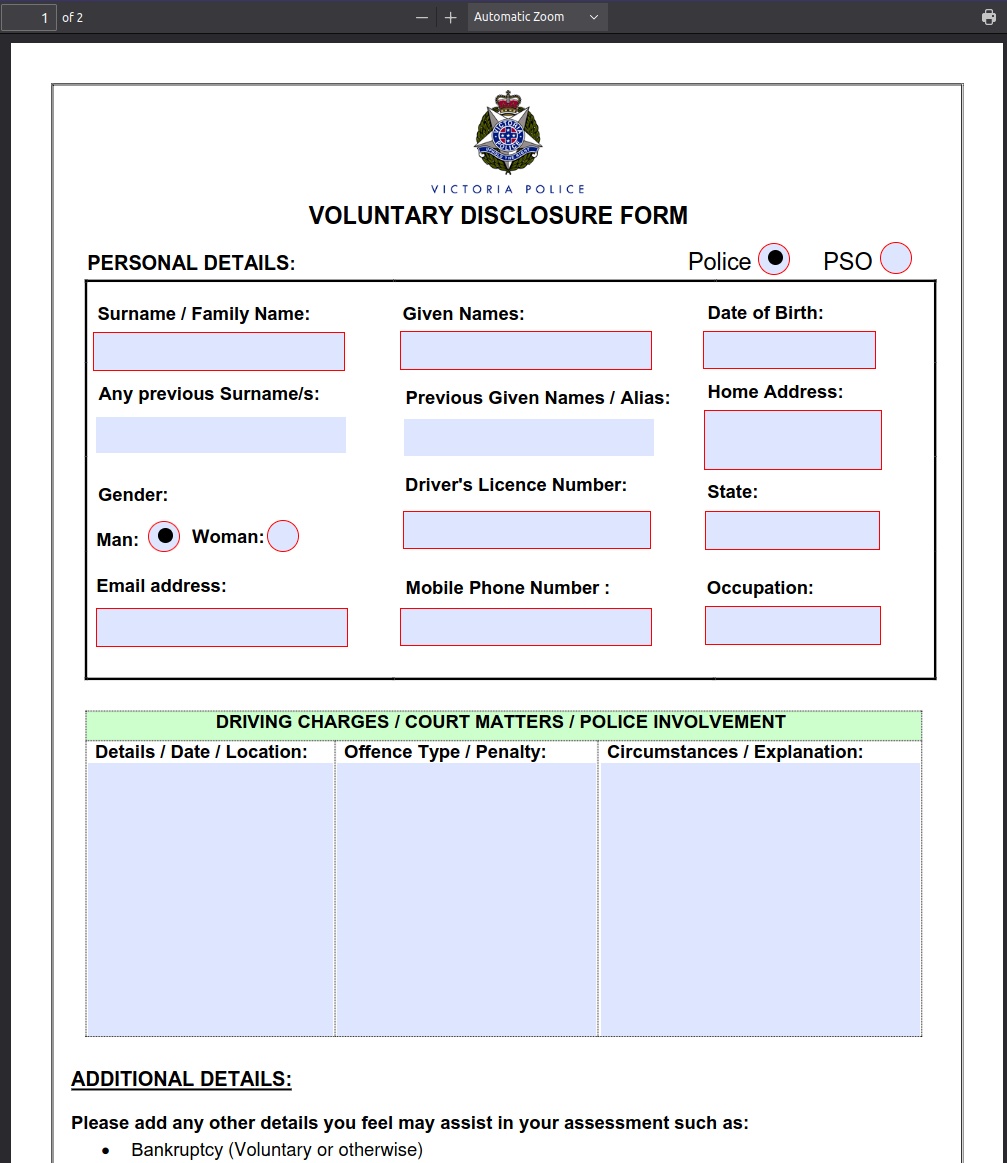
If a police officer is to be presented with this form he/she may ‘voluntarily’ give this information, or not!


Which police officer will divulge to you, the serf, that he has a criminal past that may include domestic violence or tasering a 95 year old frail woman?

It should be mandatory for an officer's past to also be submitted into evidence, Corinna Horvath matter, anyone, but that's not how the law is set up in this (penal) colony.

Just like they put out the serf's information out by default.

The are many officers that are still employed even after committing criminal activity.

Victoria Police also commit illegal actions, and are not effected by them, even if the matter is brought before a court.

See article: 

Police illegal speeding fines withdrawn before court action, a cause for concern!


It gets even worse, for the serfs.

At one point in time in Australia’s (legal) history a person had a right to a fair hearing, but this is no longer the case in Victoria.

The alleged right to a fair haring may still exist, but the reality is that in any jurisdiction be it a court or tribunal,  in Victoria a person will not have one.

The administration of justice is handled by Court Services Victoria, where stakeholder’s are involved, that being but not limited to Goldman Sachs.

In 2021 the Magistrates’ Court of Victoria, in a public document stated the following with regards to what a prospective employee must adhere to:

• As a highly influential and respected professional on MCV’s Executive Leadership Group, provide expert, complex advice to the CEO, Executive Group, judiciary and key external stakeholders on the direction and performance of the MCV workforce.

• Lead the strategic direction of the People and Culture Division consistent with the organisational strategic objectives and develop and implement supporting business plans to deliver quality people outcomes.

• Represent the Courts best interests and change agenda, acting as a professional expert in committee meetings, working parties, program development project teams and performance monitoring and review processes.

• Develop, maintain, and enhance key relationships with internal and external stakeholders to influence decision making processes and outcomes critical to the success of MCV, including court staff and judiciary, Court Services Victoria, and other Victorian government departments.

See reference to the document in the article of the headline:

Should one be more interested in the topic of criminal traffic law, the following case law may help:

Barton v Walker [1979] 2 NSWLR 740; Bainton v Rajski (1992) 29 NSWLR 539
Australian National Industries Ltd v Spedley Securities Ltd (in liq) (1992) 26 NSWLR 411 at 436; and Wentworth v Graham [2003] NSWCA 240
Barton v Walker and Barakat v Goritsas [2012] NSWCA 8 at [10]
Crabbe v Queensland Police Service [2013] QDC 122 (13 May 2013) at [28]

As you should know Australia's police force started with criminals and not honourable people.